
Multi-manager platforms are built to contain individual losses. When many pods have to cut risk at once, the correlation table is describing the wrong market.
8 min read | Oct 26, 2026
In March 2026, several of the large multi-manager platforms lost money together as crowded macro positions came under pressure. In July a similar shock, the unwind of crowded technology positions, ran through the same industry but produced sharply different results: Millennium lost money while Citadel's flagship fund gained. The two episodes raise a more useful question than whether any single platform gained or lost: how does a portfolio behave when several of its return engines meet the same market shock?
The test is not how a platform's return streams behaved when markets were calm, but whether they stay independent when many pods have to cut risk at once. This is the platform-level version of a familiar pattern: diversification tends to be conditional, dependable when markets are quiet and thinner under stress.
When shared exposure becomes shared loss
The episodes involved different trades but exposed the same vulnerability: concentrated exposures can undermine diversification when markets reverse. March is the clean case. The escalation of the Iran conflict disrupted interest-rate and inflation expectations, and large multi-strategy funds lost money together as macro and fixed-income positions came under pressure. Millennium's flagship lost 1.2% during March and Citadel's Wellington fund lost 1.9%, Balyasny and ExodusPoint fell further, by 4.3% and 4.5%. The dispersion inside that common loss already matters: the funds shared the pressure but not its magnitude.
March was difficult, but outcomes differed
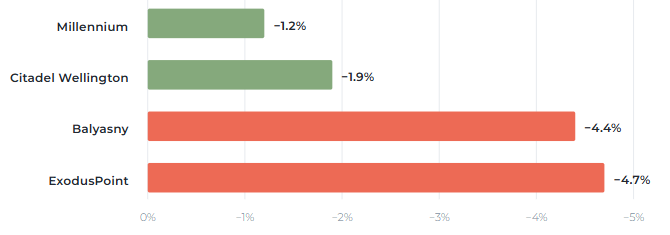 Source: Resonanz Capital; Reported monthly returns for selected flagship funds.
There is corroborating evidence of a broader reduction in risk in March. Goldman Sachs prime-brokerage data cited by Reuters showed the heaviest equity selling across hedge funds in years. Still, neither the returns nor the aggregate flow data reveal how much of that selling was caused by individual pod limits, platform risk desks or financing constraints. The causal claim should stop there.
Both recovered the following month, with Millennium up 2.7% and Citadel Wellington up 1.4%, while Balyansy and and ExodusPoint rebounded 3.2% and 3.7%, respectively; the platforms absorbed the losses and kept trading.
July is the instructive case. A similar shock, the unwind of crowded AI and semiconductor positions, hit the same industry, but the outcomes split sharply. Millennium lost 2.1% as the move whipsawed its equity pods, while Citadel's flagship Wellington fund gained about 6%. The same AI exposure that had looked like conviction on the way up looked like crowding on the way down for the books that held it in size. Citadel also bought AI positions that Situational Awareness was forced to sell as it faced margin calls, the kind of move open to a book with spare liquidity when others have to get out. The dispersion reinforces the importance of exposure selection, hedging and risk management: the same market shock can produce very different portfolio outcomes.
It would be tempting to read small losses and a quick rebound as proof that nothing is wrong. That misreads the signal. The point is not whether a platform survives, but how much of its diversification was ever real. When several supposedly independent books sit on the same crowded trade, an investor who believes they hold diversified return streams is carrying more risk than the correlation table shows. That is a sizing problem before it is a survival problem.
Different labels, same trade
Pod managers make their own investment decisions within limits on factors such as exposures, concentration, liquidity and drawdowns. Those limits differ by firm and strategy; there is no universal stop-out threshold. Allocated risk capital should also be distinguished from gross trading exposure, which can be several times larger.
Three sources of dependence matter. First, apparently distinct strategies can share factor risks or specific positions. A rates pod and a relative-value pod may express different investment ideas but still lose when the same yield-curve trade reverses. Second, financing terms and margin requirements can tighten across multiple books at once. Third, teams facing losses may all seek to reduce positions in markets where liquidity has already deteriorated.
That final interaction is the mechanism worth examining. A risk reduction that is sensible for one pod may add to price pressure if other pods and competing firms are unwinding similar trades. The process is most hazardous when positions are crowded, leverage is substantial and the market cannot absorb sales without a material concession. Whether it becomes a spiral depends on the central desk, which can recognize the overlap, offset positions internally, hedge common factors or stagger execution.
One shock, two possible outcomes
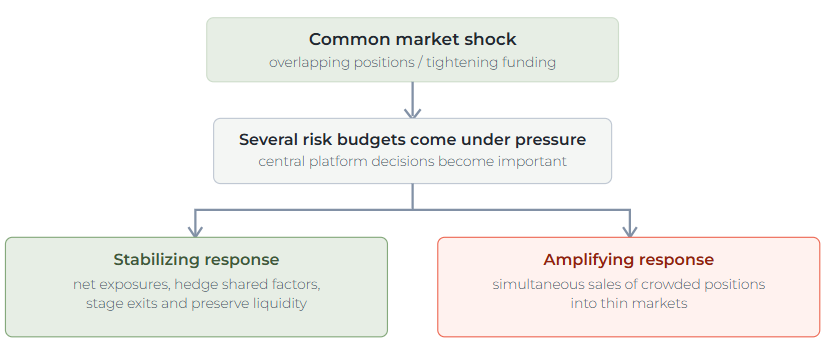
Source: Illustrative mechanism; Risk limits can stabilize or amplify. The outcome depends on position overlap, liquidity and the design of central risk management. not a measured sequence from March 2026.
Crowding carries a measurable cost
The broader empirical case comes from the IMF's October 2026 Global Financial Stability Report. Across hedge funds, the IMF examined crowded equity holdings during periods of market stress: the most crowded stocks were associated with around 10 percentage points higher volatility and four percentage points deeper drawdowns than the least crowded. Leverage and correlated investor withdrawals intensified the adverse effects.
Crowding has a measurable downside
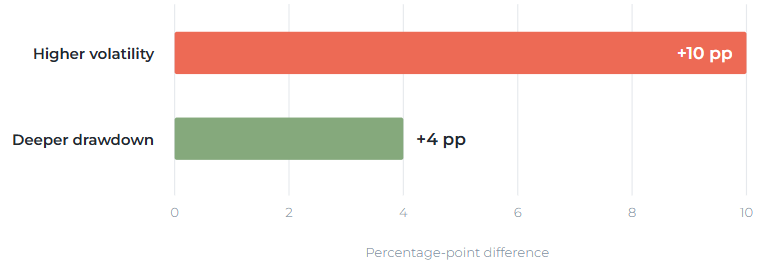 Source: IMF, Global Financial Stability Report, October 2026
The IMF evidence links crowded holdings with materially worse outcomes when liquidity is strained. That is the condition a multi-manager platform can create when overlapping books reduce risk together.
Central risk management cuts both ways
The stronger empirical case for market-impact risk comes from research covering hedge funds more broadly. In its October 2026 Global Financial Stability Report, the IMF examined crowded equity holdings during periods of market stress. The most crowded stocks were associated with around 10 percentage points higher volatility and four percentage points deeper drawdowns than the least crowded. Leverage and correlated investor withdrawals intensified the adverse effects.
Crowding has a measurable downside
Source: IMF, Global Financial Stability Report, October 2026
The IMF evidence links crowded holdings with materially worse outcomes when liquidity is strained. That is precisely the condition a multi-manager platform creates when overlapping books reduce risk together.
Central risk management cuts both ways
A central risk function is a substantial advantage of the pod model. It can aggregate exposures that individual teams do not see, prevent a single manager from dominating the fund's risk and respond quickly when portfolio losses rise. Well-run platforms can use the same infrastructure to avoid unnecessary cross-pod trading.
The important distinction is between a rule that reduces a pod's risk and a portfolio-level decision about how that reduction is executed. A firm with offsetting positions, flexible hedges and adequate liquidity may contain market impact. A firm that requires multiple books to cut similar positions immediately into a thin market faces a harder problem. The effectiveness of the system depends on judgment and execution as much as on the limits themselves.
Risk controls have helped large platforms survive difficult episodes. The question these episodes sharpen is not whether the model works, but how those controls behave when concentrated trades and thin liquidity meet several pods cutting risk at once.
Diversification is built, not inherited
The more useful question is not how to grade someone else's platform, but how to build a portfolio whose diversification survives a forced de-risking. Three principles follow, and each is a design choice made before capital is committed rather than a question asked of a counterparty afterwards.
Measure overlap before sizing. Position and factor overlap across every return engine has to be measured when the portfolio is built, not inferred from strategy labels or requested from a manager after a drawdown. Two engines that describe themselves differently but lose on the same yield-curve reversal are one exposure, and belong in the book as one.
Design the exit. How risk comes off matters as much as how it goes on. A portfolio builder sets overall sizing, hedges and liquidity reserves, and the order in which exposure comes down, even where it does not direct each manager's individual trades. Deciding that path in advance, and knowing which overlapping positions can be hedged at the portfolio level, makes the exit part of the design rather than something improvised when several engines come under pressure at once.
Build around financing and liquidity constraints. Prime-broker concentration, margin terms, collateral mobility and liquidity reserves set how much room a portfolio has under pressure. They belong in how the building blocks are chosen and sized, not in a questionnaire sent to a manager after the fact.
Historical correlation summarizes how return streams behaved over a given period. It says far less about how those exposures interact when liquidity deteriorates and several of them have to reduce risk at the same time. That depends on deliberate choices about overlap, sizing, financing and the path of de-risking. Diversification is not inherited from a strategy label. It has to be engineered into the portfolio.
Resonanz insights in your inbox...
Get the research behind strategies most professional allocators trust, but almost no-one explains.