
Volatility-target funds buy calm and sell stress. With exposure near a record in late 2026, the same rule points to forced, synchronized selling.
7 min read | Nov 2, 2026
A large pool of money bought equities through 2026 for a reason that has little to do with company earnings or the economic outlook. Volatility-target funds add exposure when markets are calm, because their instruction is to hold risk steady, and a quiet market lets them own more to reach the same target. They are, in effect, buyers who buy because nothing happened. By late 2026 that rule had pushed their equity holdings close to the highest level in more than a decade.
The same rule runs in reverse, and not symmetrically. When volatility rises, these funds have to sell to bring risk back to target, and they sell into the move that set them off. The question is not whether they will, but how much, and whether their selling lands at the same moment as everyone else's.
The rule buys calm and sells stress
A volatility-target fund holds a fixed level of portfolio risk rather than a fixed mix of assets. If the target is 10% annualised volatility and equities are realising 11% or 12%, the fund holds a little under its full weight. When realised volatility falls toward 8%, the same target permits a much larger equity position, often up to a cap. The decision is mechanical and contemporaneous: it reads the volatility the market is printing now and adjusts, with no view on what comes next.
This logic sits in more places than the funds that carry the name. It drives managed-volatility mandates, parts of the risk-parity world, the glide paths inside some target-date and insurance products, and the hedges embedded in structured notes. None of these investors is making a call on direction. They are all solving the same equation, and when realised volatility moves, they solve it in the same direction at the same time.
The rule mechanically buys calm and sells stress
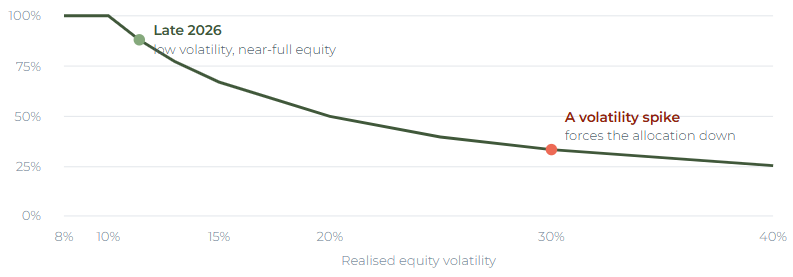 Source: The weight is a function of volatility, not of value. Illustrative allocation for a fund targeting 10% volatility and capped at a full equity position. As realised volatility falls, the permitted equity weight rises toward the cap; as it climbs, the weight is mechanically cut. The curve is a schematic of the rule, not a forecast.
How stretched the positioning is
Through the quiet stretches of 2026 the rule did what it always does. By early October, equity exposure across volatility-target strategies sat at roughly the 98th percentile of its range since 2010, according to Deutsche Bank estimates. In other words, these funds have held more equity risk only about two percent of the time in the past fifteen years. Barclays put a typical 10% volatility-target fund at about 88% invested in equities. Trend-following managed futures funds, which scale positions by a related logic, sat around their 82nd percentile.
Volatility vaporized
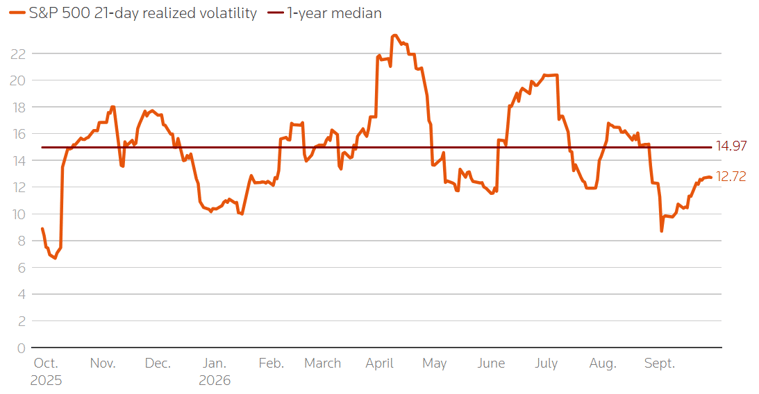 Source: LSEG; Historical volatility for S&P 500 remains near multi-month lows
The size of the pool is harder to pin down, because these strategies do not disclose their assets at the strategy level. Bank estimates put volatility-target assets somewhere between $300 billion and $500 billion. That is a wide band and it should be treated as an approximation, but the direction of the positioning inside it is not in doubt.
The asymmetry is the point
A volatility target is sold as risk reduction, and for a single fund that is a fair description: the rule keeps any one portfolio from carrying more risk than its mandate allows. The trouble appears when the same rule is running across a few hundred billion dollars at once, because the response to a shock is not symmetric.
From today's stretched starting point, a mild equity selloff could pull the typical fund's allocation below 40%, which would mean selling more than $100 billion in equities. A further drop in volatility, by contrast, could lift the allocation toward 99% and require only around $25 billion of buying. "That's a lot of asymmetry," the bank's head of US equity derivatives research told Reuters. UBS framed the same point a different way in late August: a two-sigma move could set off roughly five times as much selling on the way down as a comparable rally would produce buying on the way up.
The response is asymmetric
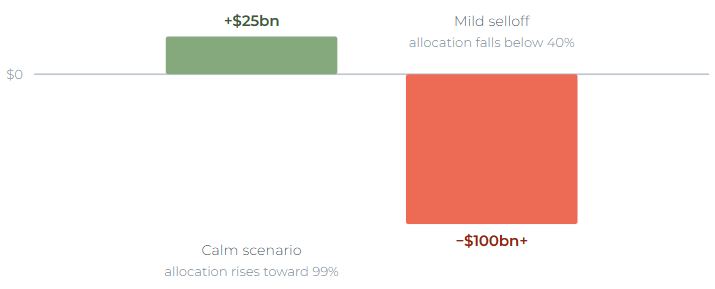 Source: Barclays estimates reported by Reuters, October 2026.
Why the selling does not stay contained
The first problem is reflexive. When these funds sell, they add to the price move, and a larger price move raises realised volatility, which is the single input their models watch. More selling begets the condition that calls for more selling. The rule has no mechanism to recognise that it is part of the volatility it is responding to.
The second problem is company. Volatility-target funds are not the only mechanical sellers in a spike. Trend-following managed futures funds, also near the top of their range in late 2026, cut positions on the same kind of signal, and short-dated option hedging can push dealers the same way. When a shock arrives, several unrelated-looking strategies can be instructed to sell the same assets within the same few days. That is the moment diversification quietly stops working, because holdings that looked independent are unwound by the same rule at the same time. We have written before about how diversification is conditional on the regime, and mechanical de-risking is one of the clearest channels through which the condition fails.
The honest counterweight
This is not a prediction that volatility-target funds will cause the next drawdown. They are a few hundred billion dollars in a far larger market, and the tail will not wag the dog. But whether they can trigger a crash is the wrong test. Their positioning does not forecast a selloff; it measures how much mechanical selling has built up behind a calm tape, and how much a single trigger could release. When equities fell early in 2026, these funds were among the sellers, and they had bought much of the exposure back within weeks. They did not have to break the market to deepen the move while it lasted, and to do it again the next time volatility turns.
What it means for building a portfolio
Two things follow for anyone building a portfolio to hold up under stress, in Europe or the Gulf as much as in the US market where these funds trade. The first is that a calm tape is not a safe one. Low realised volatility is the input that builds this exposure, so the quietest markets can be the ones in which mechanical risk is most crowded. That low measured volatility can understate real risk runs through private books as well as public ones; here it is built by a public, visible rule.
The second is that the stake is not whether these funds crash the market. It is whether your own diversification holds when it is tested. A book that looks diversified in calm conditions can find its parts moving together the moment the mechanical sellers, these funds and the trend-followers beside them, are all instructed to cut at once. The right question when sizing a position is who else has to sell it when you do. Mechanical flows are not noise to be averaged out; they belong in the liquidity and sizing assumptions, because the funds publish their rule, the behaviour is predictable, and the positioning is observable in advance. We build around the forced seller before the spike rather than discovering them during it. Diversification that depends on everyone staying calm is not diversification a portfolio can rely on. It has to survive the moment the rules turn, and the rules turn together.
Resonanz insights in your inbox...
Get the research behind strategies most professional allocators trust, but almost no-one explains.