
The diversification is real, and the record deserves respect. But the spread paid for catastrophe risk has fallen to its lowest since 2017 even as the modelled loss has risen, and that changes how much belongs in a portfolio.
6 min read | Nov 9, 2026
Catastrophe bonds have delivered three exceptional years. The Swiss Re index returned close to 20% in 2023, about 17% in 2024 and roughly 11% in 2025, and capital has poured into the asset. The returns are what draw attention. The price is what should hold it.
By the end of October 2026 the insurance risk spread, the compensation paid for bearing catastrophe risk above the cash yield earned on a bond's collateral, had fallen to 4.33%, its lowest since 2017, while the modelled expected loss of the outstanding market had risen to 2.55% from 2.25% a year earlier. The diversification these bonds provide is genuine, and we made the constructive case for it in The Reinsurance Renaissance. The question now is narrower and more useful: at today's spread, does the premium still pay for the tail, and how much of that risk belongs in a portfolio?
One event can erase years of income
The tail is not abstract. In late October 2025, Hurricane Melissa struck Jamaica and triggered a full payout on the country's 150 million dollar World Bank catastrophe bond. Investors lost all of their principal, which passed to Jamaica to fund disaster relief. The year before, the same kind of storm had spared them: Hurricane Beryl in 2024 caused damage but did not meet the bond's parametric trigger, and paid nothing out. One storm missed the threshold by a margin; the next took the whole bond.
The diversified market barely registered it. The Swiss Re Global Cat Bond Index still finished 2025 up about 11.4%. At the level of a single security the loss is total and sudden; at the level of a spread-out book the same event is a rounding error. Portfolio construction is the only thing standing between those two outcomes, which is why a historical correlation figure tells you so little about what you actually own.
One bond to zero, the index up double digits
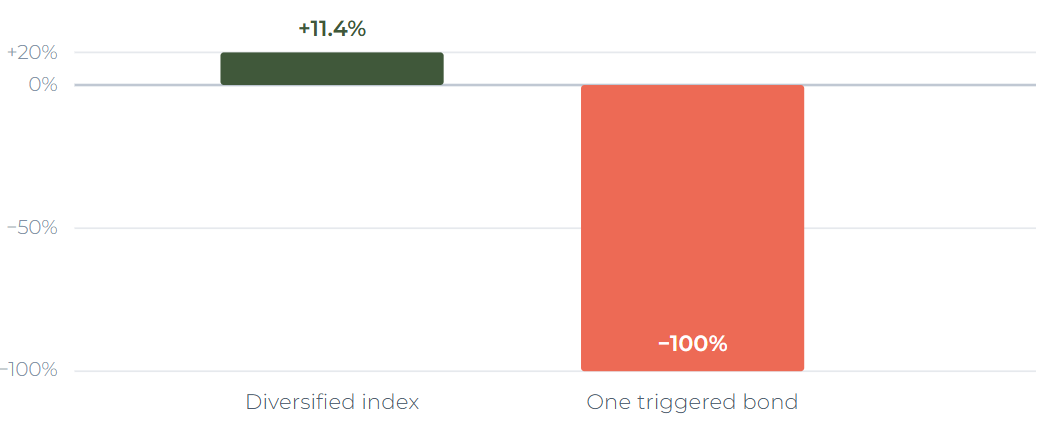 Source: World Bank and Bloomberg (Jamaica bond); Artemis, Swiss Re index (2025 return). The same event, two different objects. Jamaica's 150 million dollar World Bank catastrophe bond lost 100% of principal after Hurricane Melissa in 2025, while the Swiss Re Global Cat Bond Index returned about 11.4% for the year. A single bond and a diversified index are not comparable holdings, and that is the point.
Why the premium matters more than the coupon
An all-in yield of 8.41% looks generous, but most of a catastrophe bond's headline yield is the cash rate earned on its collateral, not the reward for taking risk. The part that pays for catastrophe risk is the insurance spread, and the number that matters is how far that spread sits above the modelled expected loss. That gap is the cushion: what is left to absorb the model being wrong.
Today the cushion is thin, and both halves of it have moved against the buyer. The 4.33% spread sits about 1.8 percentage points above the 2.55% expected loss. A year ago the spread was roughly 13% higher and the modelled loss was lower, at 2.25%. An investor is now paid less to bear a risk the models themselves estimate as larger. The compensation for the models being wrong, which is the risk that governs returns in this asset, has narrowed from both directions.
Less spread, more modelled risk: the cushion thins
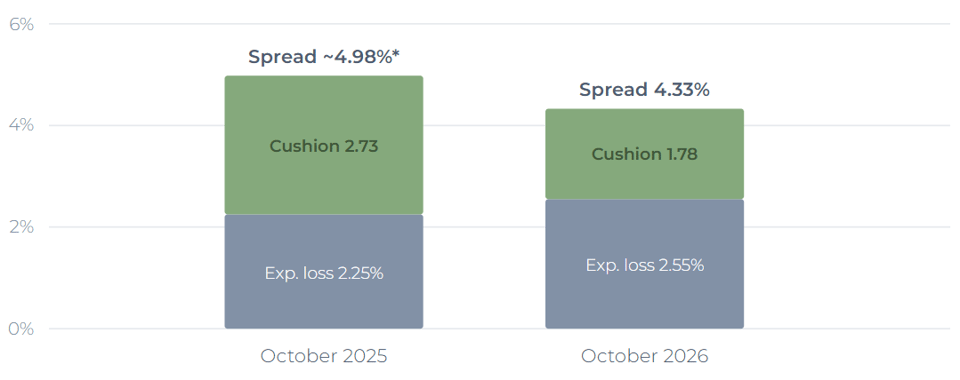 Source: Plenum, reported by Artemis, end-October 2026. The October 2025 spread is approximate, implied by the reported year-on-year fall. The hazard did not fall; the pay for it did. At end-October 2026 the insurance risk spread was 4.33%, the lowest since 2017 and about 13% below a year earlier, while modelled expected loss rose to 2.55% from 2.25%. The cushion over expected loss, what absorbs model error, narrowed.
The thin cushion matters most because the models are known to be incomplete. They have underweighted secondary perils such as wildfire, severe convective storms and flood. Loss creep, where the final bill for an event keeps growing for years, has repeatedly caught them short. And they are calibrated on a climate that is shifting the frequency and location of the hazard. A wide spread over expected loss pays an investor to be wrong about all of this. A narrow one does not.
The case for owning catastrophe risk is still strong
None of this argues against the asset, and the record deserves respect. Even in 2022, the year Hurricane Ian drove the market to its worst result, the diversified Swiss Re index fell only about 2.15%, while individual Florida-wind bonds lost far more. Coupons kept paying through the 2022 inflation shock, when equities and bonds fell together, which is exactly the behaviour a portfolio wants from a genuine diversifier. Over a full cycle the premium has rewarded patient capital, and because the collateral earns the cash rate, the asset still pays something in a quiet year. The question was never whether to own catastrophe risk. It is how much, and at what price.
Design the exposure around the loss budget
That makes the position a portfolio-construction decision rather than a security-selection one, and four questions set its size. The first is the loss budget: how much a single severe season may be allowed to cost the whole portfolio, and whether the catastrophe sleeve still fits inside that limit at its current weight. The second is the premium: with the cushion over expected loss this thin, the same sleeve is worth less than it was two years ago, which argues for a smaller weight now, not a larger one, however strong the recent returns. The third is the shape of the exposure: a book concentrated in Florida and Gulf wind is one storm from a very bad year, so the risk has to be spread across perils, regions and trigger types. The fourth is liquidity: after a major event the secondary market thins and marks lag, so the rest of the portfolio has to hold enough liquidity not to be forced to sell the sleeve at its worst moment.
The discipline that ties them together is to read a stretch of quiet returns as the absence of events, not as evidence of low risk, and to size the diversifier for the regime that tests it rather than the one that flatters it. An attractive diversifier can still deserve a smaller allocation when the premium for holding it compresses. That is the decision a strong three-year record makes easy to avoid and the current spread makes necessary. A diversifier sized for its best years is not diversification. It has to be sized for the event that defines it, and for the price being paid to bear it.
Resonanz insights in your inbox...
Get the research behind strategies most professional allocators trust, but almost no-one explains.