
Why EM macro hedge funds are outperforming in 2025, the drivers behind the rally, and what the outlook means for institutional investors.
8 min read | Dec 2, 2025
EM macro has been the right place to be and take risk in 2025. Emerging markets macro hedge funds have outperformed YTD, helped by a weaker-or-at-least-not-stronger dollar, high EM real yields, cleaner balance sheets, and a rich menu of idiosyncratic stories from restructurings to reform. EM macro specialists and EM-heavy multi-strats – such as Kirkoswald and ExodusPoint – have ridden this wave via EM rates, FX and hard-currency credit.
2025: The year EM macro came back
As of October 2025, the HFRI Emerging Markets (Total) Index was up roughly +17.5% YTD, easily beating the HFRI Fund Weighted Composite at +10.5% YTD. EM beta has been strong across the capital structure: the MSCI EM equity index is up ~28% YTD, versus less than 17% for MSCI developed markets and roughly 16% for the main J.P. Morgan EM bond index, helped by high real yields and easing DM financial conditions.
EM macro–focused managers such as Kirkoswald UCITS (EM macro only, mid-teens YTD) and Kirkoswald Offshore (blending EM and DM but with gains driven almost entirely by EM macro) have materially outperformed global macro peers.Large multi-strats such as ExodusPoint, where EM & Macro pods account for more than half of the 25 YTD, show the same pattern: the P&L engine in 2025 is increasingly led by EM macro.
EM macro has gone from being a marginal satellite risk bucket to a core source of macro alpha in many platforms during 2025.
Structural tailwinds behind EM outperformance
From U.S. exceptionalism to U.S. normalization
For most of the last decade, the story was U.S. exceptionalism: faster U.S. growth, higher real yields and a persistently strong dollar. In 2025, that story is fraying at the ends. The U.S. faces slower trend growth as fiscal policy runs into constraints, demographics bite and trade policy remains restrictive. Inflation is lower than in 2022–2023 but still structurally higher than the pre-Covid era, limiting how low U.S. real rates can go without sparking renewed inflation fears.
The net result is convergence: the U.S. now looks more like the rest of the world on growth and policy credibility, rather than a clear outlier. At the same time, EM has moved in the opposite direction: earlier hikes, more conservative fiscal responses to Covid, and improving external balances.
This divergence has created:
-
High EM real yields relative to both history and DM.
-
Space for EM central banks to ease into 2025 without losing credibility, while the Fed and ECB remain cautious.
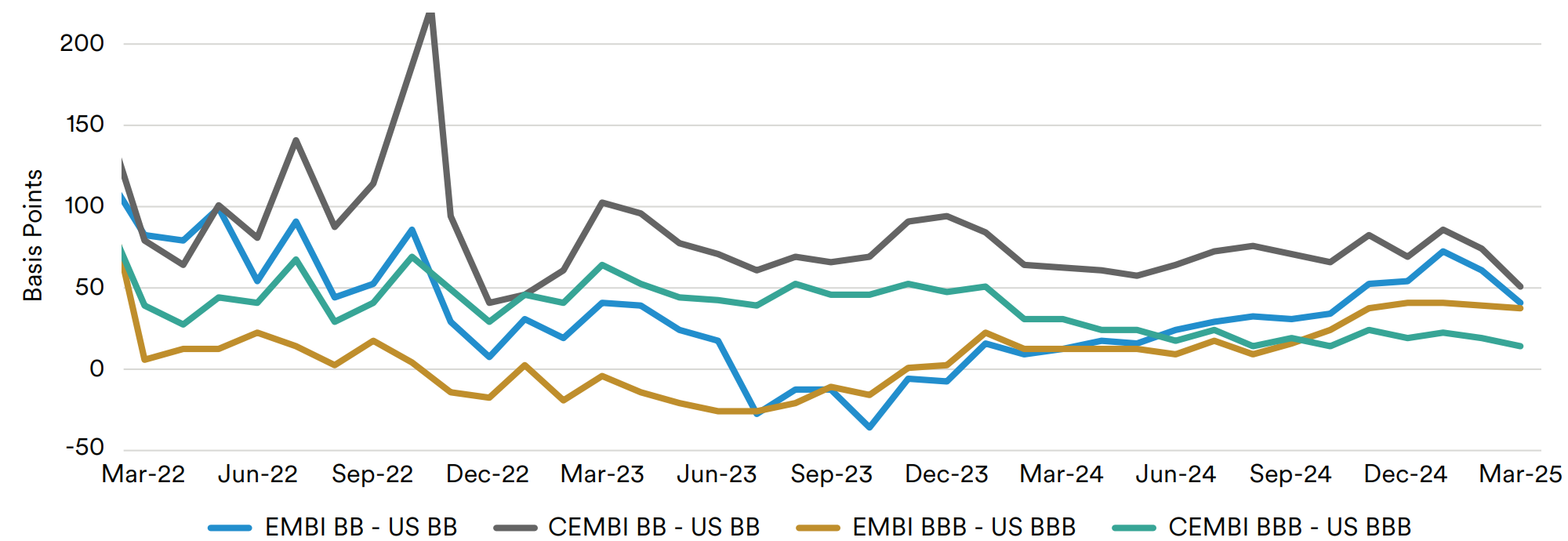
Chart1: DM vs. EM Yield Advantage; Source Bloomberg, JPM, MetLife, as of Q1-2025
From a macro-trading perspective, that’s a sweet spot for receivers in EM rates and long EM FX carry.
The USD is not a headwind anymore
A decade of chronic USD strength – culminating in the 2022 peak in the dollar index – was a key drag on EM local debt. In 2025 The USD has fallen roughly 10% from its 2022 highs, driven by slower U.S. growth and hopes of sustained Fed cuts.
19 out of 21 EM central banks are expected to cut rates in H2 2025 (excluding India and Czechia), reinforcing the local-carry story without re-igniting inflation.
EM local currency assets have historically underperformed in strong-dollar regimes but outperform once the USD plateaus or weakens, a backdrop that is increasingly likely, as U.S. fiscal and political uncertainty rises.
Better EM Fundamentals than in 2013-2018
Sovereigns and corporates are fundamentally healthier than the stereotype suggests:
- Net leverage: EM corporates run lower net leverage than U.S. peers, particularly in investment grade sectors like commodities, infrastructure and financials.
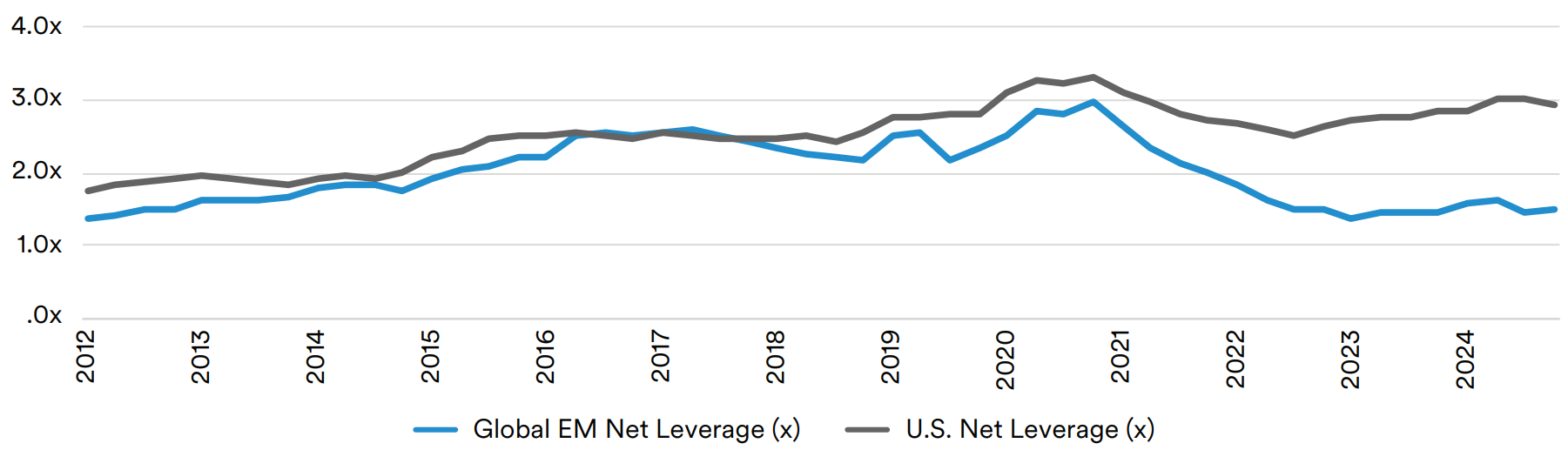
Chart 2: EM vs. U.S. net Leverage; source MetLife / BoA - Corporate balance sheets: EM corporates offer spread-per-turn-of-leverage of ~114 bps/x vs ~44 bps/x for U.S. credit – more than twice the compensation per unit of leverage.

Chart 3: Spread per Turn of Leverage EM / US; source MetLife, BoA
- Defaults: Since the GFC, average EM corporate default rates have actually been lower than DM.
- Hard-currency markets: EM external corporates now total ~$2.5tn of bonds outstanding, compared with ~$1.5tn in EM external sovereigns and ~$1.5tn in U.S. high yield, making EM corporates the largest of the three.
-
On the sovereign side: Between 2017 and 2022, 11 EM sovereigns defaulted, at one point representing about 15% of the J.P. Morgan EMBI index. By early 2025, 7 of those 11 had completed restructurings, issuing roughly 34 new bonds that now make up around 7% of EMBI – mostly lower-coupon, longer-maturity paper.
The punchline for macro traders: tail risk has been crystallized, not buried. A lot of the “bad actors” have been re-termed, spreads have compressed, and idiosyncratic distressed stories have turned into recovery and curve-normalisation trades.
Another point: hard-currency sovereigns and corporates are highly correlated (0.93 over 20 years), but a portfolio spanning both improves Sharpe and lowers tracking error versus sovereign-only. EM corporate issuance in 2025 is expected to be about $383bn, nearly double expected sovereign hard-currency issuance. For EM macro managers, this means more ways to express a country view: via sovereign spreads, quasi-sovereigns, and corporates that may offer better carry and more convexity.
How EM macro hedge funds have monetized this backdrop
EM macro in 2025 offers a rare combination:
-
High absolute carry: Double-digit nominal yields in several large markets (Brazil, Mexico, South Africa) and still-positive real yields after inflation.
-
Rate-cut cycles with a margin of safety: EM central banks tightened early and hard; inflation has rolled over; they can now cut from a position of strength.
-
Cross-sectional dispersion: In each of the last 10 years, the spread between the best and worst EM hard-currency performers has been huge; in 2024, the best country returned +118% while the worst was -6%.
Dedicated EM macro desks have several edges:
-
Full-spectrum instruments: local IRS, NDS, FX forwards and options, CDS, basis, hard-currency sovereigns and corporates.
-
Country-level relative value: long Brazil steepeners vs short U.S. 5s10s; long MXN vs basket of low-carry Asian FX; long EM high-yield corporates vs U.S. high yield.
-
Event-driven macro: restructurings and state-contingent debt instruments (SCDIs) in Zambia, Suriname, Sri Lanka, Ukraine and others, where the rise of GDP-, export- and commodity-linked structures has been a driver.
Thus, successful EM Macro managers in 2025 have been:
-
Running persistent EM carry and curve steepeners in markets with credible policy and high real yields.
-
Harvesting dispersion via country Relative Value (RV) across FX, local and hard currency.
-
Leanly warehousing event risk where restructurings, elections or policy pivots create one-off payoff profiles.
Outlook: can EM macro keep leading?
In a scenario where global growth slows but avoids recession, the Fed and ECB cut slowly, wary of reigniting inflation, and the USD drifts sideways to weaker as rate differentials compress and U.S. fiscal concerns simmer, EM assets keep seeing selective inflows and EM macro remains attractive.
Key themes for EM macro books looking forward will likely be:
-
Late-cycle DM vs mid-cycle EM: Expressed via EM vs U.S./Euro curves, EM receivers vs DM payers, or steepeners in early-easing EM countries.
-
Good carry vs bad carry: Distinguish between high carry backed by orthodoxy (Brazil, Mexico, some CEE) and high carry as compensation for questionable policy or weak external positions.
-
Post-restructuring curves and SCDIs: Ongoing restructuring pipeline (e.g., some frontier African names, legacy Ukraine risk) continues to offer idiosyncratic upside where you can model the path of GDP, export receipts or commodity prices embedded in SCDIs.
-
Hard-currency integration: Using a unified hard-currency risk budget across sovereigns, quasi-sovereigns, and corporates to optimize country exposure and manage downside risk.
What can go wrong in EM Macro?
No EM macro thesis is complete without a sober risk section.
-
U.S. re-inflation / renewed USD spike: A second inflation wave in the U.S. forcing the Fed to re-tighten would push U.S. real yields up and the dollar higher, replaying parts of 2022 and tightening EM financial conditions.
-
Global risk-off: Geopolitical shocks or a large DM credit event could widen EM spreads, hit EM FX and force local CBs to pause easing.
-
Domestic accidents: Elections, policy reversals, capital controls or fiscal slippage (the usual EM checklist) can still generate classic “sudden stop” scenarios at the country level.
-
Crowding and liquidity: If EM macro continues to outperform, risk budgets will migrate quickly; in smaller local markets and frontier hard-currency names, exit liquidity could vanish just as fast as it appeared.
Closing thoughts
In 2025, EM macro is benefiting from something rare: a positive structural story and a supportive cyclical backdrop at the same time.
The U.S. is no longer obviously exceptional, the dollar is no longer an automatic headwind, EM balance sheets and institutions are stronger than the caricature, and the EM opportunity set – especially in hard currency – is deeper and more complex than ever.
For hedge fund investors willing to allocate risk – and due diligence bandwidth – to the right EM macro managers, the next phase of this cycle still looks like a carry trade worth running.
Resonanz insights in your inbox...
Get the research behind strategies most professional allocators trust, but almost no-one explains.