
How allocators should think about price discovery, proxy hedging, and wrapper choice across hedge funds, liquid alts, SMAs, and private credit.
10 min read | Apr 12, 2026
The market usually tells you the truth before the fund report does. Different instruments absorb information on different clocks — and the gap between when public proxies reprice and when private NAVs follow is exactly where portfolio risk hides.
Listed credit vehicles trade every day. Financing lines get marked when lenders get uncomfortable. Public equities tied to the same balance-sheet chain reprice in real time. Private NAVs move slower, and semi-liquid repurchase mechanics slower still. The recent pressure in private-credit vehicles is a reminder that investment committees should care less about where an asset sits on the org chart and more about where stress will be discovered first.
The important question is: which parts of the payoff genuinely need lockups, opacity, concentration, or financing flexibility, and which parts can be owned in a more liquid wrapper without sacrificing the edge?
Right now, allocators are still increasing hedge fund exposure, while daily-liquid hedge-fund-like products are also attracting demand. Those two facts are not contradictory. They suggest the market is separating strategies that truly need structural illiquidity from strategies that merely inherited it.
Resonanz has already framed several pieces of this puzzle. On the macro side, “QIS Is Not One Thing: A Buyer’s Map for When Oil, Inflation, and Correlations Break” argues that stock-bond diversification has been less reliable since 2020, which makes deliberate liquid diversifiers more important. On structure, “The Evolution of Hedge Fund Investing: Have We Reached the Peak?” traces the shift from fund-of-funds to SMAs and platform-like architectures, where implementation and control matter almost as much as manager selection. Our more recent note, The Unbundled Hedge Fund: Why SMAs Are Changing Who Gets Funded, pushes the point further: SMAs are no longer just a cleaner access route, but a capital-formation channel that changes launch economics and shifts allocator diligence from the finished firm to the seams of the operating model. This note builds on those threads.
The public market usually knows first
Private credit is not broken because it is private. But private assets do not enjoy instantaneous price discovery. The Federal Reserve defines private credit as non-publicly traded debt provided by non-bank lenders and notes that these assets are typically held rather than actively traded, which naturally limits continuous market discovery.
That matters when conditions change. In March, Reuters reported that many listed BDCs were trading below reported asset values as concerns mounted around transparency, valuation, and liquidity. A few days later, Moody’s cut its outlook on U.S. BDCs to negative, citing redemption pressure, rising leverage, and weaker funding access, with non-traded BDCs especially exposed. Then Carlyle’s flagship semi-liquid private-credit fund disclosed repurchase requests equal to 15.7% of shares against a typical 5% quarterly limit, following similar pressure elsewhere in the channel.
The point is not that public marks are always more correct than private marks. The point is that they usually move first. Public instruments are forced to clear. A listed BDC discount, a widening unsecured spread, or a warehouse markdown is not a verdict on ultimate losses. It is an early signal about funding conditions, exit optionality, and the price at which the market is willing to warehouse uncertainty today.
That is the hierarchy worth tracking:
- liquid public proxies and financing terms,
- fund-level securities and secondary prices,
- revised NAVs and manager commentary,
- then redemption mechanics.
The SEC’s interval-fund bulletin is useful here because it says plainly what many investors mentally soften in calm markets: interval funds generally repurchase only 5% to 25% of shares in a repurchase offer, and oversubscription is generally handled pro rata. “Quarterly liquidity” is not the same thing as “exit at will.”
Credit Spreads vs. Private-Credit Redemptions Headlines
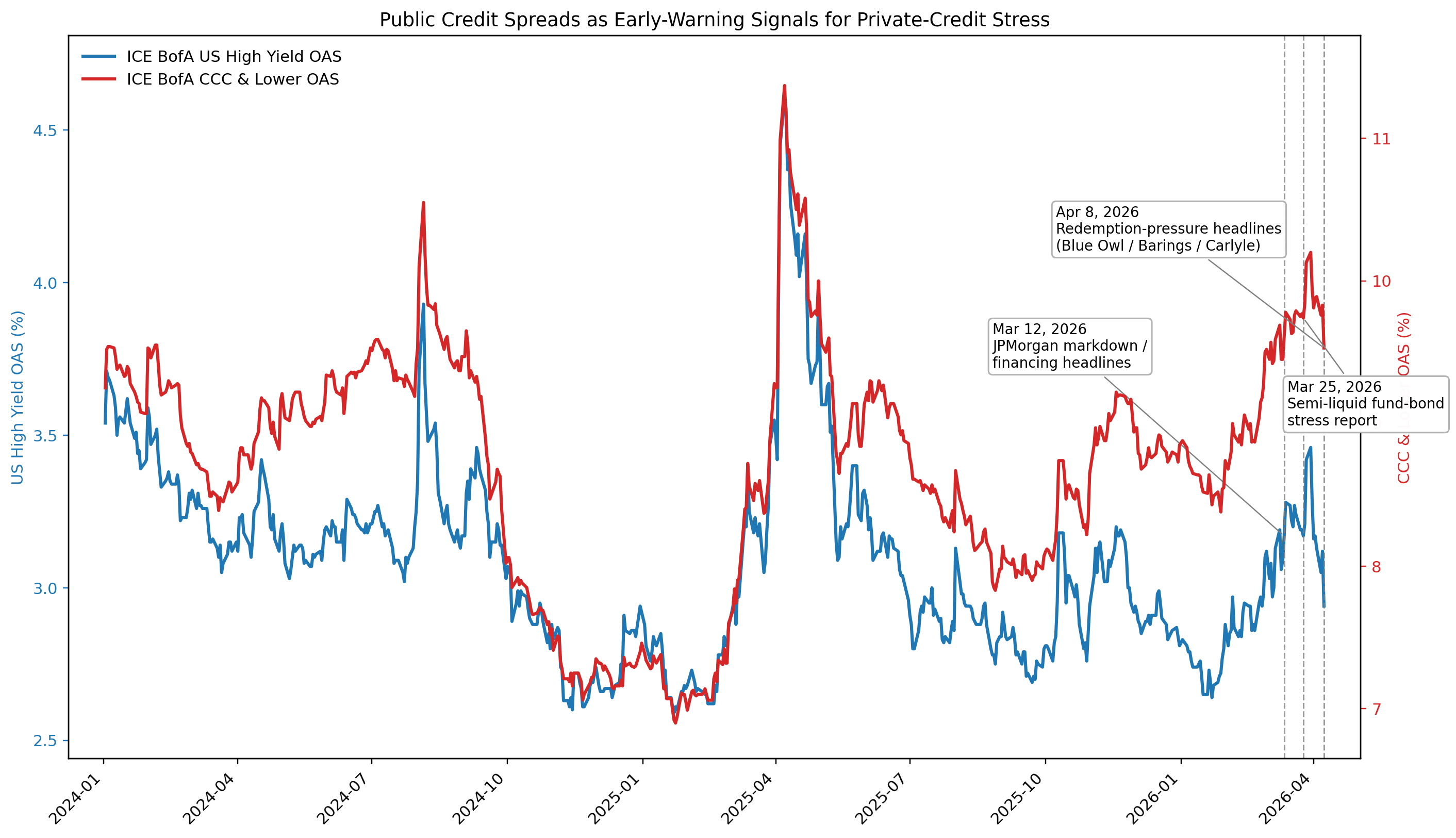
Source: FRED, Resonanz Capital
Liquid proxies may carry the hedge for illiquid books
In March, Reuters reported that hedge funds had “aggressively” shorted financial stocks, making financials the most-sold sector of the year. Banks, insurers, fintechs, and capital-markets names all came under pressure. The obvious reading is a sector call. The more interesting reading is a plumbing call. Reuters noted that these shorts may reflect concern about broader credit risk and the links between financial institutions and private lending, rather than a narrow view on bank earnings.
That distinction matters in IC discussions. A short in financials is not always a clean expression of “we dislike banks.” It can be a hedge against harder-to-mark risks elsewhere: financing lines to private-credit funds, warehouse exposure, NAV lending, subscription facilities, unsecured fund debt, or simply the fear that public institutions will have to acknowledge weaker collateral values before private portfolios do. Reuters also noted that U.S. banks had lent nearly $300 billion to private-credit providers as of mid-2025, which helps explain why listed financials can become the shock absorber for much broader credit anxiety.
That is an underappreciated portfolio lesson. Public equities are sometimes not the bet. They are the hedge.
So, which risks actually need lockups?
This is the real portfolio-construction question.
Some strategies do need structural patience. Deeply worked event situations, concentrated activist campaigns, certain private-credit sleeves, niche structured-credit trades, and less liquid special situations are not improved by daily liquidity for its own sake. They may genuinely need stable capital, lower transparency, or freedom from forced de-risking. That is a legitimate reason to accept lockups. But the burden of proof should sit with the strategy, not with convention.
Other exposures do not pass that test. If the payoff mainly comes from directional credit beta, macro carry, listed relative value, index hedging, trend, or systematic overlays, then the question is why that exposure must sit inside a slower, less flexible wrapper. Once stock-bond diversification becomes less reliable, the opportunity cost of locking away liquid diversifiers rises. That is exactly the problem we highlighted in “QIS Is Not One Thing”: when inflation, oil, and financing conditions move together, diversification has to be designed, not assumed.
That changes the hurdle for illiquidity. A lockup is not just a term. It is a claim on portfolio optionality. We made that point directly in “Putting a Price on Flexibility: Reassessing Hedge Fund Lockups” which argues that the investor is implicitly giving up an option when capital cannot be reallocated.
So the test should be straightforward:
- Does the edge require less liquid underlying assets?
- Does it require financing stability that a daily-liquid wrapper cannot support?
- Does it rely on concentration or opacity that would be diluted in a regulated liquid format?
- Does it improve enough after fees and constraints to justify the lost flexibility?
If the answer is no, the allocator should lean toward the more liquid implementation.
A Decision Grid for Hedge Funds, Liquid Alts, SMAs, and Semi-Liquid Credit
|
Vehicle / Wrapper |
What the investor is really buying |
Where stress tends to show up first |
Liquidity promise |
Portfolio benefit |
Portfolio risk |
|
Traditional commingled hedge fund |
Manager skill plus financing flexibility and opacity where needed |
Prime-broker financing, public proxy hedges, monthly/quarterly performance |
Monthly or quarterly, often with notice/gates |
Broad toolkit, fewer wrapper constraints |
Harder look-through on hidden hedges and balance-sheet use |
|
SMAs |
Strategy exposure with tighter governance and transparency |
Internal risk reporting and financing data |
Custom |
Better control, transparency, fee clarity |
Operational burden; governance can slow decision-making |
|
UCITS / '40 Act liquid alternatives |
Strategy adapted to regulated liquidity, diversification, and leverage rules |
Daily NAV, public markets, futures/swaps markets |
Daily or frequent |
Rebalancing flexibility, transparency, clean portfolio role |
Strategy may be capacity- or rule-constrained |
|
Interval fund / non-traded BDC |
Access to illiquid credit with periodic liquidity windows |
Listed proxies, fund bonds, redemption queues, public sentiment |
Periodic; typically capped tender offers |
Access to less liquid assets in regulated form |
Liquidity can be conditional and pro rata |
|
Listed BDC / closed-end vehicle |
Mark-to-market sentiment on underlying private loans |
Share price discount/premium to NAV |
Exchange-traded |
Fast price discovery, visible stress signal |
Can overshoot in panic; discount volatility adds noise |
Source: Resonanz Capital
Wrapper alpha is now part of the investment thesis
For years, wrapper choice was treated as implementation detail. It is not a detail anymore.
Allocators increasingly care about where the exposure sits, how quickly it can be resized, what they can see through the vehicle, and who controls the cash and collateral. That is why SMAs matter. Our blog post “The Evolution of Hedge Fund Investing: Have We Reached the Peak?” captures the key shift: SMAs grew because investors wanted more transparency, more customization, and better control after the financial crisis.
That logic now extends beyond classic hedge funds. Wrapper choice affects four things that belong in underwriting:
1. The speed of truth
A listed or daily-liquid wrapper forces more frequent confrontation with market prices. A semi-liquid or private wrapper delays that confrontation. Delay can be useful for patient capital. It can also hide the timing of stress.
2. The behaviour of the investor base
A strategy is not just a portfolio of assets. It is also a portfolio of liabilities. Wealth-channel money, institutional capital, SMA capital, and locked-up partnership capital do not behave the same way in a stress event. The wrapper determines who can ask for liquidity, when, and how much.
3. The manager's operating freedom
Some managers genuinely need a broader toolkit than a liquid alternative can provide. Others benefit more from a cleaner, more transparent, more tightly governed format. There is no virtue in illiquidity by itself.
4. The portfolio bucket
More alpha now lives outside the old commingled fund silo. In practice, the same manager skill can appear in an SMA, a portable-alpha sleeve, an extension strategy, or a liquid-alt product. The vehicle increasingly shapes not just how the exposure trades, but where it is budgeted inside the total portfolio.
That is wrapper alpha — the difference in outcome that comes not from what a strategy holds, but from how it is structured, governed, and held. Not because the wrapper creates the return. Because it determines whether the return survives contact with funding pressure, governance friction, and the behaviour of co-investors in the same vehicle.
The job is to know where truth will appear first
The recent market tape has been consistent on this. Public proxies have been flagging stress before private marks fully reflect it. Stock-bond diversification has been less reliable since 2020, raising the value of deliberately liquid diversifiers. Hedge fund demand remains firm, but so does the appeal of more flexible vehicles for exposures that do not truly need hard lockups.
The right questions are specific: Does this strategy require less liquid underlying assets? Does it need financing stability a daily-liquid wrapper cannot support? Does it depend on concentration or opacity that would be diluted in a regulated format? Does it improve enough after fees and constraints to justify the lost flexibility? If the answers are no, the more liquid implementation earns the mandate.
Read hedge fund shorts in public financials not only as sector calls, but as possible hedges against harder-to-mark risks elsewhere in the system. Treat wrapper selection as part of portfolio construction, not product packaging. Underwrite the price-discovery path alongside the expected return.
Smooth marks are not the same thing as stable risk.
Resonanz insights in your inbox...
Get the research behind strategies most professional allocators trust, but almost no-one explains.