
Market-neutral is a direction, not a destination. A breakdown of what survives each hedging layer and why factor purity carries a leverage cost.
8 min read | May 7, 2026
Market-neutral is not a binary property. It is a direction of travel — and one that most strategies never fully reach. The residual exposures that survive each layer of neutralisation are not rounding errors. In a concentrated equity market where factor crowding has become structural, they are the dominant sources of risk.
Three Levels of Neutralisation, and What Each One Leaves Behind
The market-neutral label covers a wide range of construction approaches. Three matter in practice: dollar-neutrality, beta-neutrality, and factor-neutrality. Each is more demanding than the last, and each, when examined closely, reveals a new layer of residual exposure.
Level 1: Dollar-Neutral
The simplest form. Equal gross notional on the long and short sides — $100 long for every $100 short. Net market exposure is, by construction, zero in dollar terms.
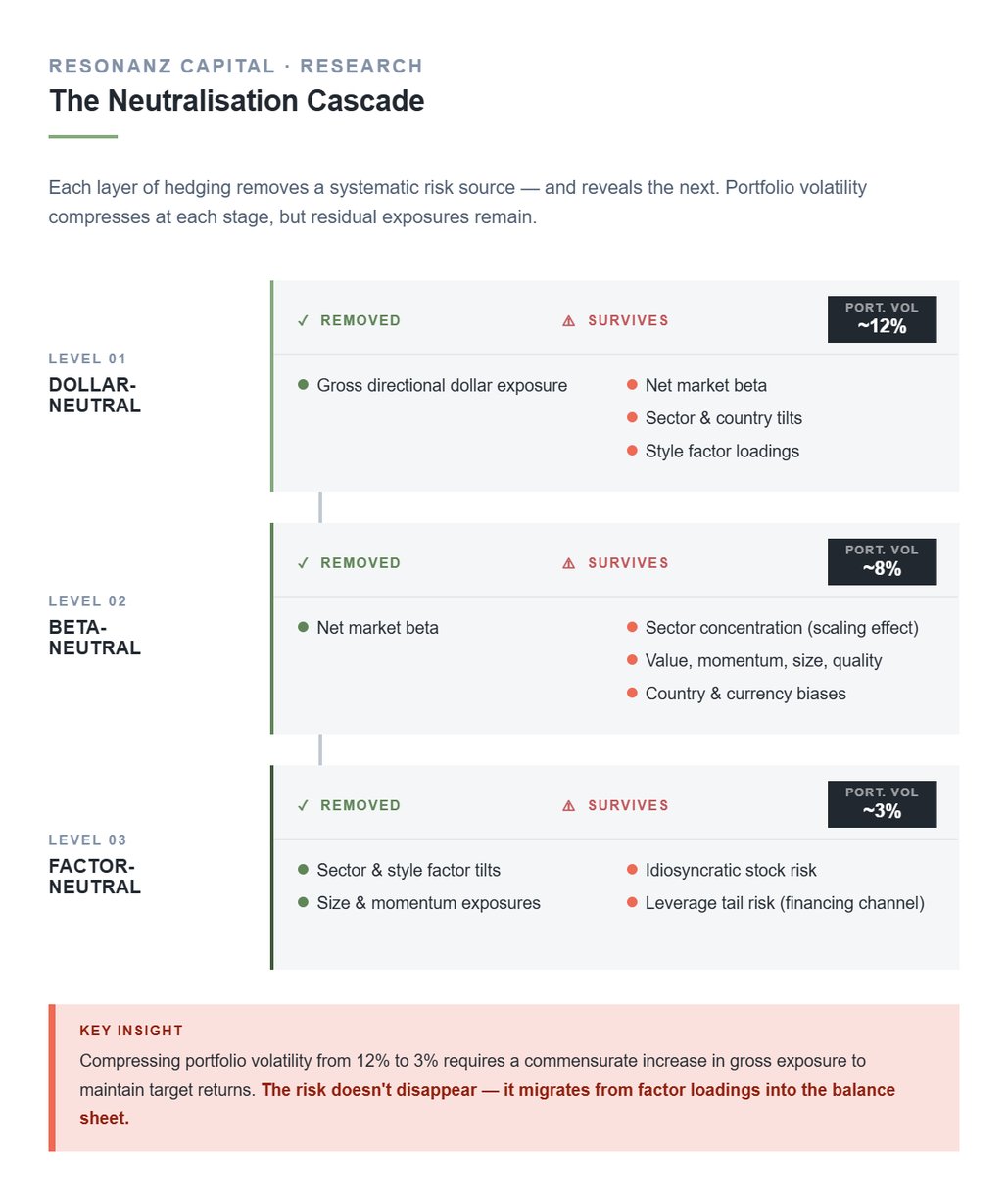
The problem is that dollars are not risk. A $100M long book with an average beta of 1.15 and a $100M short book with an average beta of 0.80 is not market-neutral. It carries a net beta of 0.35 on a $200M gross book — $35M of unhedged market exposure, or 17.5% residual beta. In a sharp market selloff, that exposure behaves exactly like a directional equity position. Dollar-neutrality is often the floor of the claim, not the substance of it.
Level 2: Beta-Neutral
The fix for residual beta is to scale the short book until the weighted net beta reaches zero. In the example above, the short book needs to be scaled to $143.75M to offset the higher-beta long book.
Net beta is now zero. But a new problem has appeared. If the short book was concentrated in low-beta defensive sectors — utilities, consumer staples, infrastructure — then scaling it up creates a structural short in those sectors. The portfolio is no longer market-sensitive in the aggregate, but it now carries significant sector tilts and style exposures. Momentum, value, size, and quality factors are alive in the book and unhedged. In 2022, when value rotated sharply and momentum reversed, beta-neutral long/short books with unhedged style tilts suffered material drawdowns — not because the market moved against them, but because their residual factor exposures did.
Level 3: Factor-Neutral
The next step is to identify and neutralise known factor exposures — sector, country, industry, and the major style factors — using portfolio optimisation or offsetting overlays. Each round of neutralisation removes another source of systematic return and compresses portfolio volatility.
A worked example illustrates how this compounds. A dollar-neutral book might carry gross volatility of 12%. After beta-neutralisation, the market contribution drops and volatility falls, perhaps to 8%. After sector and style factor neutralisation, it might fall further to 3–4%. What remains is largely idiosyncratic — stock-specific risk driven by individual earnings outcomes, competitive dynamics, or events.
This sounds like the goal. In a narrow sense, it is. But compressing systematic exposure to near-zero is not free. It introduces two structural costs that are rarely discussed in manager materials, and both are significant.
The Leverage Paradox
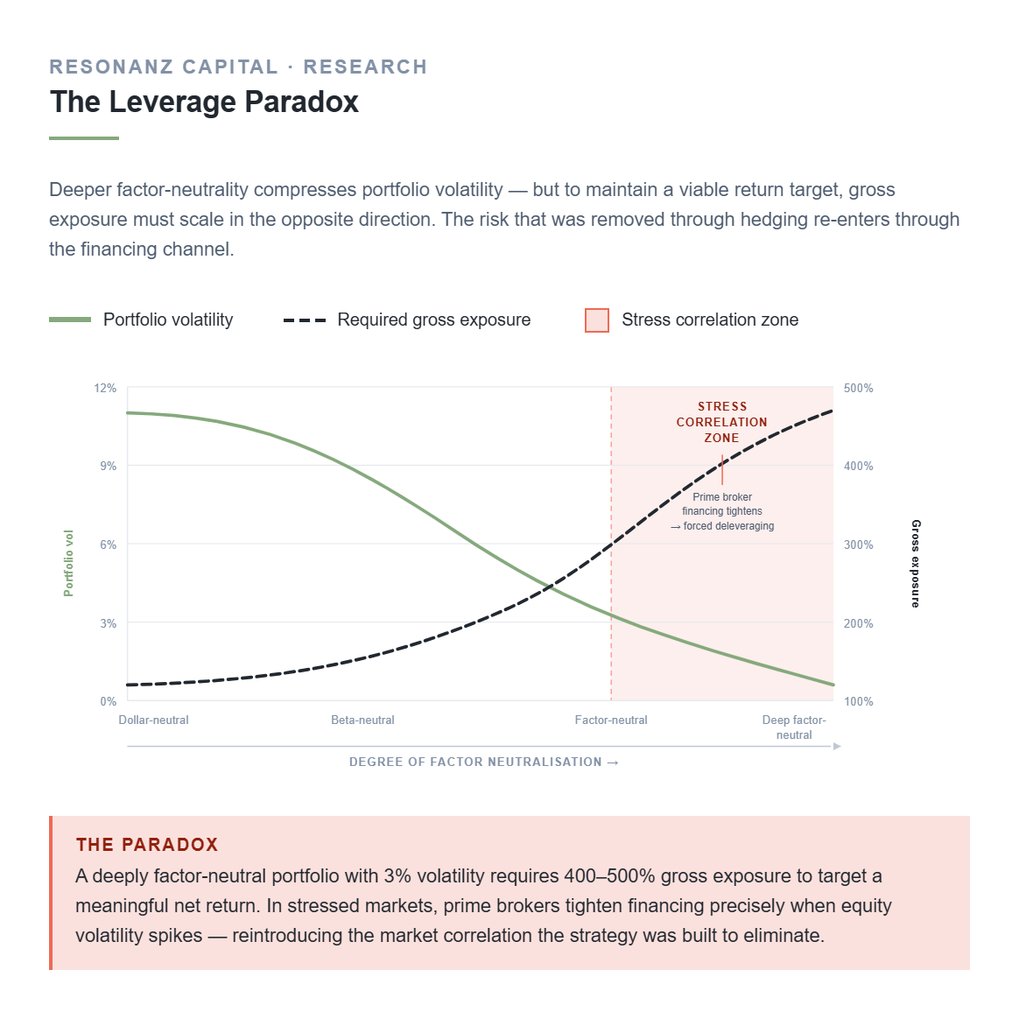
A factor-neutral portfolio with 3% annualised volatility is not viable at face value. No institutional mandate makes economic sense on 3% vol with an unlevered gross exposure — the expected return contribution is trivial. To generate any economically meaningful return, the manager must scale the book. If a 9% gross return is the target and the portfolio Sharpe is 1.0, the required gross exposure is approximately 600% — six times NAV. A 400–600% range for gross exposure is the operational norm for most deeply factor-neutral books.
This leverage is borrowed. It sits on prime brokerage financing lines, secured against the portfolio's collateral at haircuts set by the prime broker. And here the paradox closes on itself.
Prime broker financing does not tighten uniformly through time. It tightens sharply in periods of market stress — elevated VIX, widening credit spreads, rising equity correlations. The conditions under which financing becomes scarce are precisely the conditions associated with broad equity market drawdowns. The manager who built a factor-neutral portfolio to achieve independence from equity market risk finds, in the tail, that the leverage required to make that portfolio viable reintroduces a new form of equity market sensitivity — not through factor exposure, but through the financing channel.
Forced deleveraging — triggered by prime broker margin calls or haircut increases — requires selling longs and covering shorts on both sides simultaneously. When multiple market-neutral strategies do this at once, the resulting flows amplify market dislocations rather than absorbing them. August 2007, March 2020, and the deleveraging episodes of late 2018 all showed this dynamic. The correlation of market-neutral returns to equity markets in stress is not driven by sloppy factor hedging. It is a structural consequence of the leverage required to run the strategy at all.
The trade-off is precise: traditional residual beta carries directional market risk in normal conditions, but requires limited leverage. Deep factor-neutrality eliminates directional market risk in normal conditions, but requires substantial leverage — which reintroduces correlated tail risk through an entirely different mechanism.
The Transaction Cost Hurdle
The second hidden cost of factor-neutrality operates at the level of individual trade economics.
In a high-volatility directional equity book, execution costs — bid-ask spread, market impact, stock borrow — are small relative to the expected move per position. A 15% annualised vol stock moves roughly 95 basis points on an average trading day. A 10 basis point round-trip cost is manageable.
In a deeply factor-neutral book with 2–3% portfolio volatility, the expected return per unit of risk at the position level is correspondingly compressed. The same 10 basis point round-trip cost now represents a much larger fraction of the expected alpha per trade. Stock borrow costs for short positions — often 50–200 basis points annualised for crowded names — compound this further. The manager is operating with thin margins on each trade, in a portfolio that requires high turnover to maintain neutrality as factor loadings drift.
The practical consequence: the prediction accuracy required to break even — let alone generate alpha — is substantially higher in a deeply factor-neutral book than in a conventionally constructed long/short fund. The hurdle is not just higher in theory. It scales with gross exposure. On a 400% gross book, a 20 basis point average round-trip cost consumes 80 basis points of NAV per unit of turnover. Running factor-neutral at meaningful size is expensive in ways that compound with the leverage necessary to make the strategy viable.
A Practical Checklist for Evaluating Neutrality Claims
When reviewing manager materials that claim market-neutral or low-net-equity construction, these are the questions worth asking.
On residual exposures
- Is neutrality claimed at the dollar level, beta level, or factor level? Which factors are included in the neutralisation?
- What is the residual sector concentration after hedging? Is it disclosed?
- What is the net factor loading to value, momentum, size, and quality? Are these decompositions available?
On leverage and financing
- Is neutrality claimed at the dollar level, beta level, or factor level? Which factors are included in the neutralisation?
- What is the residual sector concentration after hedging? Is it disclosed?
- What is the net factor loading to value, momentum, size, and quality? Are these decompositions available?
On transaction costs and skill
- What is the current gross-to-NAV ratio, and how has it evolved over the strategy's history?
- What is the prime broker concentration? Is financing diversified across counterparties?
- Under what conditions do prime brokers have the right to increase haircuts or reduce lines, and what is the historical drawdown profile during episodes of market stress?
On the consistency of claims
- If the strategy claims deep factor-neutrality and low portfolio volatility, does the gross exposure level reflect that? A low-vol, low-gross book would not generate sufficient return — the numbers must be internally consistent.
- Does the drawdown history show the pattern expected of a genuinely factor-neutral strategy, or are there stress-period episodes that suggest residual systematic sensitivity?
Closing Thought
Market-neutral strategies sit at one of the most technically demanding intersections in portfolio construction. The pursuit of factor purity is legitimate and, in some environments, highly valuable. But it does not eliminate risk — it transforms it. The residuals that survive the hedge, the leverage required to make the strategy viable, and the transaction costs that govern whether skill translates into return — these determine whether a market-neutral allocation genuinely diversifies a portfolio, or simply relocates its risk into the financing structure.
The hedge removes what it removes. The rest is not neutral — it is just different.
Resonanz insights in your inbox...
Get the research behind strategies most professional allocators trust, but almost no-one explains.