Under what conditions can human beings reason together toward better decisions? It is a difficult question — and, for anyone who has sat in an investment committee, a familiar one.
Jürgen Habermas spent seven decades asking it. He died on 14 March 2026 at the age of 96, born in Düsseldorf, shaped by Frankfurt, and read across the world. His concern was philosophy. But the problems he named have always lived inside every investment process worth examining.
The Ideal Speech Situation — and Why Markets Are Never One
Habermas is best known for his concept of communicative rationality — the idea that human reason is not just an individual faculty but a social one. We arrive at better decisions through genuine dialogue: open, non-coercive, where the only thing that carries weight is the quality of an argument.
He called the conditions for this a Herrschaftsfreie Diskussion — a discourse free from domination. No authority bias. No positional power distorting the exchange. The better argument wins.
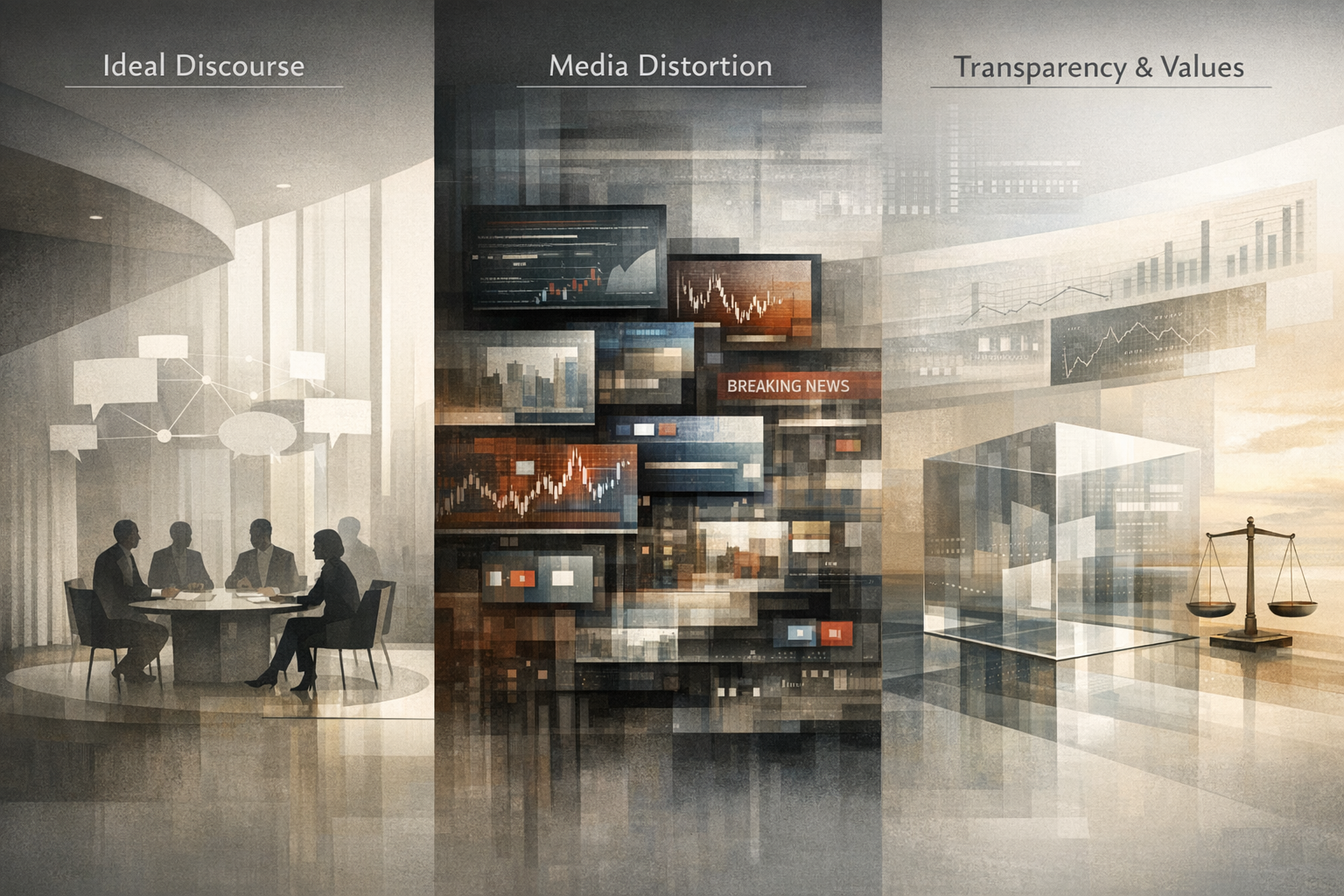
Investment committees never meet these conditions. Senior figures anchor expectations. Quiet consensus substitutes for genuine deliberation. Career risk silences dissent. The formal structure of a meeting can look rational while being anything but.
Habermas's framework names this clearly: a process is only as good as the conditions under which it operates. Portfolio construction that ignores the sociology of its own decision-making is structurally compromised, regardless of the quality of its models.
The discipline implication is not complex. It is, however, demanding: build processes that actively protect minority views, formalise dissent, and separate the quality of an argument from the seniority of the person making it.
The Public Sphere and the Degradation of Investment Discourse
In his landmark 1962 work, The Structural Transformation of the Public Sphere, Habermas traced how genuine public deliberation — once a space for reasoned debate — had been colonised by commercial interests and media spectacle. He returned to this theme in his 2023 book, A New Structural Transformation of the Public Sphere and Deliberative Politics, arguing that digital communication had fragmented discourse further still: echo chambers, algorithmic amplification, affective polarisation substituting for reasoned argument.
He was writing about democracy. He could have been writing about financial media.
The information environment facing any investment team is now structurally hostile to careful thinking. Compression of the news cycle rewards reaction over analysis. Social media surfaces confidence, not correctness. Consensus forms before evidence is complete. Narratives harden into conviction faster than fundamentals justify.
Habermas's warning is specific: when a discourse space is designed for speed and engagement rather than truth-seeking, the outputs are unreliable — not because the participants are unintelligent, but because the structure makes deliberation impossible.
The investment response is institutional. It requires deliberately insulating the analytical process from the speed of external discourse. Not ignoring markets — but not letting the rhythm of the feed set the rhythm of the process.
Knowledge and Human Interests — The Case Against Pseudo-Objectivity
Habermas's 1968 work Knowledge and Human Interests made an argument that continues to disturb. All knowledge, he contended, is shaped by the interests of those producing it. Positivism — the claim that data speaks for itself — conceals rather than removes the choices embedded in how data is gathered, framed, and deployed.
This is not a counsel of relativism. Habermas believed in rigorous inquiry. But he insisted on transparency about the assumptions behind it.
The investment industry has a positivism problem. Quantitative models are presented as neutral. Risk frameworks are treated as objective. Factor exposures are reported as if they were facts rather than interpretive choices. The language of science is applied to a practice that is, at every level, saturated with judgment.
Showing the work — the actual methodological choices, the assumptions baked into the model, the places where judgment substitutes for data — is not a weakness. It is the condition under which any claim to rigour becomes credible. Habermas would recognise the gesture immediately: it is the difference between a discourse that earns trust and one that merely performs authority.
Between Facts and Norms — Holding Both at Once
Habermas's 1992 work Between Facts and Norms examined how legal systems and democratic institutions navigate the gap between what is and what ought to be. His central concern was that neither pure empiricism nor pure idealism was adequate. Serious reasoning requires holding both simultaneously — the discipline of facts alongside the discipline of values.
Investment practice faces an equivalent tension.
The data tells you what has happened. It does not tell you what matters, what horizon is appropriate, what risks are worth taking, or what obligations attach to the capital you are managing. These are normative questions. Ducking them does not make them disappear — it just means they are being answered implicitly, without scrutiny.
Investors who treat portfolio construction as purely technical are not being rigorous. They are outsourcing their value judgements to convention. Habermas would call this a failure of communicative reason: the abdication of the reflective dimension of practice.
The alternative is not moralism. It is accountability — the willingness to state your assumptions, including the normative ones, and to subject them to the same scrutiny as your quantitative ones.
A Frankfurt Legacy, Taken Seriously
Habermas did his most important work in Frankfurt. So do we.
That is not an affectation. The Frankfurt School's central concern — that technical rationality, when detached from human judgment and genuine discourse, becomes a tool of domination rather than liberation — runs directly through the questions that serious asset managers face every day.
Who sets the agenda in the investment process? Whose views get heard? What interests are embedded in the models we trust? These are not soft questions. Left unexamined, they determine the quality of every decision that follows — more reliably, and more invisibly, than any model does.
Habermas asked them for seven decades. The discipline of taking them seriously is, in the end, what separates a genuinely rational process from one that merely resembles one.