
Event-driven isn’t one strategy. A field guide to merger arb, activism, special sits, and soft catalysts—risks, signals, and allocator checklists.
17 min read | Mar 9, 2026
Over the past 15 years, roughly two-thirds of the average event-driven fund's return is explained by equity beta, credit, and commodity factor exposure. Only about a third is alpha that cannot be attributed to systematic risk premia.
That number should change how you read a pitch book.
When a manager says "event-driven," they may mean merger arbitrage, activism, special situations, or soft catalyst positioning. Each of those four buckets has a different payout mechanism, a different failure mode, and a different fee justification. What they share is a label that conceals a wide range of exposures — some genuinely idiosyncratic, some that are equity beta with a narrative overlay.
The allocator's job is not to decide whether event-driven is a good category. It's to classify what you're actually buying, underwrite the dominant failure mode, and demand proof that you're paying for alpha rather than repackaged factor risk. Being right about the thesis is not enough. You must be classified correctly, sized correctly, and funded correctly — until you're right.
The Taxonomy: Four Buckets That Allocate Differently
1. Merger Arbitrage (Deal Spreads)
What it is: Buy the target, hedge the acquirer if it's stock-for-stock, and earn the spread if the deal closes. You are paid for time plus completion risk — the spread compensates you for deal failure, delay, and the cost of hedging.
The payout mechanism: Contractual. There is a signed agreement with a price, a timeline, and conditions. You are underwriting the probability that those conditions are met on schedule.
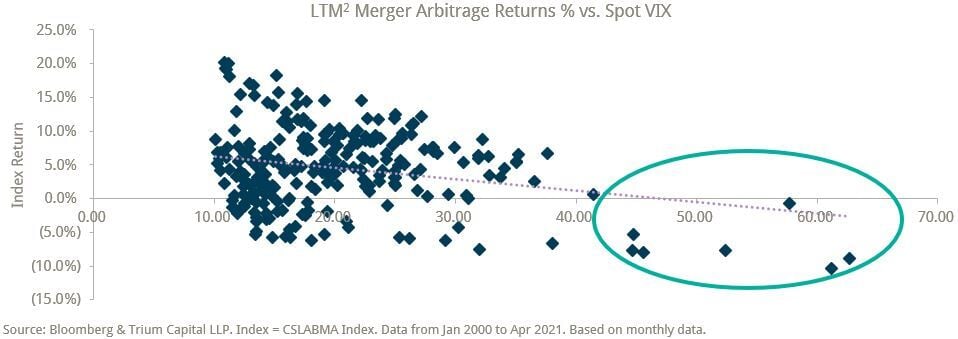
What it feels like: A short-volatility strategy in disguise. You collect small carry until a tail event arrives. Historically, roughly 94% of announced deals close — but the loss on a break is rarely symmetric with the gain on completion. One break can wipe out months of spread income. The strategy behaves like carry until it doesn't, and when it doesn't, it moves fast.
What can go wrong:
-
Regulatory and antitrust risk is typically the dominant failure mode. The DOJ/FTC Merger Guidelines define what regulators say they will scrutinize — and those guidelines have expanded over time to include theories of harm around serial acquisitions, platform dynamics, and industry structure that weren't standard analytical frameworks in prior cycles. Whether or not you agree with the regulatory posture in a given administration, the analytical work required to underwrite a large-cap deal has become more complex. A spread that widens from under 3% to over 20% on a single regulatory development is not a pricing anomaly — it is the market repricing completion probability. That happens in any regulatory environment when the deal is sufficiently complex or politically visible.
-
Financing risk can break deals that would never face regulatory problems. Leveraged transactions depend on debt markets. When issuance windows close, the deal can reprice or collapse regardless of antitrust clearance.
-
Timing risk is underappreciated. A deal that is "right" but takes 18 months or more to close destroys IRR and forces continuous hedging costs. The spread compensates you for time — but only if your capital and patience both last. A fund that marks to market during a prolonged regulatory review faces redemption pressure that has nothing to do with whether the thesis is correct.
-
Crowding is structural when spreads are thin. When the spread on a large, well-known deal compresses to near zero, leverage and positioning rise across the arb community. The exit door narrows. When a break or delay occurs, the unwind is correlated and fast.
The structural point that doesn't change across cycles: Merger arb is a short-volatility strategy regardless of deal volume or regulatory posture. You collect carry in normal environments and face asymmetric losses in stress. The manager's job is to underwrite which deals deserve to be in the book and which spreads are too thin for the risk being taken. A manager who cannot articulate their regulatory underwriting process — not just their spread targets — is taking risks they haven't priced.
Allocator tell: If a manager describes merger arb as "bond-like," they are underwriting the wrong risk. Bonds have contractual cashflows and seniority. Merger arb has completion optionality and equity-like break risk. The difference matters when a deal breaks.
Checklist questions that actually matter:
- What percentage of the book is in deals with material antitrust or multi-jurisdictional review risk, and how does sizing reflect that?
- When a deal faces a second request or active litigation, what is the specific playbook — hold at full sizing, hedge with options, reduce, or exit? Get a process answer, not a principle.
- Are there concentrated exposures to one regulator, one sector, or one political theme? Concentration in a sector under active regulatory scrutiny is not diversification.
- What is the time-to-close distribution across the current book, and what does a six-month extension do to IRR at current spread levels?
2. Activism (and Engagement-Driven)
What it is: Take a meaningful stake and force value-realizing actions — buybacks, divestitures, governance change, board refresh, strategic alternatives. You are paid for re-rating plus corporate action plus negotiation leverage.
The payout mechanism: Behavioral. There is no contract. Returns come from extracting value that exists but is trapped by incentives, structure, or inertia. You are underwriting a campaign, not a transaction. The return depends on evidence, sequencing, coalition-building, management response, and timing.
What it feels like: Closer to litigation strategy than to spread trading. Think about it the way you would underwrite a lawsuit: what is the evidence, what is the sequencing, what are the settlement alternatives, and what is the downside if the judge rules against you? Activists who win do so because they have done that work. Activists who lose do so because they substituted a compelling thesis for a credible process.
What can go wrong:
-
Time and fatigue are the primary failure modes. Markets stop caring before you win. The stock drifts. Capital is locked in a thesis that is correct but not converting. The opportunity cost of a two-year campaign that ends in a negotiated settlement for modest change is real and rarely appears in the performance attribution.
-
Coalition risk is structural. You cannot win proxy contests alone. Building shareholder support requires other institutional owners — index funds, other active managers, pension trustees — to take your side. That depends on governance norms, proxy adviser recommendations, and whether your thesis is legible to generalist investors who have no particular reason to agree with you.
-
Disclosure mechanics shape how quickly and quietly positions can be built. The SEC's amendments to Schedule 13D filing windows — shortening the deadline from 10 days to 5 business days — changed the economics of stealth accumulation. The practical effect: the window to build a position before disclosure is materially shorter, which compresses the return on the information advantage that early accumulation historically provided. This structural change favors activists with deep pre-existing research and strong coalition-building capacity. It disadvantages opportunistic, deal-by-deal entrants who relied on the accumulation window itself as an edge.
-
Management counterplay is underestimated in manager pitches. Boards have access to the same playbook activists do. Poison pills, defensive restructurings, shareholder rights plans, and the simple strategy of waiting activists out are real variables. A campaign plan that assumes management will respond rationally to pressure is a campaign plan that hasn't modeled the other side.
The structural point that doesn't change across cycles: Activism returns are outcomes, not events. The difference matters for how you underwrite. An event happens or it doesn't. An outcome depends on a chain of decisions, responses, and market conditions. Underwrite the chain, not just the endpoint.
Allocator tell: "We'll talk to management and see" is not a campaign plan. Ask for the sequencing: what happens if management says no at step one, step two, step three? A manager who cannot answer that question is running engagement, not activism. Engagement is a different product with a different expected return profile.
Checklist questions that actually matter:
- What are the top three repeatable value levers — capital return, divestiture, governance, strategy — and what is the evidence that this manager has executed them before, not just proposed them?
- Under the current disclosure window, how has their campaign preparation process changed? How do they build conviction and coalition before the first 13D filing?
- What is the downside plan if management refuses and the stock drifts for 18 months? At what point does the position get cut, and who makes that call?
- How do they avoid becoming a permanent engagement fund — one that is always "in conversation" with management but never forces an outcome?
3. Special Situations (Hard Catalysts)
What it is: Corporate actions with contractual or structural endpoints — spinoffs, tender offers, recapitalizations, restructurings, liquidations, rights issues, carve-outs, post-reorganization equities. You are paid for complexity, forced flows, and mispricing around change.
The payout mechanism: Structural. Mandate-driven forced selling, index exclusions, and shareholder base turnover create mispricing that closes at the event — not because the market agrees with you, but because someone must transact. This is the most defensible return source in event-driven: you don't need the market to validate your view, you need the event to execute. The forced flow is the mechanism. If you can't describe it precisely, you're underwriting a story, not a structure.
What it feels like: Documentation and mechanics work. The best special situations managers think like distressed credit analysts and corporate lawyers simultaneously — they map the capital structure, identify who gets paid first, and track the process calendar. The thesis is usually simple. The edge is in the execution details that most investors skip.
What can go wrong:
-
Balance-sheet reality is the most common source of misclassification. Some "special situations" are levered equity with a countdown timer. The complexity of the structure obscures the underlying credit risk. Knowing where you sit in the capital structure — and what assumptions are embedded in the recovery estimate — is not optional. It is the underwriting.
-
Legal and process risk is underestimated in pitches. Court timelines slip. Creditor priority disputes emerge mid-process. Documentation has gaps that don't become visible until the event is underway. These are not tail events in restructuring situations — they are base-case variables that any manager working in the space regularly encounters.
-
Liquidity mismatch is the failure mode that compounds everything else. Post-reorganization equities and small carve-outs can be illiquid exactly when the thesis breaks. When you need to exit, the bid disappears. A fund with redemption pressure and an illiquid post-reorg book is in a structurally bad position regardless of whether the thesis is correct.
-
The wrong catalyst. The event happens but the value doesn't show up. A spinoff without a strategic rerate, a recapitalization that improves optics but not economics. The event is necessary but not sufficient — and a manager who confuses the two has underwritten the trigger, not the outcome.
The structural point that doesn't change across cycles: Forced flows are the most durable edge in event-driven. Index rebalances, mandate constraints, and shareholder base turnover create price-insensitive selling that has nothing to do with fundamental value. That selling creates mispricing that closes when the forced flow exhausts itself. The manager's job is to identify the flow, size the position, and wait. Everything else is noise.
Allocator tell: Weak special situations managers talk about "unlocking value." Strong ones talk about who must trade and what changes at the event. If a manager cannot describe the forced flow precisely — who is selling, why they must sell, when the selling stops — they are underwriting a narrative, not a mechanism.
Checklist questions that actually matter:
- What is the hard catalyst, what can delay it, and what is the manager's explicit probability estimate for delay versus cancellation?
- Where in the capital structure is the position, and what are the assumptions embedded in the recovery or rerate estimate?
- Who is the forced seller or buyer at the event, and what does the flow path look like after it executes? When does the price-insensitive selling stop?
- What is the realistic exit — who owns the security after the event, what is the liquidity profile at that point, and what is the base-case holding period post-event?
4. Soft Catalysts (Positioning Around Probable Change)
What it is: Trades where the catalyst is not contractual — product cycles, management transitions, policy shifts, strategic reviews, rumored M&A, capital return potential. You are paid for anticipation. Sometimes you are early to a real event. Often you are taking equity risk with a narrative overlay.
The payout mechanism: None that is structural. You are underwriting behavior and market re-rating. Without a forced flow or a contractual endpoint, there is no mechanism that compels mispricing to close. You need the market to agree with you, on a timeline you don't control. That is a fundamentally different proposition from the other three buckets — and it should be priced and sized differently.
What it feels like: Long/short equity with better stories. The positions are often high-quality, the theses are often coherent, and the returns are often explained by factor exposure rather than event alpha. That is not necessarily a problem — unless you are paying event-driven fees for it.
What can go wrong:
-
Factor drift is the primary and most common failure mode. The portfolio migrates toward quality, value, or momentum exposure while retaining event language. Returns are explained by systematic factors. Fees are charged for idiosyncratic alpha. This is the bucket most likely to produce the two-thirds factor-explained return profile described in the opening paragraph. It is also the bucket most likely to be presented as something else.
-
Catalyst slippage is structural. "Next quarter" becomes "next year." The holding period extends. The opportunity cost accumulates. Without a hard endpoint, there is no forcing function, and the manager's natural bias is to stay patient rather than admit the catalyst isn't coming.
-
Crowding and fast unwinds. Soft catalysts attract consensus because they are based on public information that many investors reach simultaneously. When they fail, the unwind is fast and correlated — everyone entered for the same reason and exits for the same reason.
The structural point that doesn't change across cycles: Soft catalysts are acceptable in a portfolio if — and only if — the manager can demonstrate they are not running factor exposure with event language. That requires actual factor attribution, not qualitative assurance. If the manager cannot produce it, assume the worst.
Allocator tell: Ask for factor attribution before engaging with any other part of the soft catalyst pitch. Not a description of how the manager thinks about factors — an actual regression of realized returns against standard equity factors. If the R-squared is high, you are looking at a disguised equity book. Price it accordingly.
Checklist questions that actually matter:
- Show the factor attribution. This is non-negotiable and should precede all other diligence on this bucket.
- What is the evidence the catalyst is real — board actions, regulatory filings, a public strategic process — versus a thesis about what management should do?
- What is the kill rule? At what point does the manager exit a position where the catalyst has not materialized, and what is the average holding period on positions where the catalyst failed?
- What percentage of the book is soft catalysts versus hard catalysts, and how has that ratio changed over the past three years?
| Bucket | What you own | What you’re paid for | What breaks it | What to monitor | Allocator red flags |
|---|---|---|---|---|---|
| Merger arb | Target + (hedged) acquirer | Time + completion risk | Antitrust/financing delay, deal breaks | Regulator signals, time-to-close, credit windows | “Bond-like” framing, concentrated contested deals |
| Activism | Stake + campaign | Rerating via corporate action | Time, coalition failure, counterplay | Milestones, vote math, disclosure constraints | No “path to yes,” vague sequencing |
| Special sits | Hard-catalyst securities | Complexity + forced flows | Process delays, liquidity, cap structure errors | Catalyst calendar, cap structure, forced flows | Story without mechanism |
| Soft catalysts | Equity risk with thesis | Anticipation of change | Drift into factor beta | Factor attribution, kill rules | Long holds, no hard triggers |
The Structural Context That Doesn't Change
Regardless of the market cycle, three structural realities shape how event-driven strategies behave. Allocators who understand them are harder to mislead.
Merger arb is short volatility by design, not by accident. In every market environment, the strategy collects carry in exchange for bearing asymmetric tail risk. The tail is deal-break and deal-delay risk. The relevant question is not whether deal flow is high or low — it is whether the manager is being compensated for the tail risk they are taking in each position. A compressed spread in a buoyant deal market is not a safe spread. It is an under-compensated risk.
Activism mechanics are always shaped by the disclosure regime. The specific rules change — filing windows, group formation requirements, structured data requirements — but the underlying dynamic is constant: the disclosure regime determines how much information advantage an activist can build before going public, and therefore how much of the campaign's return is captured in the accumulation phase versus the public engagement phase. Understanding the current rules is not optional for activism underwriting, in any cycle.
Special situations always carry liquidity mismatch risk at the worst moment. Post-event securities — post-reorg equities, spun-off entities, restructured instruments — attract a specific shareholder base that includes forced sellers and opportunistic buyers. When the thesis breaks, the opportunistic buyers disappear first. The manager who entered for the forced-flow opportunity is now holding an illiquid security with no natural bid. This dynamic repeats in every cycle. The defense is sizing discipline and honest assessment of post-event liquidity before entering, not after.
Allocator Takeaways
Event-driven is a taxonomy problem before it is a return problem. Two-thirds of the category's historical return is explained by factor exposure. What you are paying for is the remainder — the genuinely idiosyncratic alpha that comes from contractual catalysts, forced flows, and superior campaign execution. Classify the book before you engage with the performance.
Underwrite the dominant failure mode for each bucket: regulatory and financing path risk in merger arb; coalition, time, and disclosure mechanics in activism; capital structure and liquidity in special sits; factor drift in soft catalysts. Each bucket fails differently. The diligence should reflect that.
Demand proof of event-ness: catalyst calendars, forced flow maps, capital structure documentation, and factor attribution. A manager who cannot produce these is asking you to underwrite a story. Stories are not mechanisms.
Understand the structural realities that don't change: merger arb is short vol regardless of deal volume; activism is shaped by whatever disclosure rules are in effect; special sits always carry post-event liquidity risk. These are not 2024 or 2026 observations. They are permanent features of how these strategies work.
Size by liquidity and path, not by optimism. In every sub-strategy of event-driven, being right about the outcome is necessary but not sufficient. You must be classified correctly, sized for the timeline, and funded through the path — until you are right.
Resonanz insights in your inbox...
Get the research behind strategies most professional allocators trust, but almost no-one explains.