
Japan’s reforms are unlocking trapped capital. What the data says drives re-ratings and how activists and event-driven managers can monetize in 2026.
9 min read | Mar 2, 2026
Japan’s opportunity today isn’t “cheap stocks in a slow economy.” It’s the combination of too much idle capital and a regulatory/exchange agenda that keeps forcing the capital-allocation conversation onto the board agenda.
That matters for event-driven and activist managers because it turns what used to be an art into a process. The inputs are clearer. The pressure points are public. The timeline is increasingly visible.
Japanese corporates spent the post-2008 era building fortress financials while U.S. corporates leveraged up. The result is a market crowded with companies where cash, marketable securities, and other low-return assets sit on the balance sheet at scale — often larger than what the market is willing to credit.
The Tokyo Stock Exchange (TSE) is now treating that as a market-structure problem, not a management style choice. Its “cost of capital and stock price” initiative is effectively a standing request for companies to explain how they will stop wasting capital.
2026 is where those threads tie together: trapped capital + a live catalyst calendar + more workable engagement plumbing.
Why this is fertile ground for activists
Fortress balance sheets created a valuation problem Japan can’t ignore
The chart below shows the median net cash position (cash & investments minus debt) as a percentage of market cap has remained meaningfully positive for Japan for years, while the U.S. median has been negative (reflecting leverage).
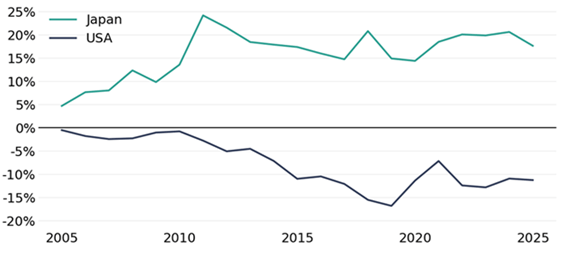
Chart 1: Net Cash position as % of markt cap: Japan vs. U.S.; source: Verdad Weekly Insights
When a company carries substantial low-return assets, there are only a few ways for equity holders to get paid:
- return capital (dividends/buybacks),
- sell or monetize low-return assets (cross-shareholdings, real estate, non-core subsidiaries),
- restructure group economics so the market can underwrite cashflows and governance.
There are many companies with little or no debt and large pools of cash and securities trading at market caps below the value of their net assets. You don’t have to like those specific names to understand the broader point: Japan still has a deep bench of “trapped capital” situations.
The critical insight: re-rating has been linked to payout growth and capex restraint
This is the part allocators should internalize, because it’s directly investable.
We look at TSE-listed companies trading below 1x P/B (price-to-book) as of 12/31/2022 and track outcomes through 12/31/2025:
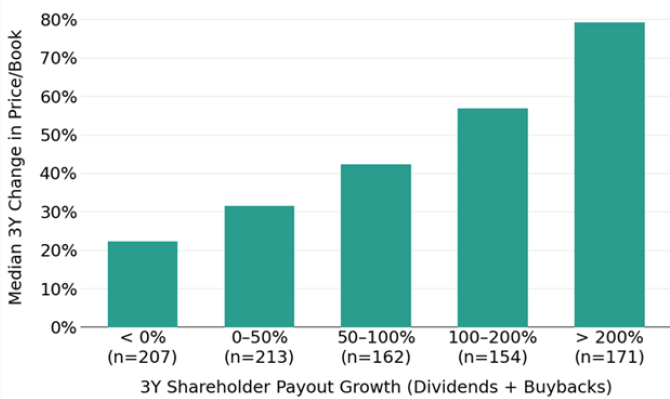
- Companies that grew shareholder payouts (dividends + buybacks) more aggressively saw larger median improvements in P/B multiples. The highest payout-growth bucket showed the strongest median re-rating.
- Among those same sub-1x P/B companies, lower capex intensity (capex as % of EBITDA over the period) was associated with materially stronger re-rating (roughly 50–60% median P/B gains in low capex buckets versus closer to ~20% in the highest capex bucket).
That’s not saying “never invest.” It’s saying markets are skeptical of “growth for growth’s sake” when the starting point is a balance sheet full of low-return assets. In that regime, capital discipline is the catalyst.
This aligns tightly with what TSE is pushing: management that is conscious of cost of capital and stock price.
For activist and event-driven managers, it sharpens the playbook: press for higher payouts and capital-light growth, not bigger budgets.
The governance regime shift in 2026
TSE moved to a public scoreboard
TSE requested Prime and Standard companies take action to implement management conscious of cost of capital and stock price in March 2023, then began publishing a list of companies that disclosed related information in January 2024.
This isn’t just disclosure theater. Public lists create two things activists care about:
- Comparable disclosures (easier screening and engagement scripting)
- Reputational pressure (a reason for boards to act sooner)
TSE’s 2026 “Policies and Initiatives” materials make clear it wants to accelerate “effective dialogue” and avoid stagnation, explicitly noting concerns that disclosure can become formalistic without real change.
Information flow is improving
A core friction in Japan used to be speed and accessibility of information for global capital. TSE is attacking that directly.
- Prime companies are required to disclose key items simultaneously in Japanese and English from April 1, 2025, with certain pre-existing Prime companies able to postpone full compliance until March 31, 2026 if they filed an implementation plan by March 14, 2025.
- TSE’s January 2026 survey summary reports progress beyond minimum obligations (for example, higher English disclosure rates for IR presentations and AGM notices).
This matters because activism often fails at the boring layer: you can’t build support if investors can’t access the same facts quickly. Better disclosure doesn’t create value by itself, but it reduces the “Japan discount” that came from opacity and slow engagement cycles.
FSA is tuning the rules to support engagement
The FSA (Financial Services Agency) finalized the third revision of Japan’s Stewardship Code in June 2025.
More importantly for 2026 mechanics, the FSA published materials clarifying how “acts of material proposal” and “joint holders” are interpreted under the large shareholding reporting framework — guidance aimed at enabling constructive dialogue and collaborative engagement, with implementation tied to May 1, 2026.
In allocator terms: fewer gray areas around engagement lowers operational friction for activist and event-driven teams, especially when building coalitions.
Takeover norms are becoming more “rules-based”
METI’s (Ministry of Economy, Trade, and Industry) takeover guidelines (August 2023) are designed to promote fair rules and best practices in M&A involving corporate control.
The direction is supportive, but not one-way. Recent reporting also highlights a policy tension: Japan wants reform and fair process, while still asserting that companies can rebuff unsolicited bids in some cases (with updates expected).
For event-driven allocators, that’s not a reason to avoid Japan. It’s a reason to diligence process risk harder in contested situations.
How to monetize changes in Japan
The practical playbook
1) Start with a “trapped capital” map, not a valuation screen.
Sub-1x P/B matters because it flags market skepticism about whether assets will translate into shareholder value. But the trade is not “P/B goes up.” The trade is “capital gets unstuck.”
2) Underwrite a specific action path.
Among sub-1x P/B companies, re-rating has been associated with higher payouts and capex restraint. So in diligence, one would want to see a manager explicitly separate:
- capital return cases (dividends/buybacks),
- asset monetization cases (cross-holdings, real estate, non-core),
- structural cases (parent-subs simplification, governance upgrades that make deals possible).
3) Use TSE’s framework as leverage
Good activists in Japan don’t lead with confrontation. They lead with the exchange’s own expectation: management conscious of cost of capital and stock price. That framing matters culturally and politically.
4) Monetize through corporate actions, not proxy “wins.”
Proxy battles make headlines. In Japan, the more repeatable payoff is management acting pre-emptively to avoid a public fight.
Reporting has noted that a record number of Japanese companies faced activist proposals in 2025, and that even when proposals fail, companies often adopt changes later. That’s a market where event-driven managers can get paid without needing dramatic vote outcomes.
Where the opportunity set is widening
Cross-shareholding unwinds
Cross-shareholdings have long protected management. They are now a live reform vector.
Reporting has described large-scale plans to facilitate the unwinding of strategic shareholdings. In the same vein, other high-profile Japanese companies have paired strategic holding sales with sizable buybacks — another example of the same pattern.
These situations create multiple trade types: blocks, buybacks, index effects, and second-order actions (portfolio pruning, group reorganizations).
Buybacks remain a backdrop, but the edge is in “incremental” capital action
Public market commentary and sell-side-style research has continued to flag elevated announced share buybacks across 2024–2025.
This supports downside, but it also raises crowding risk. The allocator question is: is the manager underwriting something beyond the buyback cycle — asset sales, governance shifts, structural simplification?
Take-privates and contested deals: more activity, more need for process underwriting
Contested outcomes are part of the maturation.
Recent high-profile disputes show that valuation and transparency can still be challenged in large going-private situations.
These situations test whether reform translates into fair outcomes for minority shareholders. They also create opportunity — if the manager has a real process edge and a disciplined downside plan.
“Activist summer” of 2026 calendar
- March 31, 2026: last date for some Prime incumbents to comply after postponement arrangements on English disclosure.
- May 1, 2026: implementation timeline associated with reporting-rule clarifications around “material proposal” and “joint holders,” relevant for collaborative engagement mechanics.
- TSE’s 2026 agenda: TSE has published forward initiatives including surveys of companies and investors and additional pressure on non-disclosers—use this as an engagement/catalyst calendar.
- June AGM season: not because you need proxy wins, but because it’s when management teams most dislike embarrassment and become more willing to settle privately.
Allocator takeaways
- Anchor Japan underwriting in “trapped capital,” not macro. The balance sheet is the raw material, and it’s unusually abundant in Japan.
- Use above results as a diligence filter: in sub-1x P/B land, the re-rating has been linked to payout growth and capex discipline. Ask managers to show this logic in their position memos, not just in a deck.
- Prefer managers who can force sequence: disclosure → engagement → capital action → structural change. TSE’s framework helps, but execution still separates managers.
- Underwrite process risk explicitly in contested and controlled situations. The opportunity is bigger; so is the tail risk.
- Don’t let this turn into a buyback beta sleeve. Elevated buybacks support the market, but your edge should come from incremental catalysts and idiosyncratic outcomes.
- Decide currency policy upfront and enforce it. Hedging drift is a silent P&L leak in multi-situation books.
Resonanz insights in your inbox...
Get the research behind strategies most professional allocators trust, but almost no-one explains.