
How SMAs and outsourced infrastructure are changing hedge fund launch economics, and what allocators need to underwrite differently.
8 min read | Mar 31, 2026
The hedge fund business still looks concentrated from the outside. Flows are skewed to large platforms. Capacity is tight in some of the best-performing segments. Bigger firms keep getting bigger. Under the surface, the operating model is moving the other way now.
The hedge fund is being unbundled. The investment process, legal wrapper, operating stack, and capital base no longer need to arrive as one finished institution. A manager can now launch with a smaller in-house build, one or two anchor accounts, and outsourced infrastructure that would have looked subscale a decade ago.
That shift matters for allocators because it changes what you are underwriting. The old question was whether a manager had already built a firm. The new question is whether the parts of the firm that matter are truly inside the manager, and whether the rest can be rented without weakening the proposition. SMAs are no longer a side show of the industry. They are becoming one of the main channels through which new hedge fund capital is organized, negotiated, and seeded.
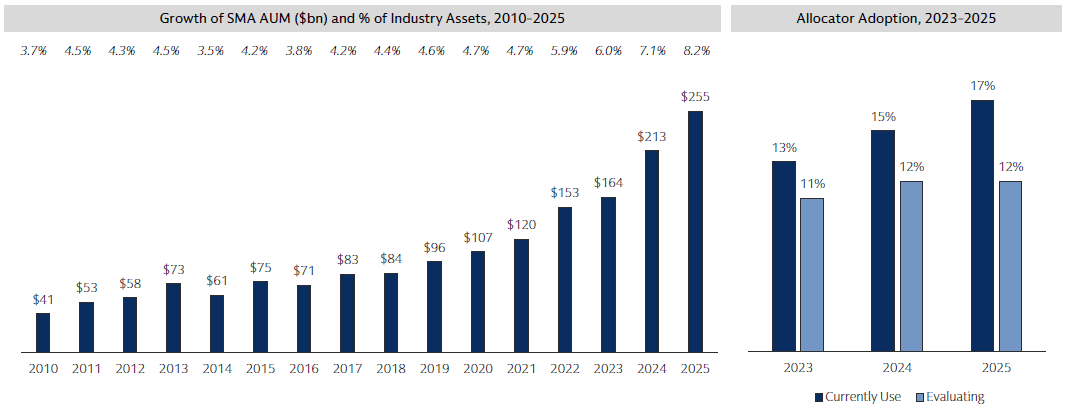
Growth of SMAs and their adoption by allocators
Source: Goldman Sachs, Generation Alpha, 2026
The wrapper has become part of the investment thesis

That is the core change.
For years, allocators treated the wrapper as secondary. First decide whether the strategy is good. Then decide whether to access it through a commingled fund, fund-of-one, or managed account.
That sequencing no longer holds. The structure is now part of the reason an allocator invests.
According to BNP’s 2026 survey 25% of allocators use SMAs. Among those that do, the structure accounts for 36% of hedge fund assets. More important, 20% expect to increase SMA usage in 2026, while commingled structures face a modest net decline. Barclays gets similar results: about a quarter of investors currently use SMAs, but those investors are expected to drive about half of gross hedge fund allocations in 2026. That is not wrapper housekeeping anymore. That is significant capital formation.
Why do allocators want it? The instinctive answer is transparency. That is true, but incomplete.
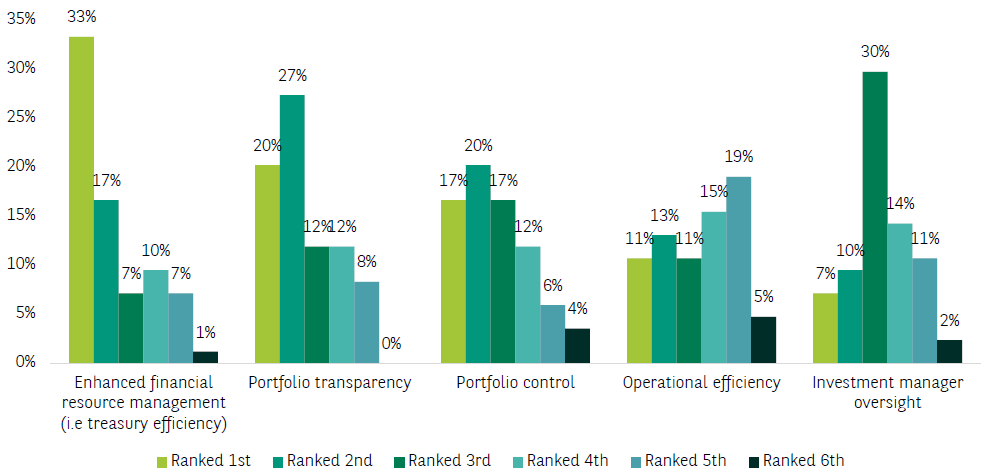
The top driver is treasury efficiency, ranked first by 33% of allocators in the BNP survey. Transparency and control matter, but the lead argument turns out to be balance-sheet economics. The appeal is not just seeing the book more clearly but financing the book more intelligently. Among allocators who do set a target for those savings, the average target is 88 bps. That is meaningful. It says the allocator case for SMAs is often about portfolio economics, not just governance optics.
Principal drivers for using SMAs
Source: BNP Paribas, 2026 Hedge Fund Outlook
Why this changes who gets funded
Once the wrapper becomes part of the investment case, it also changes the launch equation.
A new manager used to need more institutional build on day one. More headcount. More fixed cost. More infrastructure. More patience from early investors. In practice, that meant many good PMs still needed a longer runway, larger anchor, or stronger balance sheet before they were investable.
That hurdle has not disappeared. It has moved. Now the critical asset is not always a fully built firm. Sometimes it is one credible anchor account, clean documentation, a prime broker that can support the structure, and an operating model that can withstand institutional diligence without pretending to be something it is not.
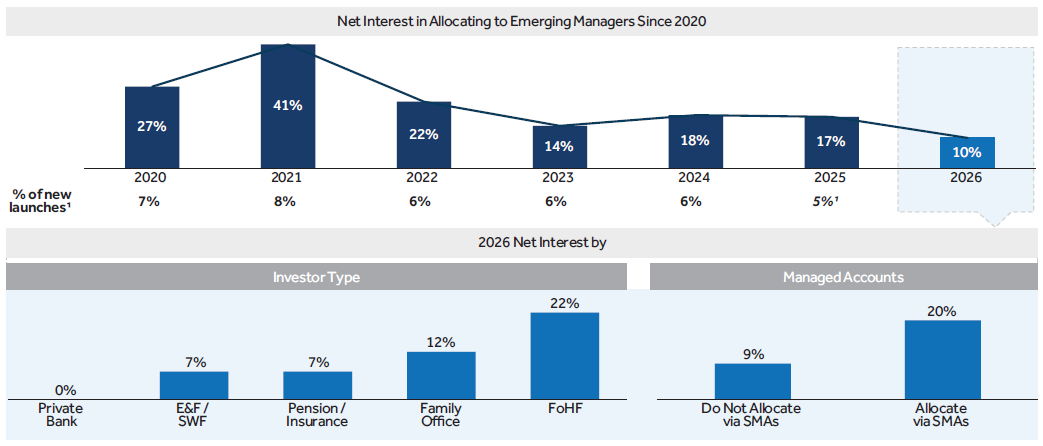
According to Barclays survey, investors who allocate through managed accounts show 20% net interest in emerging managers for 2026, versus 9% for those who do not. That gap matters. It suggests SMAs are not merely a better way to access established firms. They are also one of the few mechanisms through which new firms can still access institutional capital.
Emerging Manager Interest
Source: Barclays, 2026 Global Hedge Fund Outlook
Barclays also notes that among 2025 launches above $1bn, about two-thirds received allocations from multi-manager platforms, which supplied roughly 70% of the total capital to those launches. In other words, new-manager funding has not become broad-based. It has become more conditional, more concentrated, and more architecture dependent. That fits Goldman’s data. The firm estimates that up to $50bn of SMA capital may now come from multi-manager platforms, whose external allocation activity rose to 71% in 2025 from 54% in 2022. The implication is simple: the capital base for new and smaller firms is increasingly tied to institutions that want control, speed, and negotiated implementation.
Demand is strong, access is limited
This is where the story becomes more interesting.
The industry backdrop is supportive. Hedge fund industry AUM exceeded $5tn by year-end 2025, helped by $116bn of net inflows, the highest annual inflow since 2007. This comes on the heels of 2 years of double-digit average hedge fund returns. BNP reports that 64% of allocators plan to increase hedge fund exposure on a net basis in 2026. By itself, that sounds like an easy capital-raising market. It is not.
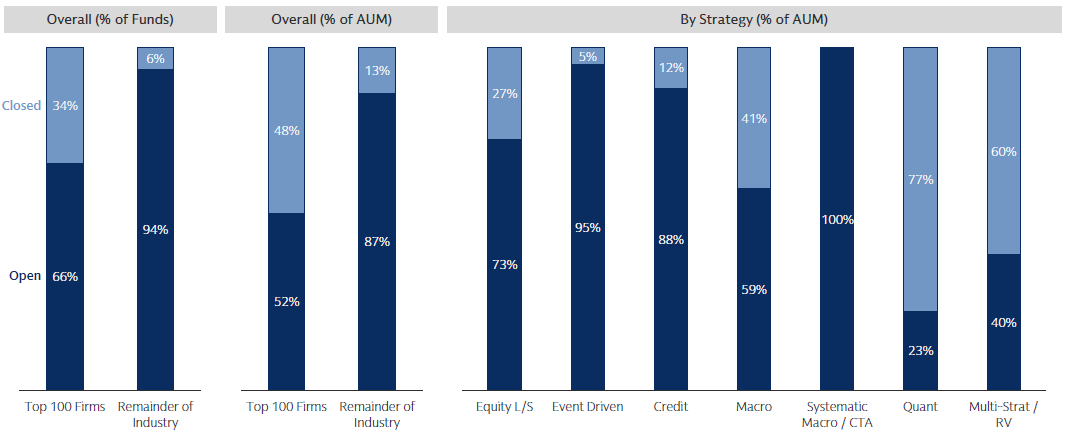
The reason is capacity. Among the largest 100 managers, 34% of flagship funds are closed, representing 48% of flagship assets, according to Goldman Sachs. At a strategy level, the pinch is sharpest in quant, multi-strategy and macro. In quant, 77% of flagship assets are closed to new investors. That creates a paradox. Allocators want more hedge fund exposure, but a meaningful slice of the most obvious capacity is shut. That does not guarantee flows to new managers. It does increase the value of alternative funding channels, negotiated access, and structures that allow capital to move earlier and with more control.
This is where the lean launch model becomes economically relevant, not just operationally clever. If established capacity is constrained, and if allocators increasingly want structure control anyway, then funding a manager through an SMA can solve two problems at once: access and implementation.
Capacity status of flagship funds
Source: Goldman Sachs, Generation Alpha, 2026
Lean does not mean low-risk
A smaller launch supported by SMA capital may reduce fixed cost. It may improve alignment. It may make underwriting cleaner. It does not remove fragility though.
The first risk is revenue concentration. A manager launched around one or two large accounts can look well capitalized and still be economically brittle. The business may depend on renewal risk, tight guidelines, or one client relationship that carries too much weight.
The second risk is hidden dependence inside the operating stack. Once you outsource more functions, diligence has to move past the org chart. Who reconciles? Who owns the control framework? Who is monitoring the vendors? Who can port the strategy if a service provider fails? The manager still owns the failure even when the function is external.
The third risk is strategy drift through customization. SMA terms can range from pari passu to carve-outs, adjusted net or gross exposure, currency hedging, and bespoke solutions. That flexibility is powerful. It can also distort the core investment process if the manager ends up running tailored books instead of a coherent strategy.
BNP’s manager survey adds another useful data point: 40% of managers took capital through an SMA in 2025, but the report is explicit that the trade-off is more nuanced on the manager side. Administration is heavier. Transparency can become a deal-breaker. Not every strategy wants, or should want, this structure.
What an allocator should actually underwrite
The due-diligence template needs to catch up. The old model asked whether the manager had already built an institutional firm. The new model needs to ask which parts of the institution must be native.
Investment judgment must be native. Risk ownership must be native. Liquidity management, client communication in bad markets, and control over the portfolio construction process must be native.
Other functions may not need to be. Parts of the operating stack can be rented. Parts of the reporting stack can be rented. Some launch infrastructure can be rented. That is the point of the new model.
But the allocator now has to underwrite the seams.
How much of the manager’s AUM is in SMAs? Barclays says managers that use SMAs have roughly 25% of AUM in them. Goldman says more than half of managers now run at least one SMA. Are the terms standardized or bespoke? Is the business diversified enough to survive a large redemption? Can the manager scale beyond the anchor account, or is the entire firm really one tailored mandate with a brand name attached?
Allocator takeaways
- Treat the SMA as part of the investment thesis, not an administrative afterthought.
- Underwrite treasury economics. That is often the real driver.
- Use SMA-friendly managers to widen access, but do not confuse access with durability.
- Pay close attention to client concentration in new launches.
- Diligence the vendor chain, not just the PM.
- Ask whether customization strengthens the portfolio or weakens the franchise.
- Recognize the market structure backdrop: strong allocator demand and tighter flagship capacity.
The hedge fund industry is not becoming simpler. It is becoming more modular. That is good news for allocators who know what they want from structure. It is also a trap for allocators who mistake a lighter launch model for a weaker need to diligence the business. The firm may look smaller. The underwriting job is not.
Resonanz insights in your inbox...
Get the research behind strategies most professional allocators trust, but almost no-one explains.