
Pass-through fees can turn “2/20” into a blank check. A selector’s audit of multi-manager expenses, incentives, and LP guardrails.
10 min read | Mar 9, 2026
In a full pass-through multi-strat, the average LP keeps $0.41 of every dollar of gross return. The rest goes to expenses and fees.
That number — which has circulated in Barclays and BNP Paribas survey work — is not the worst-case scenario. It is the average. And it explains why the fight in multi-manager hedge funds is no longer about 2-and-20. It's about who controls the operating bill, and how much of gross P&L actually reaches you.
Pass-through expenses can be rational. These platforms run hundreds of risk books, pay for elite talent, and spend heavily on technology and data. The problem is not that costs exist. The problem is that the cost line is open-ended while the marketing narrative is often "low management fee." A 1% management fee sounds cheaper than 2-and-20. It isn't, once the pass-through lands.
This is a practical guide to understanding the difference, auditing the real load, and knowing what to demand before you sign.
What "Pass-Through" Really Means
In a classic 2/20 structure, the management fee pays for the firm's overhead — salaries, rent, technology, administration. Performance fees pay for investment success. The GP can't push its operating costs into the fund without disclosure and limits. The incentive is clear: if the firm wants to spend more, it spends from its own revenue.
In a pass-through structure, a significant portion of those operating costs are charged directly to the fund. Compensation-related items, infrastructure, data, technology — costs that historically sat in the manager's P&L now sit in yours. The economic logic offered is: "we run an expensive trading factory; you fund the cost, and you get a relatively stable net return profile."
That can work. It breaks when performance is mediocre, assets stop growing, or the platform's cost base rises faster than its alpha engine.
Capped pass-through is the LP's response to that asymmetry: we accept the model in principle, but not as a blank check. Common guardrail structures include a hard cap on total pass-through as a percentage of NAV, separate category caps for compensation and technology, growth caps tied to AUM, and annual budgets with defined variance bands.
These are not just fee negotiations. They're an attempt to restore cost discipline to a model that otherwise socializes the manager's operating decisions onto investors.
Hedge Fund Pass-through Fees - 2026 Allocator Survey
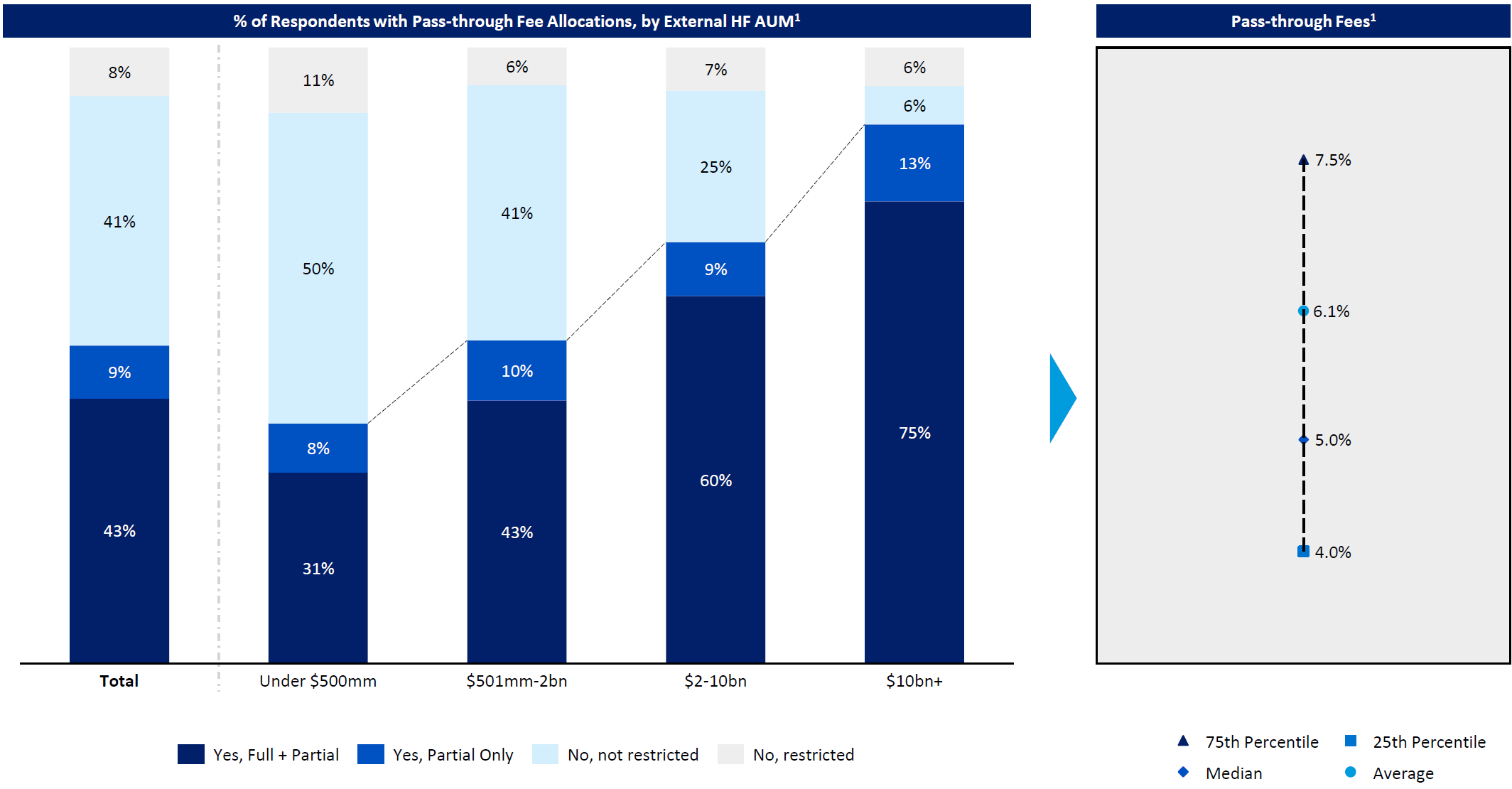
Source: Bank of America Global Markets Capital Strategy Group, Investor
The Math: What Each Model Looks Like Across Market Conditions
Abstract fee discussions are forgettable. Here's what each structure actually produces for an LP in three scenarios, assuming a fund that grosses 12% in a strong year, 5% in a mediocre year, and -2% gross in a down year. Pass-through assumed at 4% of NAV; management fee at 1.5% for the 2/20 comparison; incentive fee at 20% with no hurdle.
| Strong Year (12% gross) | Mediocre Year (5% gross) | Down Year (-2% gross) | |
| 2/20 | ~8.1% net | ~2.0% net | ~-3.5% net |
| Pass-Through (no cap) | ~6.4% net | ~0.0% net | ~-7.6% net |
| Capped Pass-Through (2% cap) | ~7.4% net | ~1.6% net | ~-4.4% net |
A few things jump out. In a mediocre year, a full pass-through structure nearly wipes out net returns before incentive fees. In a down year, the LP absorbs both the investment loss and the operating bill — the full cost base lands on a shrinking NAV. The capped structure materially closes the gap but doesn't eliminate it.
The point is not that pass-through is always worse. It's that pass-through is only better than 2/20 when net outcomes are meaningfully stronger — which is exactly what you need to underwrite, and exactly what the marketing materials tend not to show you.
MANAGEMENT FEE, PERFORMANCE FEE AND FUND EXPENSES ACROSS FEE STRUCTURES
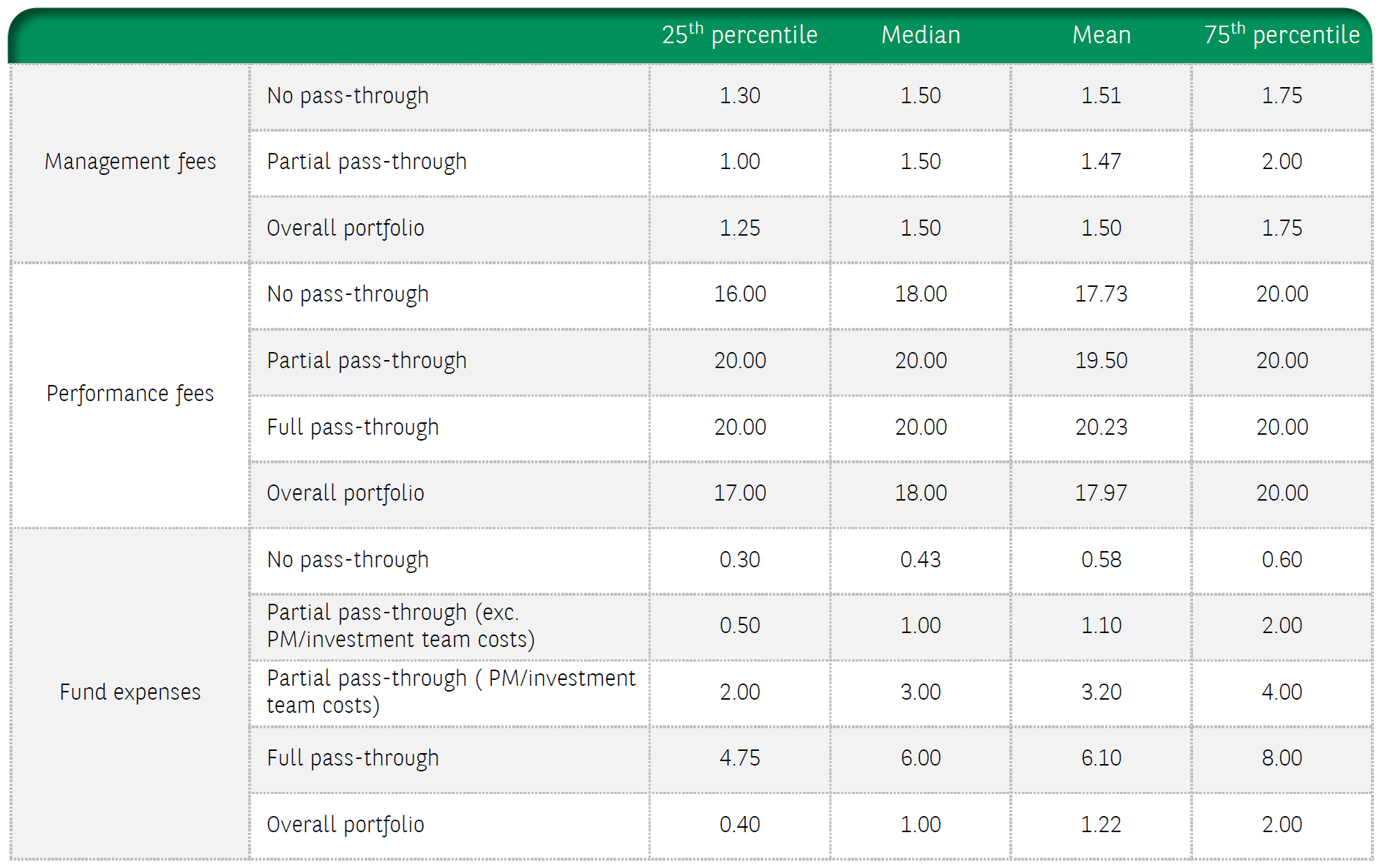
Source: BNP Paribas Hedge Fund Outlook – Allocator Questionnaire, 2026 (as of Jan 2026)
What the Capula Case Illustrates
Capula's published accounts showed pass-through expenses rising approximately 20% in a year when performance fees dropped materially. That's the investor pain point in a single data point: costs don't fall when performance falls.
This is structural, not accidental. These platforms compete in a global talent market. PM guarantees, support teams, data costs, and compute don't reprice downward in a soft year. When the cost base is sticky and the return is not, the LP absorbs the gap.
The Eisler Capital shutdown illustrates the endpoint of that dynamic. A smaller multi-strat carrying a large fixed cost base on a shrinking asset base found the pass-through economics untenable. The cost structure that made sense at peak AUM became a burden as assets declined — and unlike a traditional manager, there was no management fee cushion to absorb it. The operating bill passed straight through to investors until it didn't.
The Four Failure Modes
1. Down-year asymmetry
In a traditional structure, a bad year costs the manager a performance fee it didn't earn. In pass-through, a bad year costs the LP the operating bill it still owes. The manager's incentive to control costs is weakest precisely when cost control matters most to you.
2. Category creep
Pass-through definitions expand over time. "Necessary investment expenses" becomes "platform overhead," which becomes "retention compensation," which becomes "special items." This doesn't happen through bad faith alone — it happens because the definitions are loose and no one is pushing back on individual line items quarterly.
Your defense is not trust. It's category-level transparency and ex-ante budgeting with defined variance rules.
3. Incentive misalignment at the margin
If the LP pays the operating bill, the GP has structurally weaker pressure to optimize the cost base. Every dollar of cost the manager moves into pass-through is a dollar removed from the manager's own P&L constraint. Capped pass-through is essentially an incentive repair mechanism — it forces a choice between spending more and absorbing it, or living within the guardrail.
4. Cross-subsidization
Multi-class fund structures can create fairness problems that are invisible without line-item data. Are certain share classes subsidizing others? Are newer investors paying for legacy deferred compensation? Are costs allocated proportionally to AUM, usage, or risk? If you can't answer these questions from the reporting you receive, you don't have cost transparency — you have cost summaries.
The Pass-Through Audit: What to Demand and Why It Matters
The SEC adopted private fund adviser reforms that would have required detailed quarterly expense statements with line-item specificity. Those rules were vacated by the Fifth Circuit, and the SEC allowed key deadlines to pass. Mandatory transparency is off the table. Which means your leverage is the side letter, the disclosure schedule, and the willingness to walk away.
EXPENSES CHARGES BY MANAGERS TO FUND INVESTORS
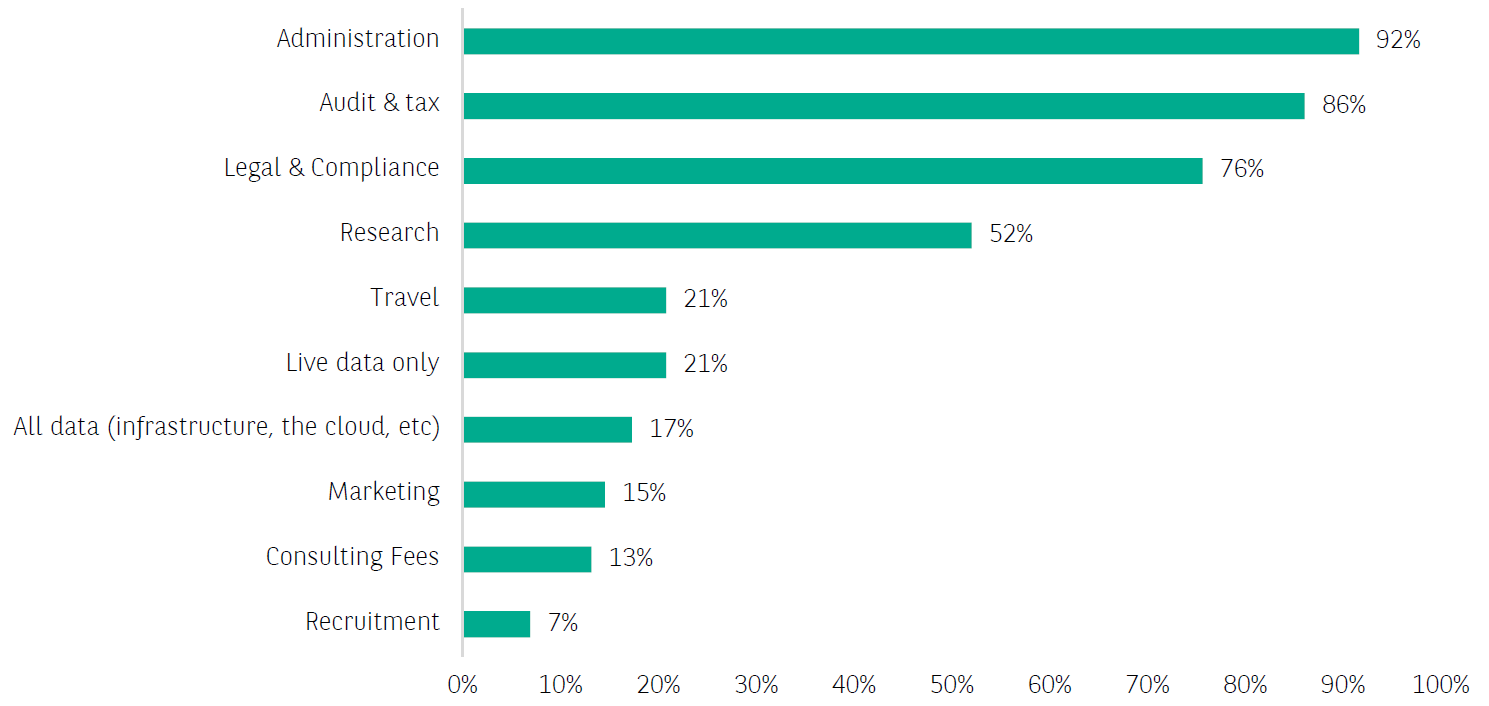
Source: BNP Paribas Hedge Fund Outlook –Manager Questionnaire, 2026 (as of Jan 2026)
Here's what to demand.
1. Line-item expense schedule — not categories
Ask for a full year of actual expenses by line item, plus the current-year budget and YTD variance. "Miscellaneous" is not an answer. If a manager can't give you this, assume the cost line will drift — because that's how open-ended expense models behave when no one is watching.
The vacated SEC quarterly statement template is still the best benchmark for what good disclosure looks like. Use it as your ask.
2. Budget governance with teeth
Minimum standard: an annual budget, quarterly variance reporting, and defined thresholds that trigger LP notice. Without this, you're not underwriting a fee structure — you're underwriting a manager's future spending decisions with no visibility into what those decisions will be.
3. A clean "not chargeable" list
You want an explicit exclusion schedule. Examples of what should be on it: regulatory fines and penalties, marketing expenses, manager legal and compliance costs that are not fund-specific, and extraordinary items not tied to trading operations. If the manager resists a "not chargeable" list, ask why.
4. Net return objective with a cash hurdle
LPs are increasingly pushing for a T-bill hurdle before incentive fees apply, or a fee reset when net returns don't clear a minimum. This is not exotic. It's an alignment mechanism for a structure where the cost base doesn't reset with performance. Push for it. If you don't get it, price the asymmetry.
5. Investor share of gross — reported explicitly
This is the single most useful KPI for a pass-through fund. Ask for it to be reported quarterly:
Gross P&L - Pass-through Expenses Minus Incentive Fee = Net to LP Expressed as LP Share of Gross
Barclays' survey work puts concrete numbers around this concept in the pass-through vs fixed-cost comparison. In a well-run pass-through fund in a good year, LP share of gross can be competitive with 2/20. In a mediocre year, it often isn't. Reporting this number quarterly makes the comparison visible in real time rather than retrospectively.
What Good Guardrails Look Like
A workable guardrail package includes five elements:
An all-in cap on fund expenses plus pass-through as a percentage of NAV, with clear carve-outs defined in advance. A category cap structure that limits compensation-related pass-through separately from technology, data, and occupancy. Budget discipline — annual budget, explicit variance bands, and automatic LP disclosure when thresholds are breached. True-up mechanics that specify how overages are handled: does the manager absorb them, rebate them, or carry them forward? And independent verification — audit scope that explicitly includes expense allocation testing, not just financial statement accuracy.
The Maples Group's industry work shows that caps exist but are not yet standard, and that pass-through disclosure norms are still being negotiated across the industry. That's your leverage window. What you can negotiate today is harder to extract once you're already invested.
Allocator Takeaways
Pass-through is not a fee term. It's a governance term: it defines who controls the cost base and who absorbs the consequences when costs rise and performance doesn't.
Underwrite all-in economics, not headline management fees. A 1% management fee with uncapped pass-through is not cheaper than 2-and-20 — it's just less visible until it isn't.
Demand line-item transparency and budget governance. The SEC's vacated quarterly statement template is the right benchmark for what disclosure should look like. Use it.
Guardrails work when they cap the open-ended bill and force trade-offs. "Capped pass-through" is incentive alignment, not just optics — it puts the manager's own economics at risk when costs exceed the guardrail.
The $0.41 number is an average. Your job is to underwrite whether the fund you're evaluating will beat it — and to make sure you have the reporting to know the answer quarterly, not annually.
Resonanz insights in your inbox...
Get the research behind strategies most professional allocators trust, but almost no-one explains.