
Rising AUM isn't proof of skill. It's often the first sign of capacity constraints — and what to check before committing more capital.
5 min read | Jul 20, 2026
A manager triples assets in three years and every IC memo calls it validation. Bigger book, more institutional interest, stronger franchise. Almost nobody in the room asks the only question that actually matters: at what size does this stop working?
Capacity isn't a footnote. It's a number every strategy has, whether the manager has calculated it or not, and it's one of the few risks in this industry that nobody is paid to disclose.
Aggregate Hedge Fund Gross Asset Value (USD)
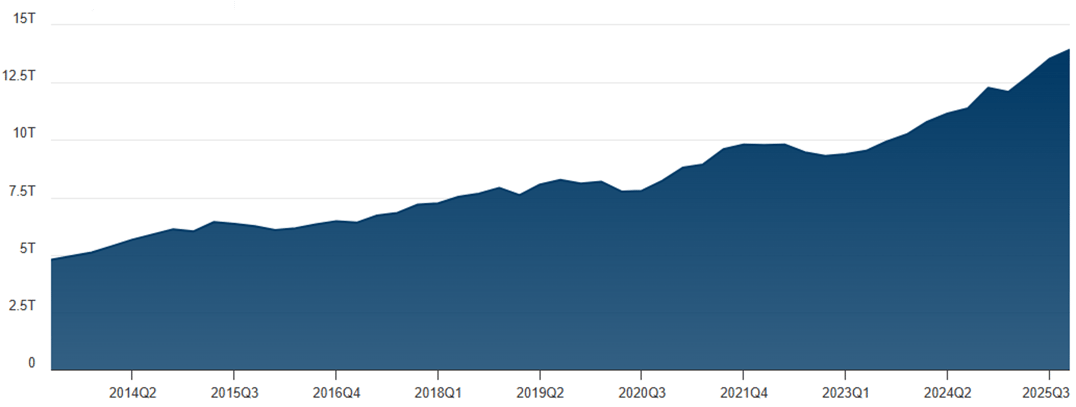
Source: SEC; data as reported on Form PF
How a strategy actually runs out of room
A signal doesn't fail at scale because the idea stops being true. It fails because executing it gets expensive. Bigger positions move prices against you going in and coming out. Slippage eats the edge before it shows up in the return stream. None of this requires a market crisis. It just requires more capital than the opportunity can absorb without the fund itself becoming the price-setter.
Academic work on this goes back further than most investors assume. A study across eight hedge fund strategies found that capital inflows statistically preceded declines in alpha for four of them — inflows came first, underperformance followed, not the other way around1 . A more recent paper built peer "cohorts" of funds running correlated strategies and found the same pattern holds when crowding is measured at the strategy level, not the single fund: returns degrade as the whole cohort's combined AUM grows, regardless of any one manager's individual size2.
That second point matters more than it sounds. A fund can look appropriately sized on its own balance sheet and still be running out of room, because ten other managers are quietly crowding the same trade alongside it. The capacity constraint isn't the fund's problem to solve. It's the strategy's.
It's already happening, not a hypothetical
This isn't abstract. European long-short equity has been pulling in flows through 2026 as investors look past the US market, and at least two managers have already responded by shutting the door: Helikon Investments capped new capital at roughly $8 billion, and Kintbury Capital introduced capacity constraints with AUM nearing $3 billion.
Both of those are good signs, not bad ones. A manager who closes before the return stream degrades is doing exactly what the research says should happen. The problem is these are the exceptions. Most managers don't close. Fee economics don't reward it — management fees scale with assets, not with discipline — and nothing in the standard due diligence pack forces the question.
Why disclosure won't catch this for you
If you're hoping regulatory reporting fills the gap, the direction of travel argues against you. On April 20, 2026, the SEC and CFTC jointly proposed raising Form PF reporting thresholds significantly: the general filing threshold from $150 million to $1 billion in AUM, and the large-hedge-fund-adviser threshold from $1.5 billion to $10 billion.
If adopted, a meaningful share of funds currently inside the SEC's systemic-risk monitoring perimeter will fall outside it. And even for funds that remain inside, Form PF was built to flag leverage, counterparty exposure, and liquidity terms. It was never built to answer "is this strategy approaching its capacity ceiling." No regulatory filing asks that question today, and the current proposal moves toward less visibility, not more.
What you can actually check
You don't need the manager's internal capacity model to get a read on this. A few things are visible from the outside, in due diligence materials you already receive:
Turnover and concentration trends. A strategy that used to trade a diversified basket and now concentrates in fewer, larger positions is often responding to the same liquidity constraint that shows up later as slippage. Ask for the trend, not just the current snapshot.
Days-to-liquidate metrics. If a fund reports how long it would take to unwind the book without moving the market, watch that number over time relative to AUM. If it's growing faster than the fund's own risk limits assume, that's the capacity ceiling approaching in real time.
A closing history — or the absence of one. Ask directly: has this strategy ever turned away capital, reduced fee tiers to slow inflows, or closed to new investors at any point? A manager with no answer to that question, across a multi-year track record and meaningful AUM growth, has either never approached capacity or has never been willing to say no. Both are worth knowing before you allocate more.
Peer cohort AUM, not just fund AUM. Per the cohort research above, the number that predicts degradation isn't your manager's balance sheet. It's the combined size of every fund running a correlated version of the same trade. That's harder to get precisely, but a rough estimate from prime broker positioning data or public 13F-style filings for correlated public strategies is better than assuming your manager exists in isolation.
Resonanz insights in your inbox...
Get the research behind strategies most professional allocators trust, but almost no-one explains.