
A bumpy ride is not an investment thesis.
5 min read | Sep 21, 2026
“You have to own this strategy through the cycle.”
Fair enough. Good managers have bad years, and even a sound investment process can disappoint for longer than anyone would like. Selling every time that happens is unlikely to end well.
The part I question is what sometimes comes next: if you can live with the volatility of a concentrated stock portfolio or a directional macro strategy, you should expect better long-term returns than you would get from a smoother, less market-dependent alternative.
There may be a good reason to expect that. But “you need to be patient” isn’t one.
A worthwhile investment may require patience. That does not mean an investment requiring patience is worthwhile.
This matters most when things go badly. A manager makes money, and we credit the investment process. The manager loses money, and we remind ourselves to take a longer view. Both responses can be reasonable. But if those are the only two possible conclusions, when would we ever decide that the investment wasn’t working?
I suspect this argument appeals to us partly because it fits a story we’ve heard all our lives. Work hard, make sacrifices, resist the easy option, and eventually you’ll earn the reward. We bring some of that thinking into investing. Conviction and discipline sound admirable. Looking for a smoother ride can sound like wanting something for nothing.
Yet an investor who finds a way to earn the same expected return with less risk has made a better trade-off. There is no extra merit in accepting volatility that serves no useful purpose.
Of course, some uncomfortable risks do have a good reason to pay. Investors may demand a lower price for an asset that tends to lose money just when they most need their capital. Buying at that price can offer an attractive expected return. A manager may also have an insight that takes years to pay off.
Those are investment cases we can examine. We can ask whether the price is attractive or whether the manager’s insight is credible. Knowing that the journey will be difficult doesn’t answer either question.
What makes this frustrating is that the distinction is familiar from textbook finance. CAPM allows an expected premium for market beta. It offers no additional reward simply for putting more money into a handful of companies and taking risks that could have been diversified away. This is standard CFA material.
Concentration may still make sense if a manager has enough skill to justify it. The same goes for a large macro position. But we need a reason to believe the extra risk improves the expected outcome after costs.
And we should be just as demanding of the smoother alternative. A market-neutral strategy needs a source of return too. Low correlation doesn’t create one, and a smooth track record can hide funding problems or losses that simply haven’t happened yet. Both managers have something to explain.
A simple example helps separate the amount of risk from what we expect to earn for taking it:
$$E[R]-r_f=S\sigma.$$
Expected return above cash equals the expected Sharpe ratio, (S), multiplied by volatility, (\sigma). Taking more risk is only part of the equation; the expected return per unit of risk matters as well.
Suppose we are looking at these two hypothetical strategies:
| Strategy A | Strategy B | |
|---|---|---|
| Expected annual return above cash | 6% | 4% |
| Annual volatility | 15% | 5% |
| Expected Sharpe ratio | 0.40 | 0.80 |
As they stand, A has the higher expected return. B has the better expected return for each unit of volatility.
Now suppose we could increase our exposure to B to 1.5 times its original size, borrowing at the cash rate and leaving the underlying strategy unchanged. Its expected return above cash would rise to 6%, with volatility of 7.5%. We would have the same expected return as A, at half the volatility.
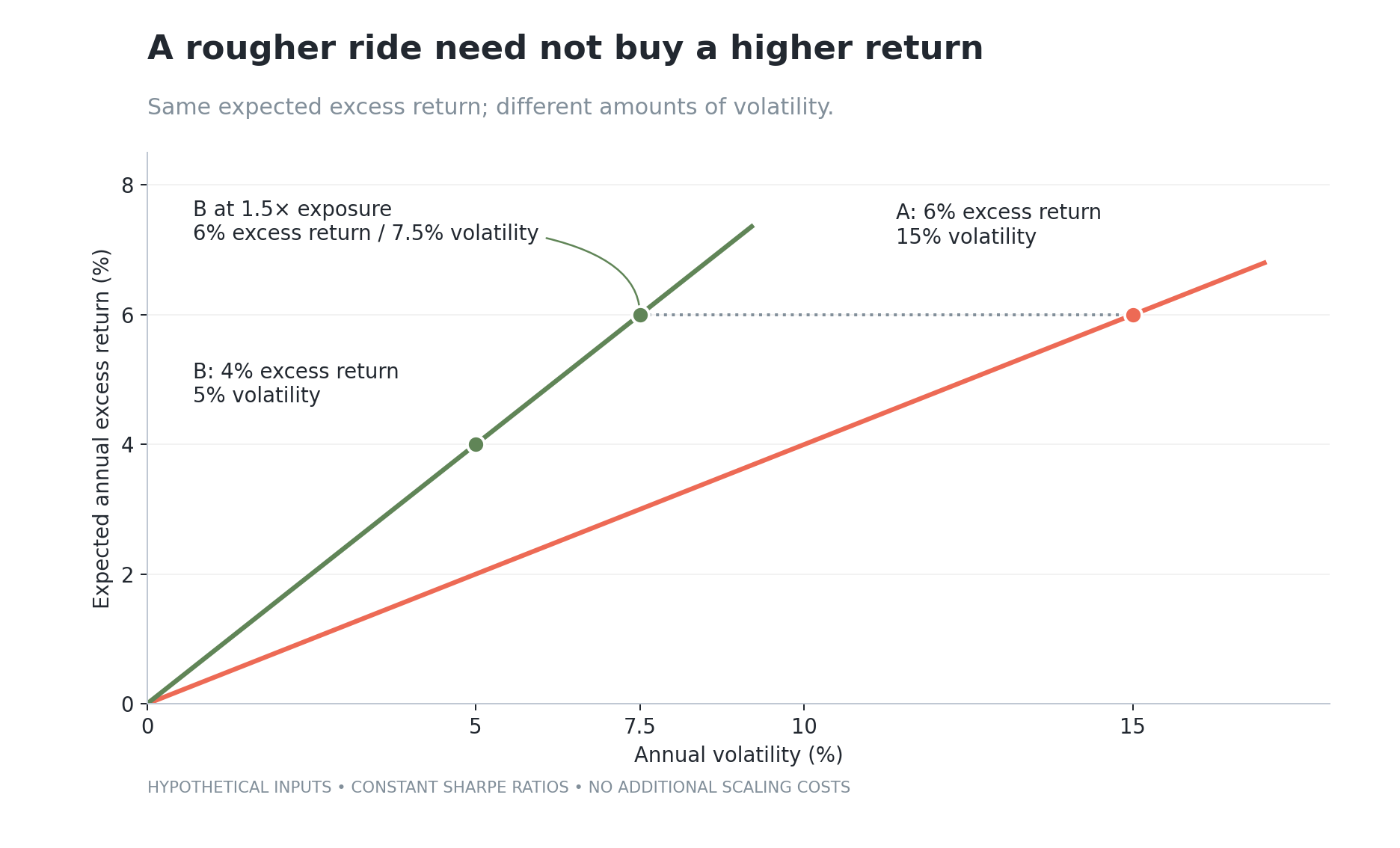
Illustrative assumptions, not observed performance or forecasts. Scaling assumes financing at the cash rate and no additional implementation costs or changes in capacity, liquidity or the return process.
Finding and implementing B is another matter. Borrowing may cost more. Capacity may be limited. Margin calls may make the extra exposure impractical. For some investors, those constraints could make A the better choice.
But we would then know why we preferred A. Its bumpier ride, and our willingness to put up with it, wouldn’t be the explanation.
Diversification can improve the trade-off too. Combining strategies that don’t move together can reduce volatility while preserving their weighted average expected return. We can keep that lower risk or, where practical, take more exposure. There is no requirement to accept every bump in an individual strategy just because we like its return potential.
A longer holding period doesn’t change the need to make these comparisons.
It can give an investment time to work, reduce trading costs and help us avoid selling under pressure. Those are real advantages. But waiting doesn’t tell us whether we chose well in the first place, or whether the investment still deserves its place in the portfolio.
A loss doesn’t make a recovery more deserved, either. A company’s shares may now be cheaper and more attractive. Or its business may have deteriorated enough to justify the fall. We have to revisit the investment case to tell the difference.
Before accepting “stay the course”, I’d want answers to three questions:
- Where should the return come from, after fees and financing?
- Why is this a better use of our capital than the alternatives we can actually invest in?
- What would make us change our mind?
Sometimes those answers will give us good reason to sit through a difficult period. Sometimes they’ll tell us that our patience would be better spent elsewhere. Either way, we should be able to explain what makes the investment worth holding beyond the fact that we’ve already endured the losses.
Patience can help you capture a return. It cannot create the reason that return should exist.
Resonanz insights in your inbox...
Get the research behind strategies most professional allocators trust, but almost no-one explains.