
Private credit still offers a spread pickup. But investors may surrender part of that advantage for smoother valuations, just as liquidity terms become more important.
6 min read | Oct 19, 2026
The private-credit spread is real. Whether the illiquidity premium survives smoothed marks, fees and credit losses is a separate question, and for investors who cannot choose their exit date, the answer is less comfortable.
Private-credit investors aren't naive about quarterly marks. Loans rarely trade, and appraisal-based NAVs move more slowly than prices in public credit markets. For an institution prepared to hold to maturity, that can be perfectly manageable. There is some comfort in a return series that does not lurch around every time spreads widen.
In his 2019 essay The Illiquidity Discount?, Cliff Asness asked whether investors like that comfort enough to pay for it. If they bid up assets with smoother reported returns, the expected return falls. The premium for holding an illiquid asset could shrink even though the asset has become no easier to sell.
The issue becomes more pressing when investors cannot choose their exit date. Evergreen and semi-liquid credit funds offer periodic redemptions, but the loans in their portfolios may take months to sell. A fund that needs cash eventually has to test its marks against market bids.
How much of the premium survives?
The spread pickup in private credit is visible. PitchBook LCD put the new-issue direct-lending premium over broadly syndicated loans at 162 basis points in the three months through August 2026, around 39 basis points higher than in the first quarter. Recent redemption pressure has also helped direct lenders regain some pricing power.
The Gross Spread Premium Is Still There
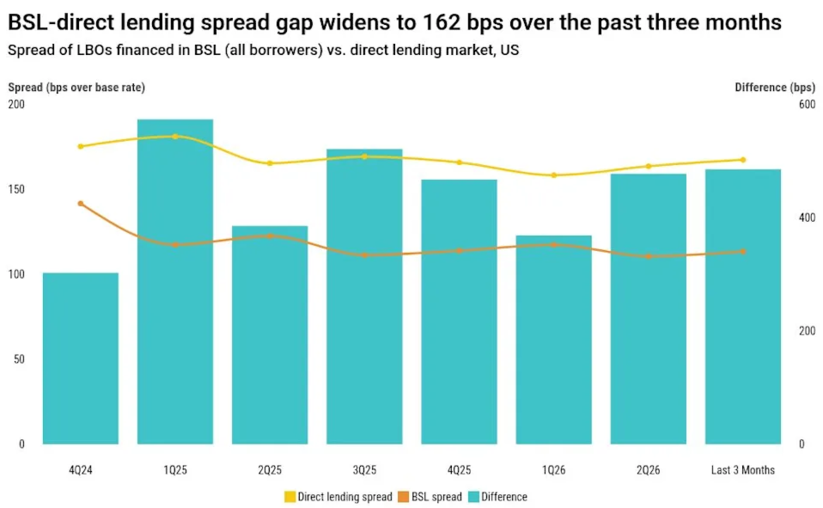 Source: PitchBook LCD, reported by PitchBook News, 10 September 2026. The Q1 premium is implied from the reported 39 bp increase.
Those extra basis points matter. They compensate for more than the inconvenience of holding an illiquid loan. Direct-lending borrowers and loan structures differ from syndicated credits, and investors may face weaker borrower liquidity, concentrated exposures, limited exit options and different underwriting standards. Fund fees, leverage and eventual credit losses determine how much of the spread investors keep.
Then comes Asness's argument. If buyers accept a lower expected return for a smoother reported experience, competition can eat into the spread they hoped to collect. There is no reliable basis-point estimate for this effect in private credit. The observed premium is real; whether it is enough after costs and risks remains an underwriting question.
Traded prices often move first
Most private loans are valued using models, comparable transactions and manager judgment. These marks can adjust slowly when required credit spreads rise or a borrower weakens.
In an August 2026 working paper, Reena Aggarwal, Isil Erel and Changyong Song studied listed business development companies (BDCs). BDC shares trade daily, while their loan portfolios are marked periodically. Weak share performance and widening discounts to NAV helped predict later NAV markdowns. Share discounts also reflect leverage, fees and investor sentiment, so they cannot be used as direct estimates of loan-sale prices.
But March 2026 data showed a related divergence. At the 25th percentile, BDC loan marks stood at 97.51 cents on the dollar, against 94.95 cents for broadly syndicated loans. These are different loan populations, so the comparison does not establish mispricing. It does give investors a reason to look more closely when private marks stay steady as traded credit reprices.
25-th Percentile Loan Prices
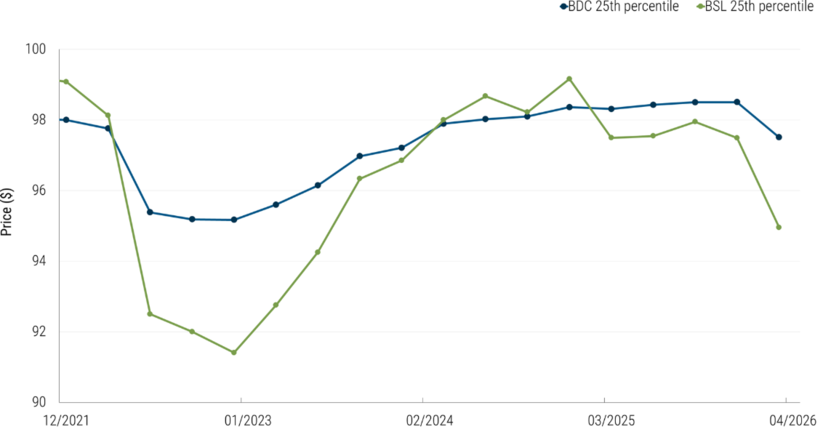 Source: PIMCO, PitchBook and Morningstar, 31 March 2026. The two loan populations are not directly comparable
Senior floating-rate credit deserves a qualification. Contractual cash flows and limited duration exposure can genuinely temper economic volatility. A loan can still lose value before it misses a payment, especially if borrower credit quality deteriorates or the market demands a wider spread.
When investors cannot wait
A pension fund or insurer with predictable liabilities can often wait for repayments or maturity. It may have no reason to sell during a downturn. An evergreen fund with quarterly redemption windows faces a different problem. Investors can ask for cash even when finding buyers for the underlying loans would require price concessions.
Blackstone Private Credit Fund (BCRED) provides a recent example. In both the second and third quarters of 2026, investors requested repurchases equal to roughly 10% of shares outstanding. The fund met, or expected to meet, about 5% each quarter under its normal limits. Blackstone reported approximately $17 billion of available liquidity in September. These figures do not imply distressed sales. They show redemption demand running ahead of the fund's scheduled repurchase capacity.
Redemption Requests Exceed The Quarterly Limit
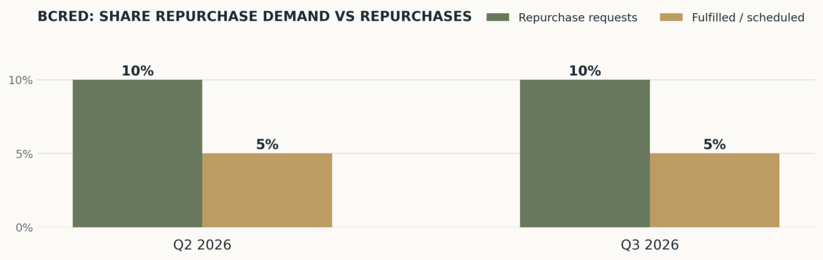 Source: BCRED shareholder letters filed with the SEC, 4 June and 3 September 2026. Approximate figures; Q3 repurchases were expected as at 3 September
Repurchase limits protect a fund from having to sell too much at once, although some investors must wait. If the manager sells loans below carrying value, the lower price becomes a realized loss. If an exiting investor receives a NAV above what the assets could fetch, remaining holders may bear the difference. The timing of the mark starts to matter when someone has to transact.
Underwrite the exit alongside the loan
The starting point for an investor is expected return after fees and credit losses, compared with genuinely similar traded credit. Look at how NAVs respond when loan spreads widen. Where possible, compare marks with prices achieved in actual secondary transactions. Historical Sharpe ratios and correlations offer limited reassurance when marks are slow to move.
Then test the liquidity terms. Match redemption limits against cash holdings, expected loan repayments and borrowing capacity. Review non-accruals, payment-in-kind income, borrower coverage and concentration. Stress the portfolio for a period in which redemption requests rise while bids for loans weaken. A stable NAV is of little use to an investor who needs cash before the vehicle can provide it.
Asness's argument does not establish that every private-credit investor pays for smoothing. It does challenge the assumption that an illiquidity premium can be read straight from a spread comparison. That premium can be attractive for patient capital. An investor who may have to exit on someone else's timetable also needs compensation for the price of getting out.
Resonanz insights in your inbox...
Get the research behind strategies most professional allocators trust, but almost no-one explains.