
Regime-conditional analysis reveals two distinct failure modes that any static multi-strategy QIS allocation runs into — and what it actually takes to do better.
4 min read | Jun 22, 2026
Most multi-strategy QIS portfolios are less diversified than they look. The strategies are there — sometimes more than sixty of them. What's missing is the right weights for the regime the market is actually in.
A static allocation doesn't solve this. It assumes the regime mix of the next decade will look like the last one. It won't. And when it doesn't, the portfolio runs into one of two failure modes that are entirely predictable and entirely avoidable.
Your weights are probably wrong for the current environment
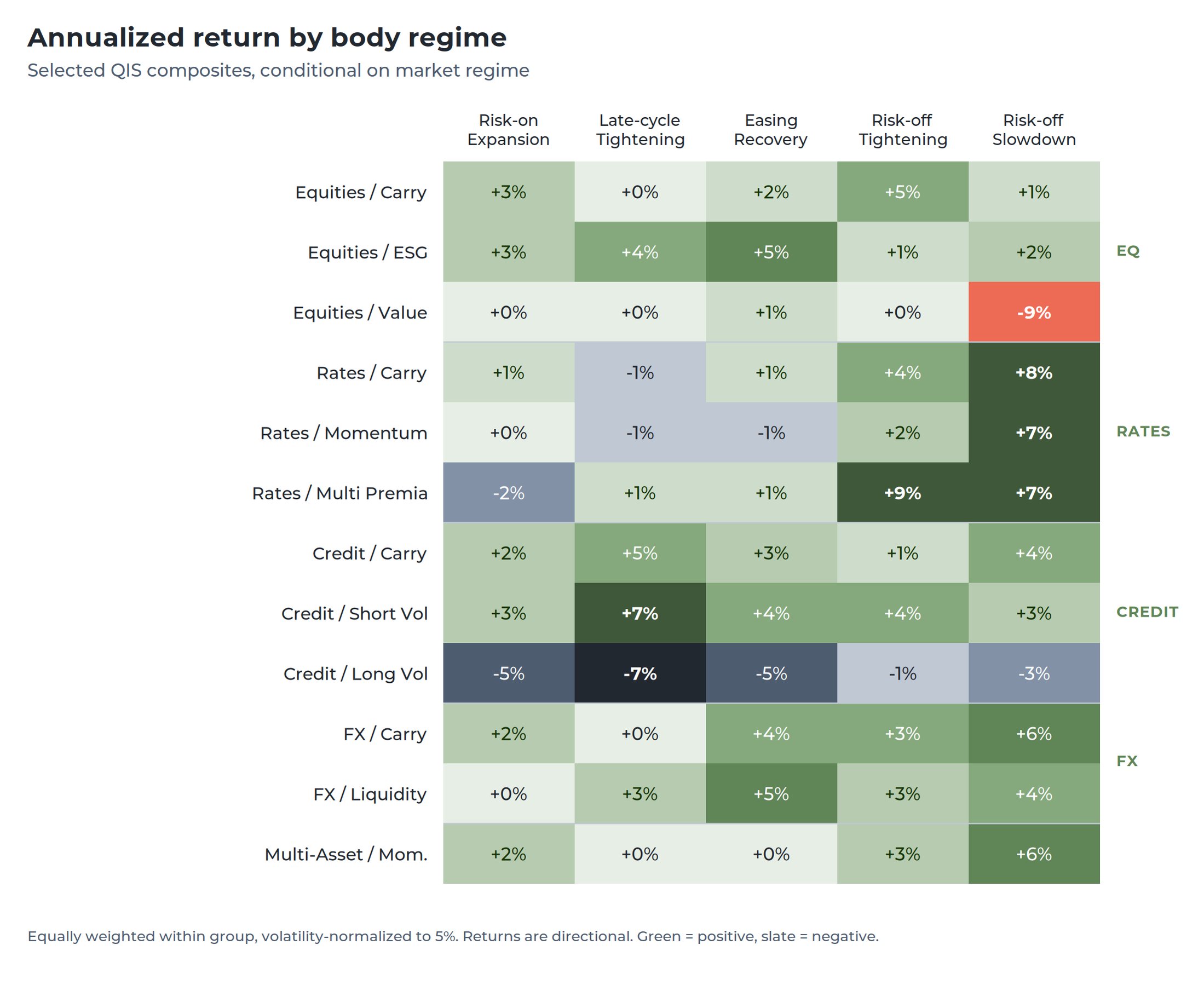
The heatmap shows annualized returns for a selection of QIS composites across five market regimes, each volatility-normalized to 5%. The pattern is unambiguous. Rates composites — flat or negative in calm environments — return +7 to +9% in Risk-off regimes. Equities/Value, which does nothing in four regimes, drops -9% in Risk-off Slowdown. FX strategies lead Easing Recovery and lag everywhere else.
A static portfolio that holds all of these in fixed proportions is structurally underweight whatever happens to be leading. That is not diversification — it is regime-averaged mediocrity. The wider the toolbox, the more return you leave on the table if you're not positioned correctly.
Failure mode one: you're paying for protection that fails in two out of three crises
Long Volatility strategies are designed to bleed slowly in normal conditions and pay off in stress. The question is whether that's actually the deal you're getting.
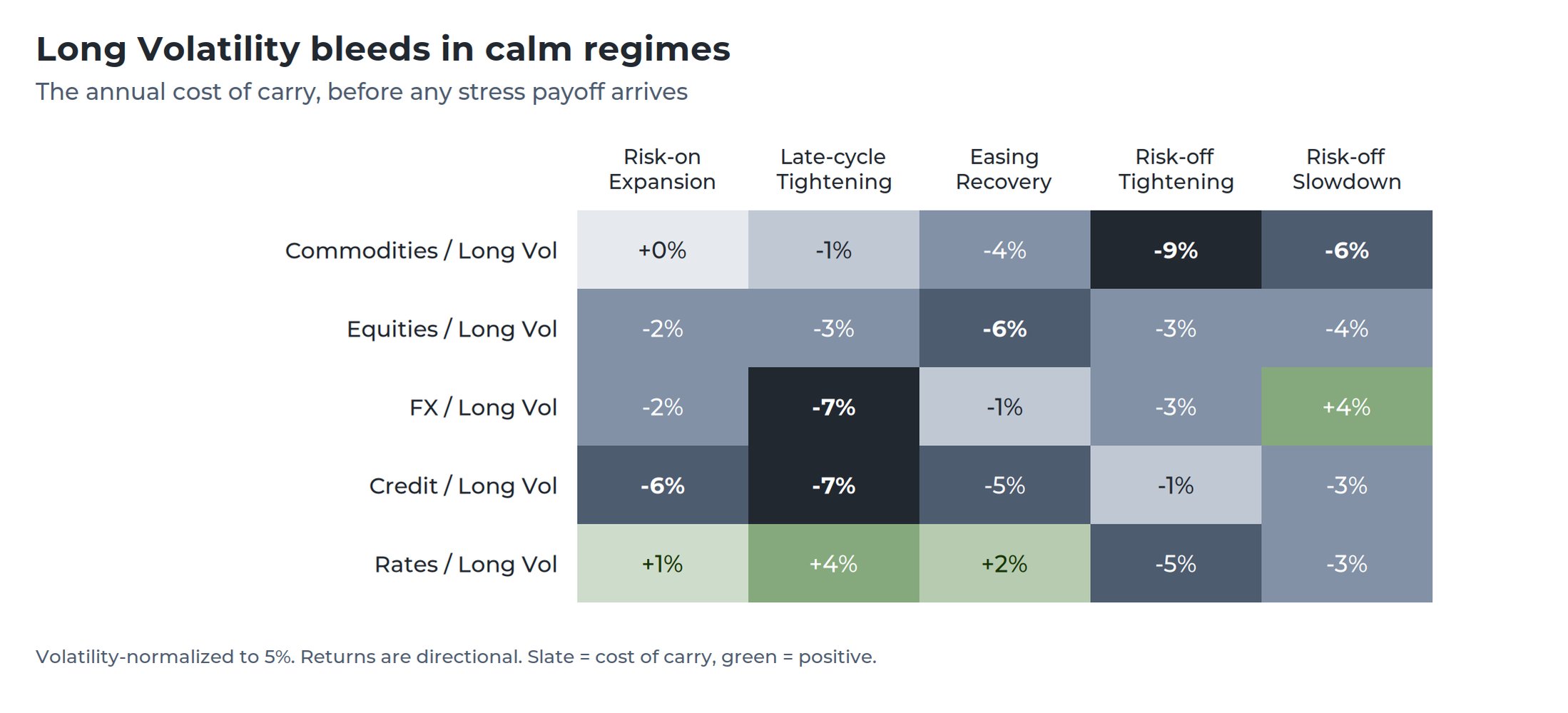
In normal conditions, the carrying cost is real. Credit/Long Vol loses 5–7% per year across most regimes. Commodities/Long Vol loses 4–9%. These are not rounding errors — they are the annual price of protection that may or may not arrive when you need it.
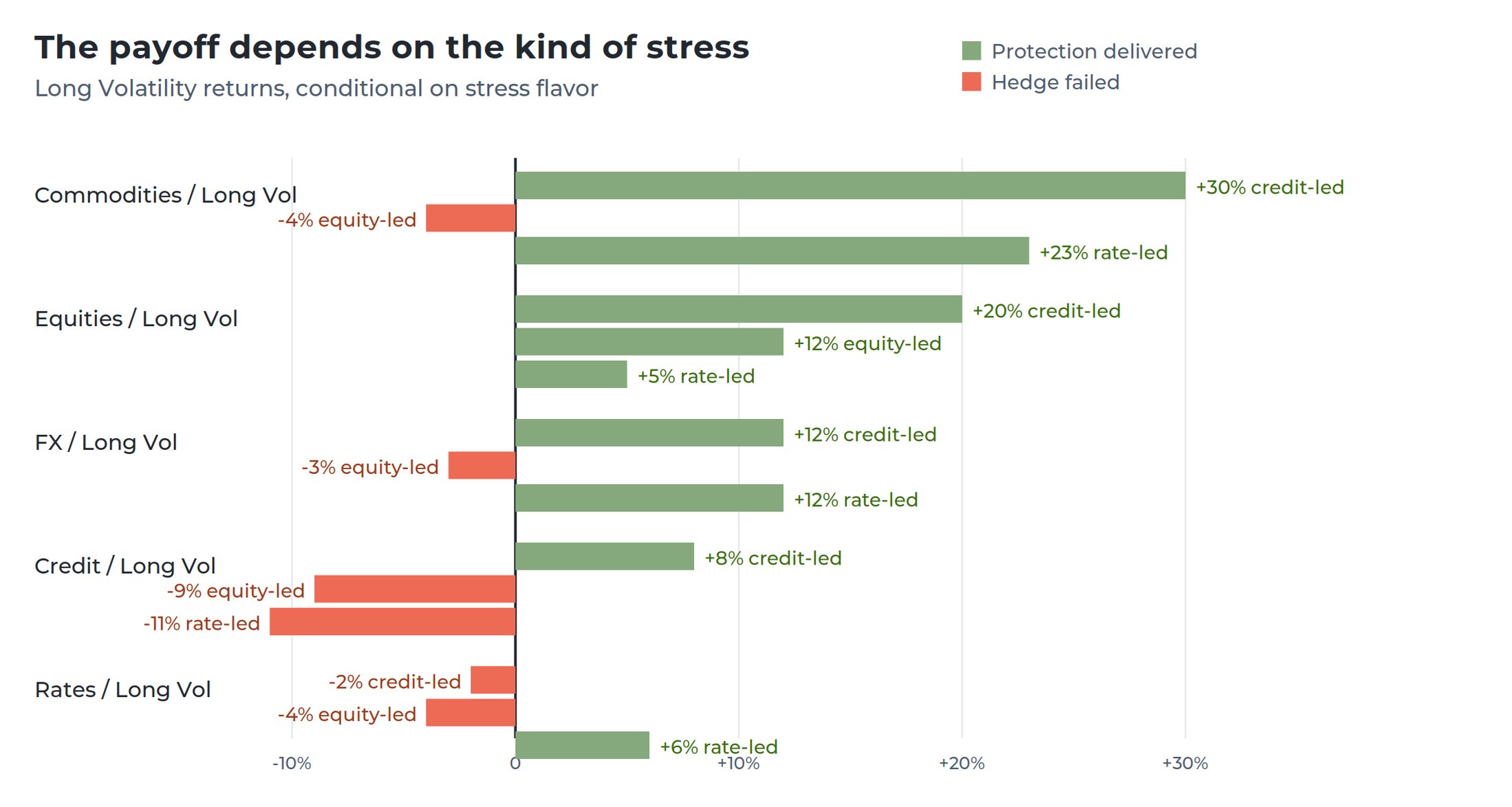
When stress does arrive, the payoff depends entirely on which kind. Equities/Long Vol is the most consistent — +20% in credit-led stress, +12% in equity-led, +5% in rate-led. Credit/Long Vol is the problem case: +8% in credit-led stress, but -9% in equity-led and -11% in rate-led. The strategy most investors reach for as a credit hedge fails in two of three stress scenarios while costing 5–7% per year in carry.
You are paying continuously for coverage that is conditional on the stress flavor matching the composite you happen to hold.
Failure mode two: your strongest performers are hiding their worst risk
Short Volatility looks like the opposite problem — and it is more common, because it looks like skill during calm periods.
Short Vol strategies earn a premium for selling optionality. In normal regimes, they carry well. Credit/Short Vol returns +7.6% in Late-cycle Tightening. Attractive Sharpe, sensible risk-adjusted return. The problem is what that number is hiding.
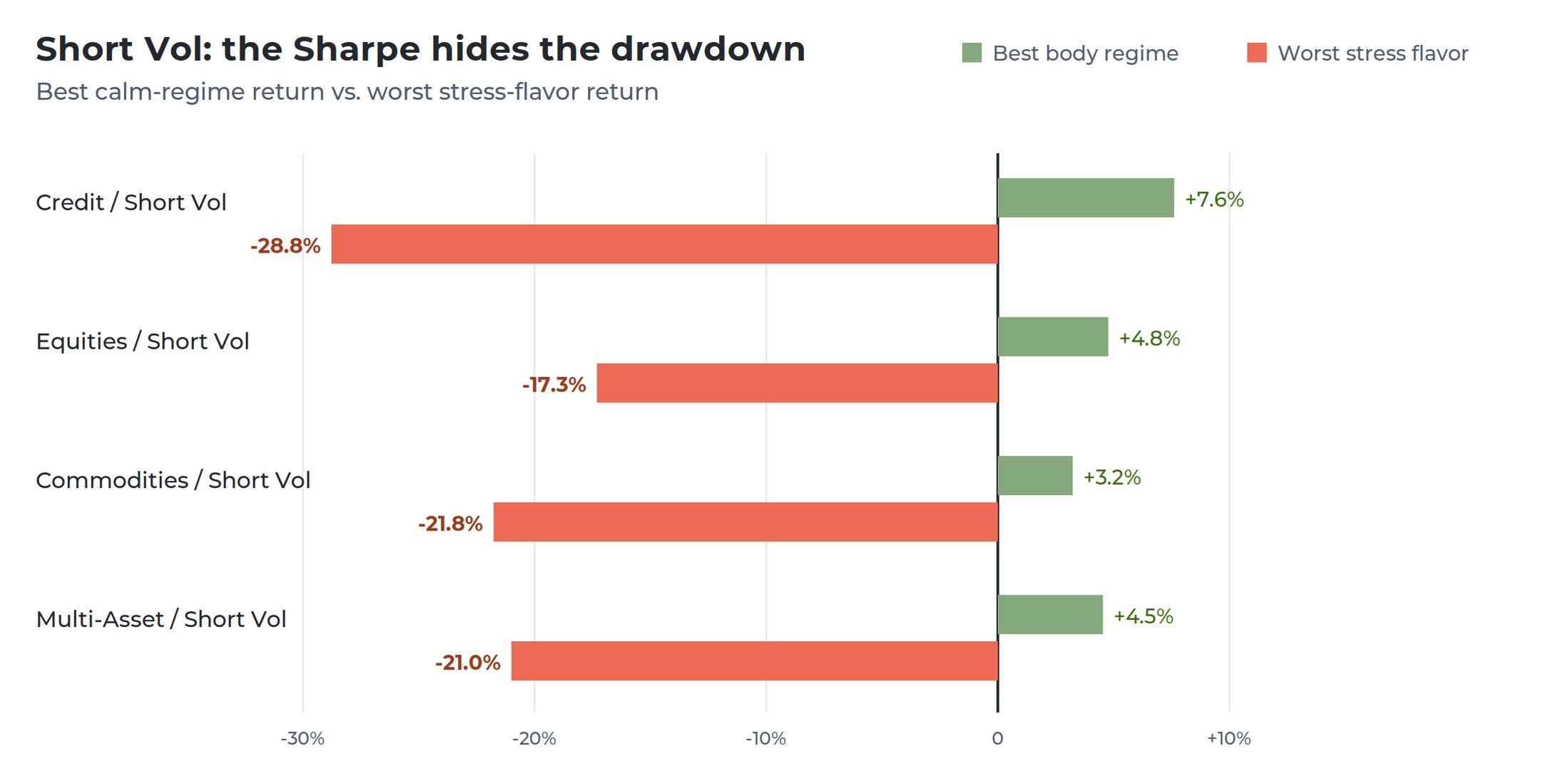
The same strategy loses -28.8% in rate-led stress. Equities and Commodities Short Vol lose -17% to -22%. The strategy is not broken — it is doing exactly what it was designed to do. The mistake is treating a full-sample Sharpe ratio as a risk measure when it is a regime-conditional average. The risk doesn't appear in the Sharpe until it has already appeared in your P&L.
Most static QIS books end up with more Short Vol than intended, because Short Vol systematically looks like the best risk-adjusted performer during quiet years. Then the regime shifts.
The part most "be dynamic" arguments skip
Showing that regimes matter is the easy part. Acting on them is a forecasting problem, and there is no honest way to pretend otherwise. The moment you reweight in anticipation of conditions holding or turning, you are making a prediction. The question is not whether you forecast. It is what kind of forecast, and whether the edge survives the noise.
We do not think the edge lies in predicting regimes alone. The signal in any single composite is too thin and too noisy for that to be a business. What matters too is breadth — spreading many small, weakly-related judgments across a wide enough set of strategies that no single one has to be right for the portfolio to be right.
This is the part worth being precise about. A thin per-bet edge is not a problem if it is applied across enough independent positions; it is the diversification of many imperfect judgments, not the accuracy of any one of them, that does the work. The skill is in the breadth and the measurement, not in calling the turn.
Fixed weights applied to a regime-sensitive toolkit produce portfolios that simultaneously overpay for the wrong type of protection and underallocate to whatever the current environment is actually rewarding. There is no static allocation that solves this.
The harder question is how far the alternative can be pushed — how cleanly a regime can be measured in real time, and how much independent breadth a multi-strategy book can genuinely sustain.
Resonanz insights in your inbox...
Get the research behind strategies most professional allocators trust, but almost no-one explains.