
Capacity is not only a fund getting too big. It is every dollar chasing the same return, and in 2026 they are arriving together.
6 min read | Nov 16, 2026
An edge is a finite resource. A strategy earns its returns from a specific mispricing, and that mispricing has only so much room in it. The success that reveals the edge is also what fills the room: capital arrives chasing the returns, until the returns it came for are gone.
In 2026 the capital is arriving fast. After hedge funds returned around 7% in the first half, against a long-run first-half average closer to 4%, Goldman Sachs found net demand at a record high, with almost half of surveyed investors planning to add to hedge funds in the second half and only 3% planning to cut. For the first time in five years, every major strategy drew positive net inflows. This is usually read as a question of individual funds growing too large. The more useful version is harder to see: a strategy can run out of capacity without any single fund raising another dollar.
The money is arriving in one direction
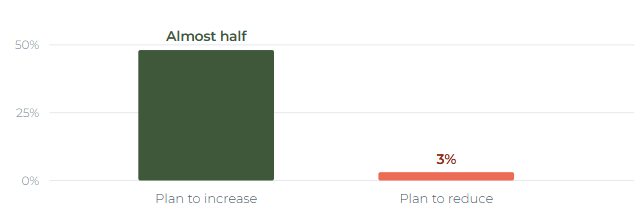
Source: Goldman Sachs, reported July 2026. Record demand, pointed one way. A Goldman Sachs survey of 341 investors overseeing more than 1.5 trillion dollars found net demand for hedge funds at a record high, with almost half intending to add exposure in the second half of 2026 and only 3% intending to cut.
That it is a problem of fund size at all is the familiar version of the argument, and we looked at that question in Does Size Really Matter?. What follows is the sharper one: capacity is shared, and the capital now flooding into the same strategies is spending it for everyone.
Capacity belongs to the strategy, not the fund
A strategy's capacity is a property of the opportunity, not of whoever happens to run it. A relative-value trade, a systematic signal, a crowded position: each can absorb only so much money before the opportunity thins, and that limit is reached by all the capital pursuing it together, across every fund. Two managers can each sit well below their own size limit and still compete for the same trade, and the trade does not care which of them holds it. A strategy can therefore lose its edge while every fund running it still looks comfortably sized.
The evidence points this way. In a study of hedge-fund capacity, Forsberg, Gallagher and Warren found that a fund's future performance is more reliably related to its cohort size, the assets run in the same strategy across the industry, than to the fund's own size. The crowd, not the fund, is the better predictor of what comes next. Related work on the industry reaches the same place: returns depend on scale at both the fund and the strategy level. The question to carry into diligence changes accordingly. It is not only "is this manager too large?" but "how much capital is already competing for this return, and what does that leave for the next dollar?"
The alpha runs out at the strategy's limit, not the fund's
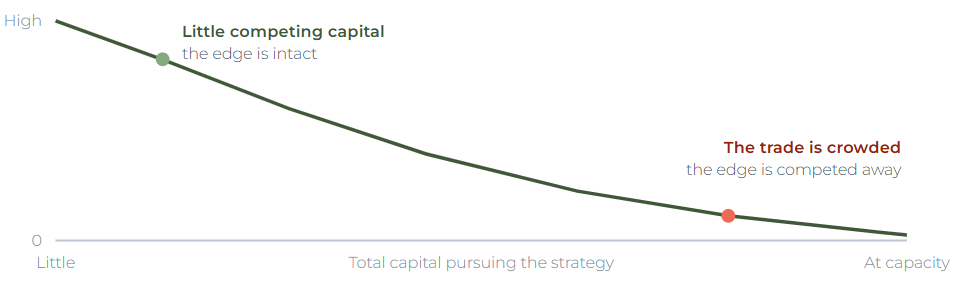
Source: Illustrative, not a specific strategy. The limit is the opportunity's, not the fund's. A schematic of the expected alpha after fees available to a new dollar, against the total capital pursuing the same strategy across all funds. The equilibrium is an abnormal return competed back toward normal, not the disappearance of returns or of manager skill.
Why scale changes the economics
Whether the capital sits in one fund or spreads across many, the mechanics that wear down the edge are the same. A larger position means larger orders, and larger orders move the price before the trade is even built, so each one starts further underwater. Few profitable signals stay proprietary for long, and when many managers run the same one the crowd competes the return away and turns the exit into a stampede. Capital with more to deploy than the best ideas can absorb has to spread into second-choice trades, hold more cash, or hug more liquid names with thinner edges. Each of these is a tax on scale, and in a crowded strategy it is paid by everyone in the trade, not only the fund that grew .
Why managers don't always protect capacity
If crowding erodes the return, why does the capital keep coming, and why do managers keep taking it? Because the economics of the management company and the economics of the strategy pull in different directions. Fee income rises with assets even as the return on each dollar falls, so the business is better off a little past the size where the strategy works best. That pull is real, but it is not the whole story: performance fees, a manager's own capital in the fund, and the franchise value of a durable record all pull back toward protecting returns. Where a manager lands depends on how the fund is owned and who bears the cost of growth.
The rare example that caps itself is instructive for what it shows, not what it proves. Renaissance holds its Medallion fund near ten billion dollars, returns its gains rather than compounding the base, and has been closed to outside money for two decades, all to keep the strategy small enough to work. It shows the discipline is possible, not that every manager who keeps raising is failing investors. A soft close or a return of capital is a signal that a manager is weighing the strategy's marginal return against its own fee base, which is the trade-off worth watching.
Capacity is a portfolio constraint
Because the limit belongs to the strategy and not the fund, capacity is a question for the whole portfolio rather than for any one manager in it. Building a portfolio of return sources means asking, for each one, how much capital is already pursuing it, how its expected contribution changes as more arrives, and where the next dollar still earns its place. Two engines that each look fine alone can be the same crowded trade once combined, and a book that has quietly concentrated its risk in a saturated opportunity has run out of capacity even though none of its managers looks too large.
That turns the track record from an answer into a starting point. We have argued that you should decide a manager's role before you read the track record; capacity is why the record cannot be the last word. A strong history is evidence of what worked at a given level of competition. How much of that opportunity is left, and how much a portfolio can add before the next dollar stops earning, is a separate measurement, and it moves as capital floods in. The work is to size each source to the room it still has and to redeploy when an opportunity fills. The objective is not to find managers with space. It is to build a set of return engines where each is held at the size the strategy can still support, and no more.
Resonanz insights in your inbox...
Get the research behind strategies most professional allocators trust, but almost no-one explains.