
Swap spread arbitrage is not the basis trade. Why the negative swap spread is the rental price of bank balance sheet, and why the trade keeps re-forming.
5 min read | Jul 23, 2026
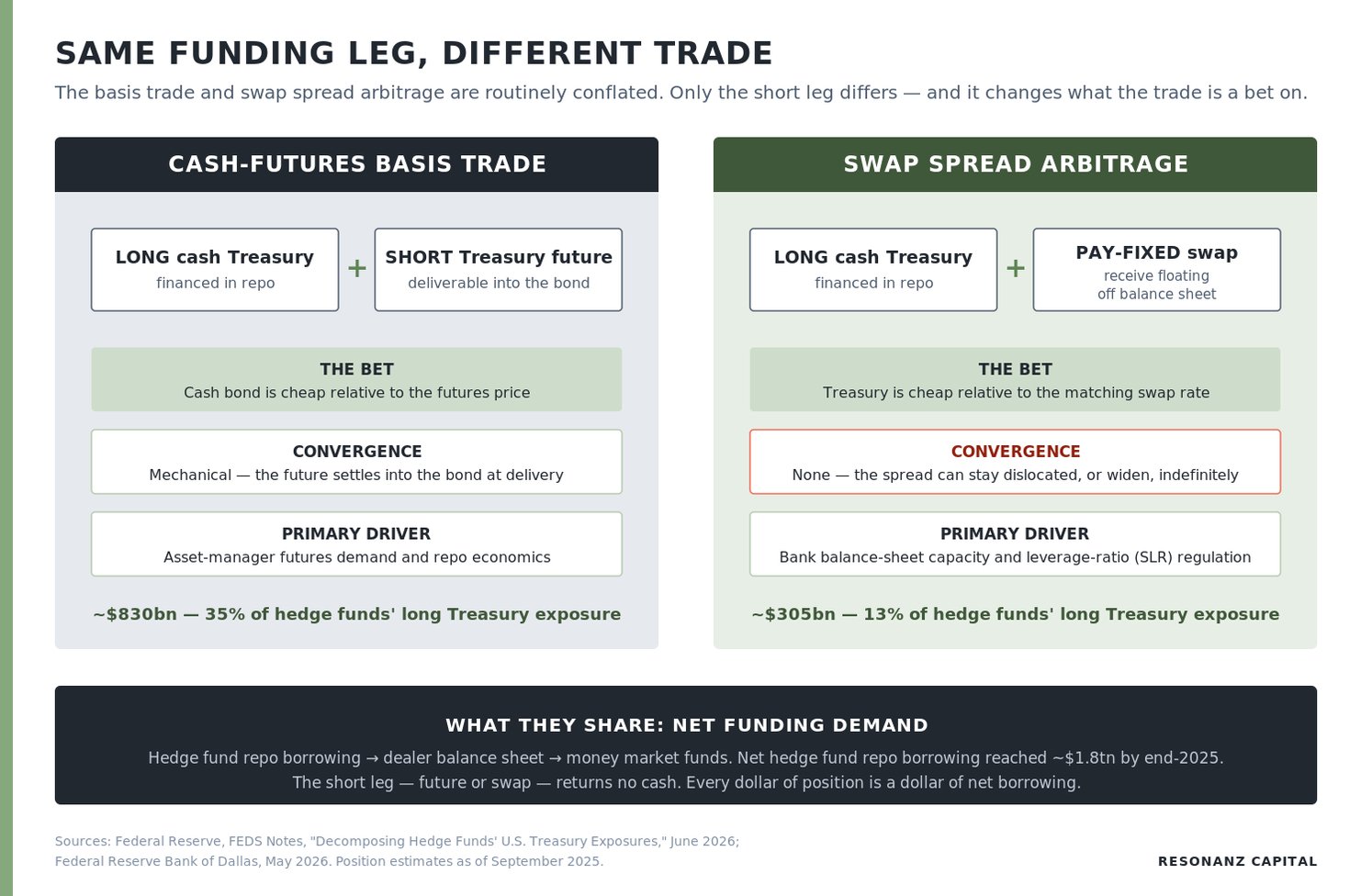
Swap spread arbitrage is not the basis trade. They get lumped together in every discussion of hedge fund leverage in Treasuries. They shouldn't be. Different bets, different risks, different reasons for existing.
The numbers, from the Fed's June 2026 decomposition of hedge funds' $2.4 trillion in long Treasury exposure:
The basis trade: ~$830 billion. Long a cash Treasury financed in repo, short the Treasury future it delivers into. The bet: the bond is cheap versus the future.
Swap spread arbitrage: ~$305 billion. Long the same repo-financed Treasury, paying fixed in an interest rate swap. The bet: the bond is cheap versus the swap.
Same long leg. Same repo funding. The short leg is the whole story.
Hedge Funds’ Estimated Swap Spread Trade Positions
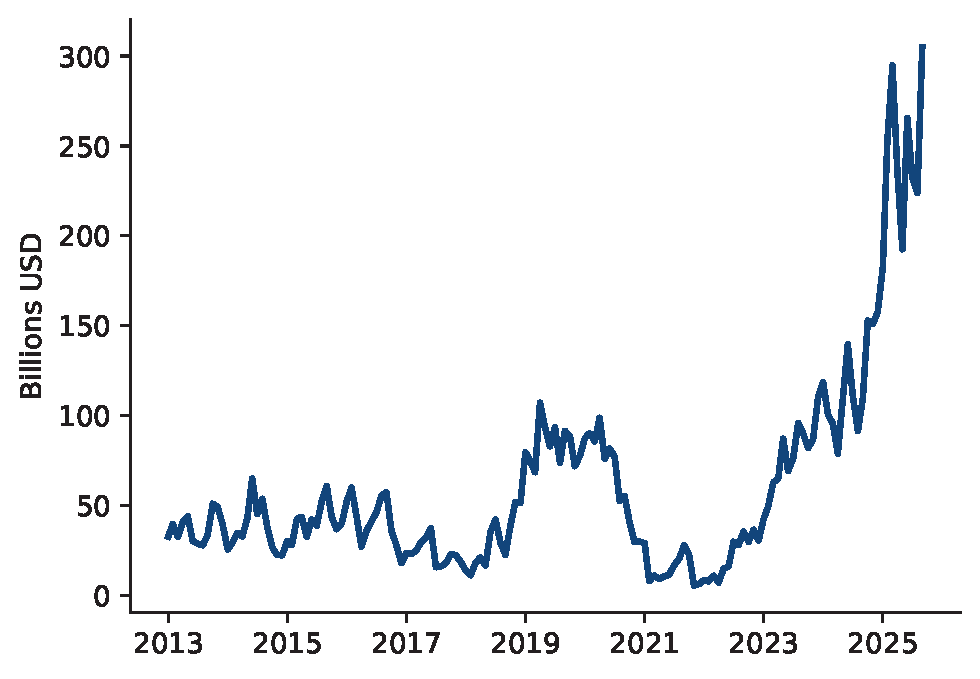
Hedge funds' estimated swap spread arbitrage positions reached ~$305bn by September 2025, recovering fully from the April 2025 unwind. Source: Federal Reserve, FEDS Notes, June 2026.
One trade has a deadline. The other doesn't.
The basis trade converges mechanically: at expiry, the future settles into the bond. You know when you get paid.
Swap spread arbitrage has no delivery date. The spread can stay dislocated, or widen, indefinitely. That is not a detail. It defines what the trade actually is. To see why, you need one counterintuitive fact.
The market pays more to lend to the US government than to banks. On purpose.
Thirty-year swap rates have traded below thirty-year Treasury yields since September 2008. Read literally: lending to a panel of banks yields less than lending to the sovereign. That should be impossible.
It isn't a credit judgment. It is a balance-sheet artifact. A Treasury is an asset; it must sit on someone's balance sheet and be financed. A swap is an exchange of cash flows with no principal; it consumes almost none. Post-2008 leverage rules (the SLR, or Supplementary Leverage Ratio) charge banks capital on total assets regardless of risk. Warehousing Treasuries costs capital. Intermediating swaps barely does.
Add two pressures. Pension and LDI (liability-driven investment) investors get long duration more cheaply in swaps than in bonds, pushing swap rates down. And Treasury issuance has grown ninefold since 2000 while traditional buyers grew fourfold (Dallas Fed). A bond whose natural holders are constrained, and whose supply is not, trades cheap.
The negative swap spread is the rental price of bank balance sheet.
So the trade is a bet on regulation, not on rates.
The two legs offset in duration. The arbitrageur has no rates view. The position earns if Treasuries richen versus swaps, which happens when balance-sheet constraints ease, and loses if the discount deepens.
2024–25 proved the point. The trade grew $175 billion in fifteen months on expectations of SLR relief. When the April 2025 tariff shock hit, spreads moved the wrong way: $60 billion unwound in a month, $40 billion more in May. By September, positions were back to $305 billion.
It did not die. It re-formed. It always re-forms.
Why it keeps coming back
Because the imbalance never left. The Treasury keeps issuing. Real-money demand keeps lagging. Bank balance sheets stay rationed by regulation. Someone has to hold the bonds, and the negative spread is the fee paid to leveraged intermediaries for doing so. After every unwind, the dislocation is still there, usually wider. So the capital comes back.
Treasury supply has outgrown its traditional buyers
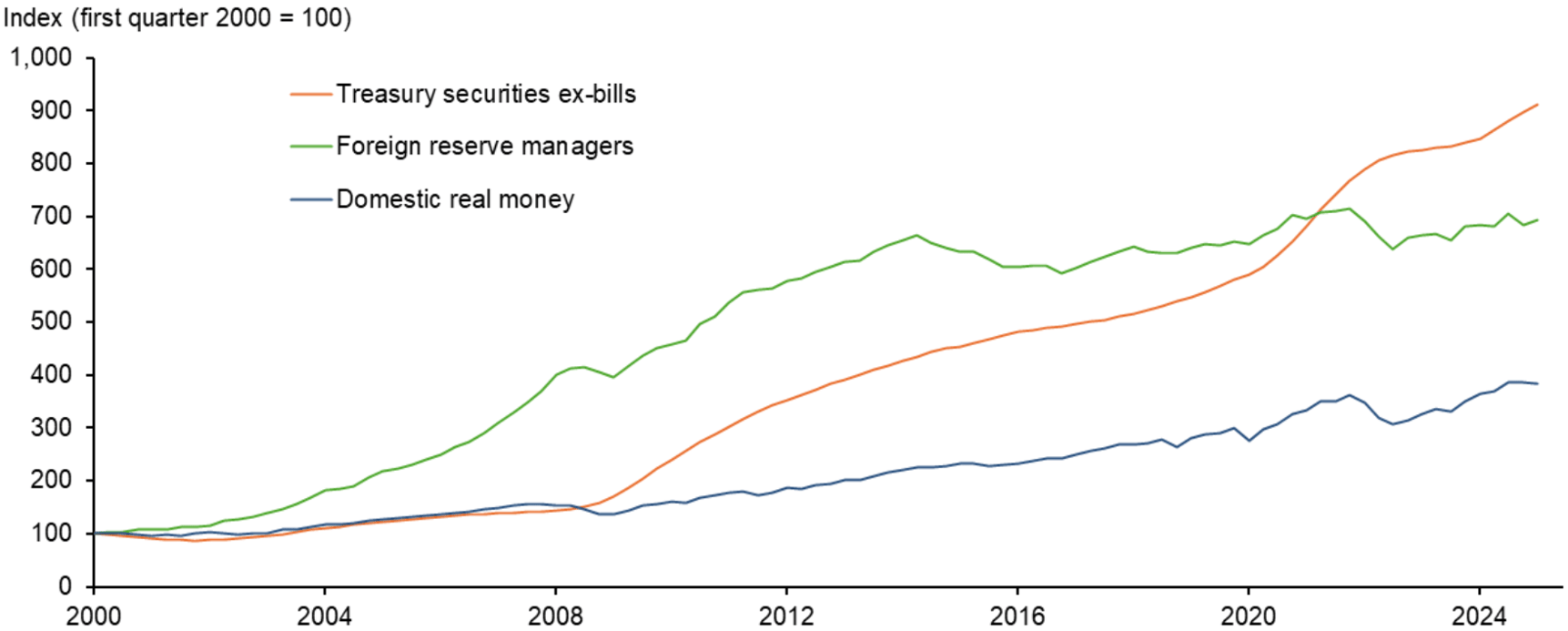
Indexed growth since 2000: Treasury notes and bonds outstanding (~9x) versus foreign reserve managers (~7x) and domestic real-money assets (~4x). This is the structural imbalance behind 'why the trade keeps coming back'.
Source page: Federal Reserve Bank of Dallas, 'Rising hedge fund leverage affects monetary policy implementation' (Kahn & McCormick, May 28, 2026)
You can watch this at issuance. Primary dealers, the banks whose historical job was to warehouse whatever an auction did not clear, now take almost none of it. The same capital rule that makes the swap spread negative makes it expensive for a dealer to hold a bond on its balance sheet at all. The warehousing retreats; the paper still has to be financed by someone; and the negative spread is the fee that pays whoever steps in.
One more shared feature, flagged by the Dallas Fed: both trades are pure funding demand. The short leg, whether future or swap, returns no cash, so every dollar of position is a dollar of net repo borrowing. That stock reached roughly $1.8 trillion by end-2025, and about 90 percent of the exposure sits with the fifty largest funds.
What an investor should take from this
Labels mislead. "Relative value fixed income" contains at least two distinct trades. One converges on a date; one waits on regulation. Size and stress them separately.
The risk lives in the funding leg. Repo term, haircut stability, crowding. Not the bonds. And with dealers now warehousing almost nothing, the intermediation that would cushion a forced unwind is thinner than calm markets suggest.
A regulatory return driver carries regulatory timing risk. SLR reform that arrives richens the position. SLR reform that stalls is a mark-to-market loss with no delivery date to wait for.
Swap spread arbitrage is often described as picking up basis points in the world's safest market. It is better described as selling insurance against bank balance-sheet constraints tightening further. That can be a well-constructed trade, but only if you know that is the trade you own.
Sources:
Federal Reserve, "Decomposing Hedge Funds' U.S. Treasury Exposures," FEDS Notes, June 22, 2026.
Federal Reserve Bank of Dallas, "Rising hedge fund leverage affects monetary policy implementation," May 28, 2026.
U.S. Department of the Treasury, auction allotment data by investor class (TreasuryDirect).
Resonanz insights in your inbox...
Get the research behind strategies most professional allocators trust, but almost no-one explains.