
The illiquidity premium is thinner and cash now pays. Here is how allocators should reset the hurdle and reprice illiquid assets
9 min read | Apr 12, 2026
Locking up capital used to be enough to earn a spread. That shortcut no longer works.
The premium has not vanished. But it has become thinner, less reliable, and much less uniform than allocators often assume. In some areas, too much capital has competed it away. In others, what looks like illiquidity premium is really complexity premium, access premium, or simply stale marks. At the same time, cash now pays a real yield — an illiquid asset no longer competes with zero, it competes with a meaningful risk-free alternative.
That is why the relevant allocator question is no longer "does the illiquidity premium exist?" It is: what part of the premium is still defensible, and what price should I demand for giving up flexibility?
The illiquidity premium is not one premium
Most allocators talk about the illiquidity premium as though it were a single thing. It is not.
There are at least three distinct premia inside what people casually call "illiquidity."
The first is the liquidity premium: compensation for not being able to exit when you want to. This is the cleanest version. If capital is locked for years or redemptions are gated, the investor should be paid for surrendering optionality.
The second is the complexity premium: compensation for doing work that many investors cannot or will not do — legal structuring, sourcing, underwriting, servicing, and operational intensity. Complexity can look like illiquidity, but it is not the same thing. A complicated asset can be hard to underwrite even if it is not especially hard to sell.
The third is the access premium: compensation for being able to transact where others cannot, whether through origination capability, sponsor relationships, servicing infrastructure, or simply being a credible buyer in a thin market.
This distinction matters because these premia compress for different reasons and at different speeds. A lower-middle-market private credit strategy may still earn a real premium because it combines all three: limited liquidity, genuine underwriting complexity, and constrained access. A large-cap buyout fund marketed through semi-liquid feeder channels may offer much less of any of them. The capital may still be locked, but that does not mean the premium is attractive.
AQR's research on private equity expected returns makes the complementary point: investors often overstate the economic premium in private assets because they conflate true excess return with return smoothing from infrequent marking. If some of the appeal of illiquid assets comes from smoother reported returns rather than higher expected economic returns, the hurdle should be higher, not lower.
Do not ask "is this illiquid?" Ask "what exactly am I being paid for?"
Decomposing the illiquidity premium — what you are actually being paid for
|
Premium type |
What it compensates |
Where it remains defensible |
Compression pressure |
Replicable? |
|---|---|---|---|---|
|
Liquidity premium |
Surrendering the right to exit — gates, lockups, long fund lives | Narrowing as evergreen and semi-liquid structures broaden access | High | Partly |
|
Complexity premium |
Legal structuring, underwriting, servicing, and operational intensity | Specialty finance, lower-mid-market credit, niche asset-backed lending | Moderate | Harder |
|
Access premium |
Origination edge, sponsor relationships, credible buyer in thin markets | Secondaries at motivated-seller price; niche real assets with operational moat | Lower | Hardest |
|
Mark smoothing |
Not a premium — reported volatility reduction from infrequent valuation | Nowhere — this is not economic return, it is presentation | N/A | Yes |
Source: Resonanz Capital.
Why the premium is compressing — and why cash makes it harder to ignore
The structural compression story is not complicated. Too much capital is chasing too few genuinely scarce opportunities — and the conditions that once amplified returns have structurally changed.
McKinsey's 2026 Global Private Markets Report is direct on this point: the tailwinds of declining interest rates, expanding multiples, and abundant leverage that accounted for 59% of buyout returns between 2010 and 2022 have passed. In 2025, top-quartile global buyout returns averaged 8% — less than half the 18% returned by the S&P 500. The 2015–17 buyout vintages are generating roughly 2% IRRs, pulling the average buyout return for the decade 2015–2025 to around 6%. That is not a cyclical dip. It is a structural repricing.
Global private markets fundraising — traditional commingled vehicles (US$bn)
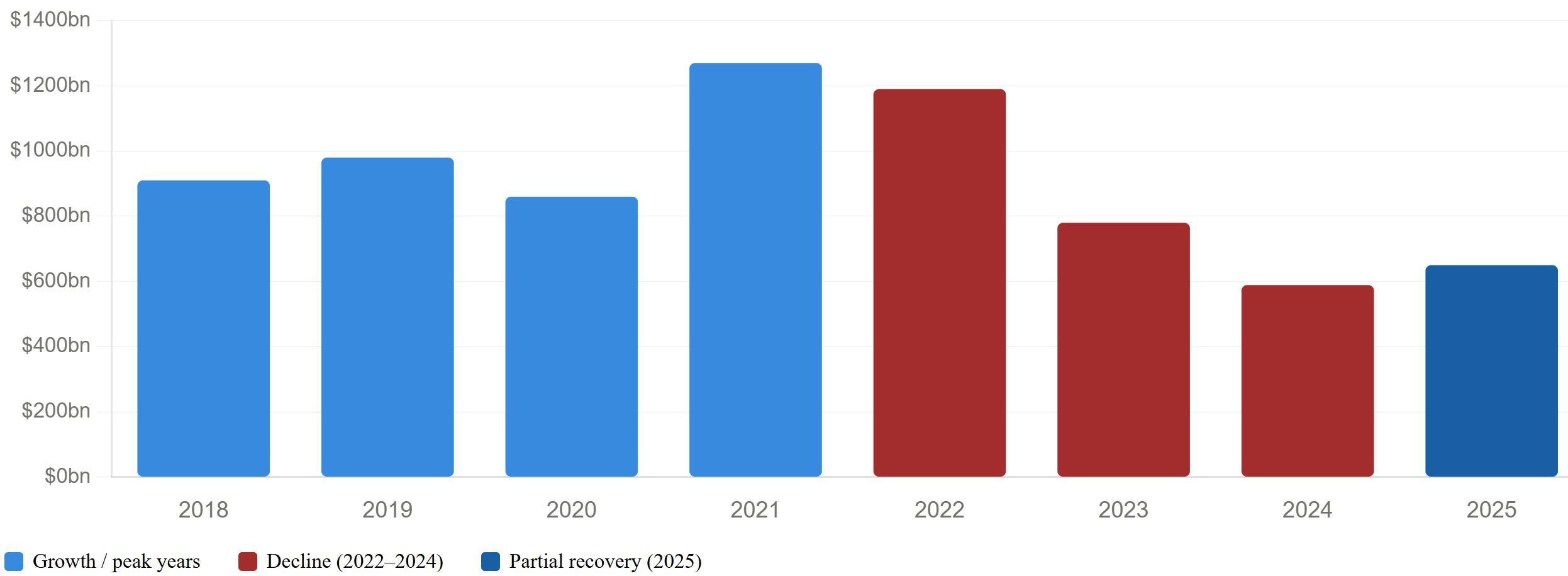
Source: McKinsey Global Private Markets Report 2025 · Fundraising fell to its lowest level since 2016 in 2024, down 24% year-on-year
Liquidity tells the same story. DPI as a share of total PE AUM was 6% in the twelve months ended June 2025, against a 2015–19 average of 16%. Five-year rolling DPI hit its lowest recorded level — around 10% — in the same period. Capital is going in more easily than it is coming out.
At the same time, access is broadening. Semi-liquid private equity vehicles in the US more than doubled since 2023 to $204 billion of fundraising in 2025. An expanding investor base — including wealth and retirement capital — is entering through structures that did not exist a decade ago. Broader access may be good for industry growth. It is not automatically good for premium preservation. A premium built on scarcity cannot remain unchanged when the buyer base expands and product structures broaden.
Then there is cash. The 3-month Treasury bill rate was effectively zero for much of the 2010s. It moved above 5% in 2023 and remained materially above pre-2022 norms through 2024 and into 2025. Even after easing, it represents a real hurdle — and that changes the economics of illiquidity in two ways.
First, the opportunity cost is now visible. Giving up quarterly or annual liquidity is no longer competing with zero carry. Second, the required premium must clear both cash and risk. If an investor takes equity-like risk, pays high fees, gives up liquidity, and ends up only modestly ahead of T-bills, the asset did not earn its keep. Bain captures the magnitude of the operational shift with a single phrase: "12 is the new 5" — meaning private equity deals now need roughly 12% EBITDA growth per year to generate historical returns, compared to 5% when cheap leverage and easy multiple expansion did the rest.
US buyout net returns vs. 3-month T-bill rate (%)
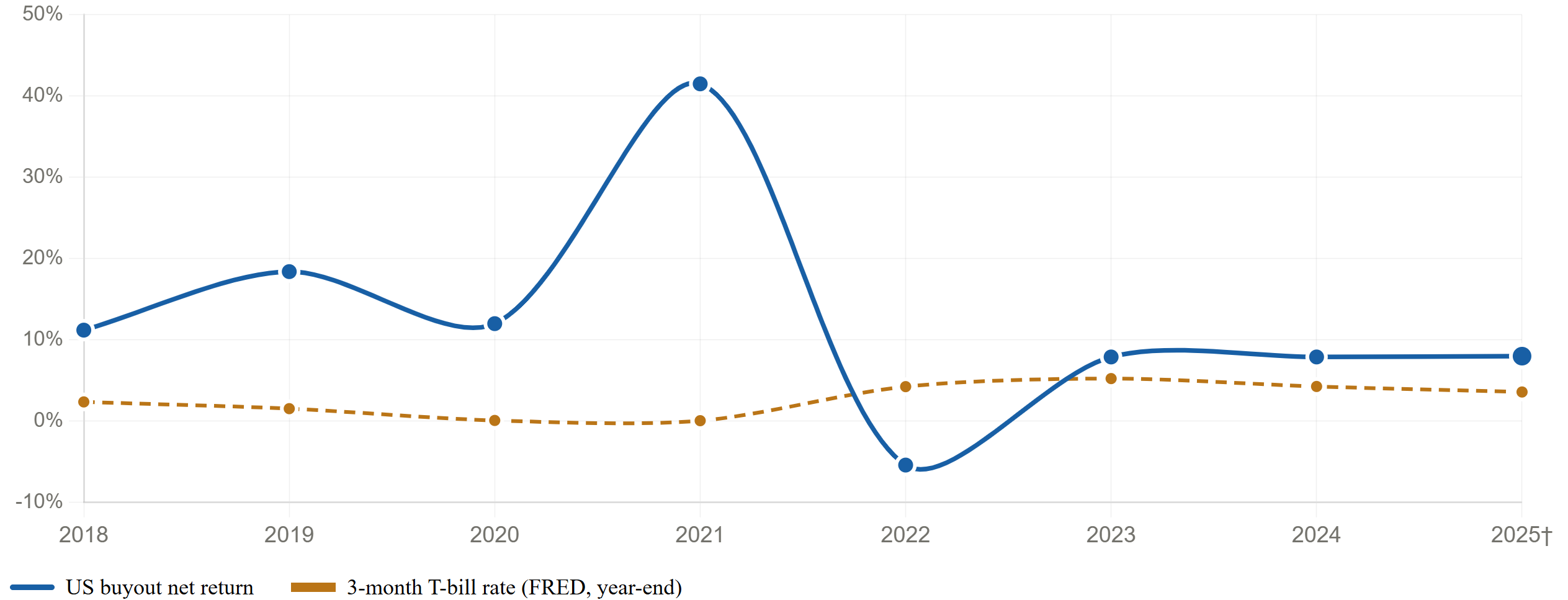
Source: Cambridge Associates US PE Index (annual); Federal Reserve H.15 / FRED · The cash hurdle has risen materially — the spread is thinner than it looks
The test is no longer "does this beat public markets in the long run?" The first test is simpler: does this beat cash by enough to justify the lock-up, complexity, fees, and governance burden?
Where genuine premium still exists
There are still areas where the premium is real because access is limited, complexity is high, or forced sellers exist.
Specialty finance and niche asset-backed lending remain compelling in pockets. These strategies require servicing infrastructure, legal expertise, and sourcing capabilities that generalist capital pools do not have. That is complexity and access premium, not just liquidity premium — and it is harder to arbitrage away.
Lower-middle-market private credit is another area where scale itself can be a disadvantage. Large pools of capital gravitate toward larger, more intermediated transactions. Smaller, bespoke loans can still offer a real premium because they are harder to source and harder to underwrite.
Private secondaries deserve attention — not because they offer the same premium they once did, but because liquidity itself has become an asset class. McKinsey estimates global secondary AUM above $700 billion with roughly $130 billion raised in 2024. That growth does not mean secondaries are overdone. The question is price: when a secondary transaction is solving a genuine liquidity problem for a motivated seller, the economics can still be attractive.
Global private equity secondary market transaction volume (US$bn)
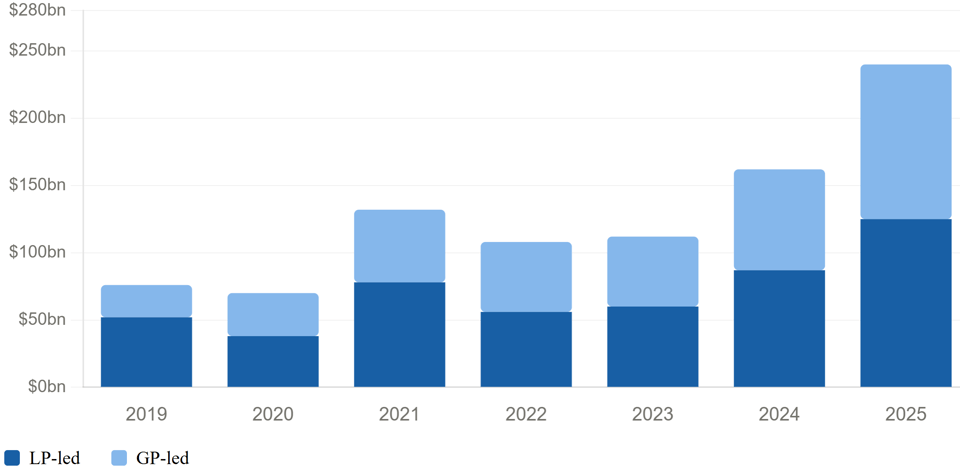
Source: Jefferies Global Secondary Market Reviews (2023–2026) · 2025 reached $240bn — a 48% increase and new record
Niche real assets with genuinely limited access and hard-to-commoditise operational know-how also retain a defensible case.
The common thread: genuine premia still exist where at least one of the three drivers — liquidity scarcity, complexity, or access — remains hard to replicate. If the only thing left is the lock-up, be careful. Lock-up alone is no longer enough.
What this means for portfolio construction
The first implication is decomposition. Allocators should stop underwriting the illiquid sleeve as a single return source and start asking three separate questions for each allocation: how much liquidity am I giving up, how much complexity am I actually underwriting, and how much genuine access edge does the manager have? Those are different risk budgets and they deserve different hurdles.
The second is that the hurdle must be reset against cash, not just against public beta. If short-term rates are at 4% and the asset is hard to exit, a 600–700 basis point expected spread over cash is a more honest test than a vague claim to beat equities over a cycle. The hurdle should be explicit and it should be current.
The third is redeployment, not necessarily reduction. Repricing does not mean abandoning illiquids — it means reallocating within them. Less upper-mid-market buyout beta where capital is abundant and multiples are full. More exposure to the pockets where complexity and access still create genuine barriers. That reallocation argument is as important as the sizing question.
The fourth is that liquid alternatives become more competitive when illiquidity premia compress. This is not because hedge funds are better than private markets in any absolute sense. It is because the trade-off shifts. When the premium for giving up flexibility narrows, liquid strategies with monthly dealing, cleaner marks, and comparable cash-plus return profiles deserve a harder look at the portfolio level.
The fifth is governance. A compressed premium is not just a return problem — it is a decision-making problem. If the investment committee is still underwriting illiquidity with the assumptions of the zero-rate era, the portfolio is being priced off the wrong map. That is the hardest thing to fix and the most important.
The bottom line
The illiquidity premium has not disappeared. But it has stopped being a shortcut. Allocators who built alternatives programs on the premise that lock-up automatically pays now need to rebuild that premise from the ground up — premium by premium, strategy by strategy, vintage by vintage.
Resonanz insights in your inbox...
Get the research behind strategies most professional allocators trust, but almost no-one explains.