When Oil, Inflation, and Correlations Break: A QIS Buyer's Map
7 min read | Mar 16, 2026
The Iran conflict is a macro stress test, not just an energy headline.
Brent trading back above $100. Hormuz disruption impeding a critical corridor for global crude. Rate-cut expectations scaled back. The IMF flagging that stocks and bonds have moved together more frequently during sharp selloffs since 2020 — making traditional diversification less reliable at precisely the moment portfolios need it most.
The right framing is a single question: does this stay contained, or does it become prolonged?
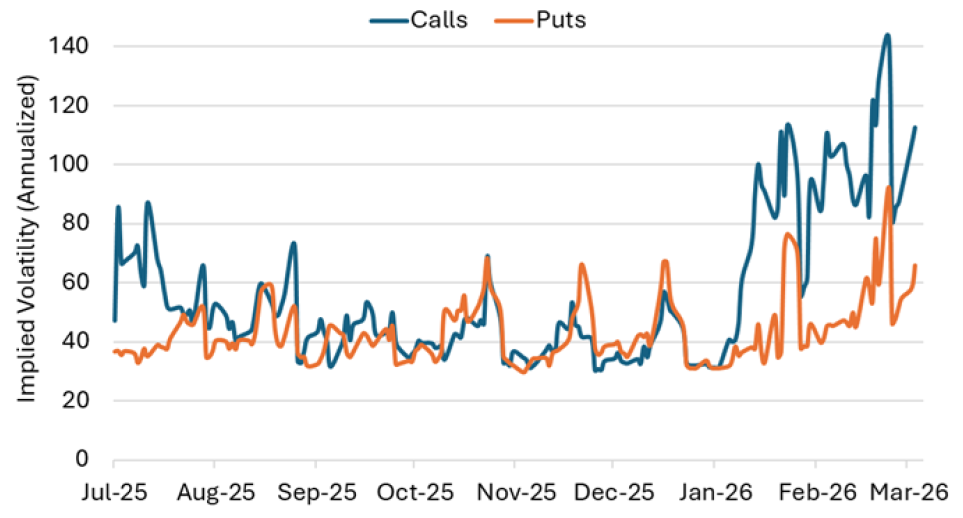
Chart 1: Brent oil futures implied volatility; source Verdad Capital, Bloomberg
That question matters because it exposes a persistent problem in how investors hold QIS. In calm markets, "systematic" gets treated as a category. In stress, it turns out to be a set of very different exposures — each suited to a different regime, each failing in a different way when the regime shifts.
The buyer's map
The confusion starts with how QIS is sold. Carry strategies get discussed alongside defensive overlays as though both belong in the same sleeve. Trend gets benchmarked against structured payoffs even though they solve different problems. Volatility harvesting gets labelled diversification when it may just be another form of short convexity.
The more useful lens is portfolio function, not product label.
Carry earns premia in stable or mildly disrupted markets — but warehouses tail risk and sells insurance, whether or not the documentation says so.
Trend is built for persistence. It doesn't need mean reversion or policy rescue. It needs directional regimes to sustain themselves long enough to harvest.
Dispersion monetises the gap between winners and losers within markets — sectors, geographies, names. It benefits from microstructure chaos before macro clarity arrives.
Volatility harvesting exploits repricing between implied and realised vol, or dislocations in term structure. Precision matters here: some implementations are effectively short-vol carry with fragile tails.
Defensive overlays absorb shocks when correlation assumptions fail — when stocks and bonds sell off together and traditional diversification stops functioning as designed.
Alternative risk premia provide systematic factor exposure beyond beta — but regime-dependence is real and often underestimated.
The Iran conflict doesn't change this map. It makes it decision-relevant in a way that calm markets don't.
Scenario one: contained conflict
If the conflict stays sharp but bounded, markets can eventually re-anchor. The portfolio problem isn't necessarily preparing for a multi-quarter bear market. It's exploiting cross-asset dislocation while it lasts.
Volatility harvesting can work well in this environment — not because the world is ending, but because repricing is abrupt and uneven. Implied volatility often moves faster than realised fundamentals. Markets overpay for protection. Correlations gap. The key distinction is between strategies that monetise term structure dislocations versus those that are simply collecting carry with a fragile tail. In a contained shock, that difference is everything.
Dispersion is the other natural fit. War doesn't produce uniform risk-off. It produces winners and losers: energy versus airlines, exporters versus importers, defence versus consumer. Contained geopolitical shocks create microstructure chaos before macro clarity — exactly the environment where strategies designed to monetise within-market differences have an edge over those calling direction.
Carry can survive a contained shock if de-escalation is quick and macro damage stays limited. But this is where investors get sloppy. Carry is not a neutral holding. It is selling insurance, often at the worst moments to be short it. In the contained scenario it isn't necessarily wrong — it's just no longer innocent.
Scenario two: prolonged conflict
If the conflict drags, the problem changes completely.
This stops being a volatility event and starts becoming a macro regime. Oil stays elevated. Inflation becomes stickier. Growth weakens. Policy becomes constrained. Markets stop debating this month's CPI print and start asking whether central banks can ease into an energy-driven inflation shock at all. The BIS has warned that a prolonged conflict could amplify financial stress through exactly this mechanism. Market pricing has already moved toward fewer cuts and tighter conditions.
This is the environment in which the 60/40 playbook becomes structurally unreliable — not tactically challenged, but architecturally inadequate.
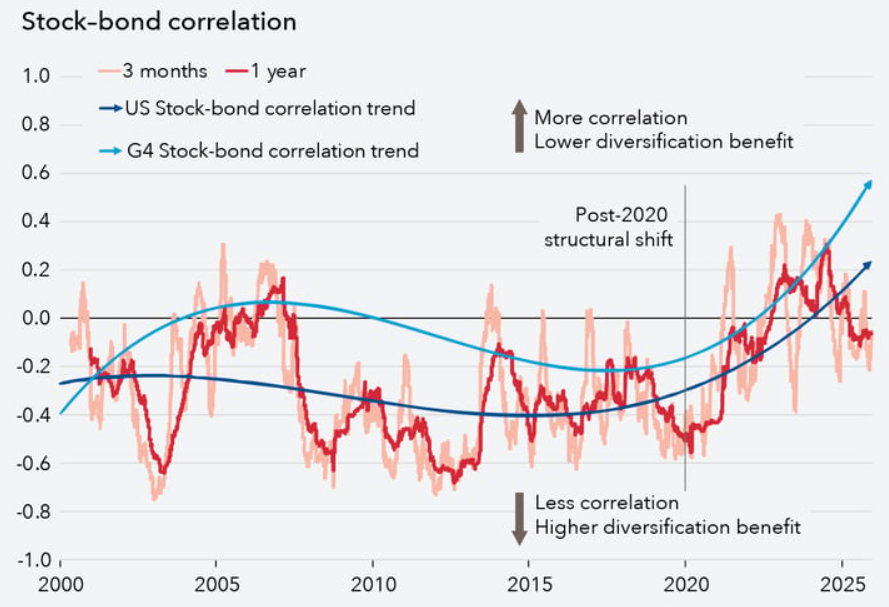
Chart 2: Stock-bond correlation has increased since 2020; source: IMF blog
Trend is the most natural alignment in a prolonged conflict. The single biggest mistake in this scenario is assuming that yesterday's macro relationships will reassert themselves quickly. Trend doesn't need that. If energy keeps climbing, rates stay under pressure, currencies reprice, and equity leadership shifts, trend-following can become one of the few systematic styles aligned with the new regime rather than positioned against it. The contrast with tactical macro is worth making explicit: tactical traders may monetise the initial shock; trend is what investors reach for when the shock becomes a sustained directional environment.
Defensive overlays shift from underappreciated to essential. Investors consistently underprice these in calm markets and scramble for them when correlations break. If stocks and bonds can sell off together — and the evidence since 2020 suggests they can — protection has to be designed deliberately, not assumed from portfolio construction. That doesn't mean every overlay needs to be an expensive tail hedge. It means strategies that can absorb simultaneous inflation and growth shocks need to be identified before the shock, not after.
Alternative risk premia require genuine decomposition in this environment. Momentum, value, volatility, carry, quality — these don't respond uniformly when an oil shock destabilises growth and inflation simultaneously. The relevant questions: which premia are implicitly short inflation volatility? Which depend on benign funding conditions? Which rely on stable factor leadership? Which become more attractive as dispersion widens? ARP is not a clean diversifier by default in this regime. It needs to be taken apart and examined.
Carry is the most dangerous "safe" exposure in a prolonged shock — and also the most commonly underexamined one. Carry often looks stable right up until a regime change makes its embedded risk obvious. In a stagflationary environment, carry is the first sleeve to interrogate, not the last. That includes not just explicit carry trades but the hidden carry embedded in short-vol structures, correlation-sensitive strategies, and income-like products that appear diversified until they don't. When oil, inflation, and financing conditions shift together, carry stops being a return engine and starts being a vulnerability map.
Selection, not just allocation
This is not only a macro story. It's a strategy selection story.
Prolonged conflict increases dispersion. Dispersion rewards adaptability. But it also exposes strategies who were quietly leaning on the old regime — lower inflation, stable growth, falling rates, dependable stock-bond diversification. 2022 was a recent example: strategies that had looked differentiated in the prior decade were exposed as regime-dependent within months of conditions changing.
The useful question isn't risk-on or risk-off. It's: where is dispersion widening, which strategies are built to harvest it, and which are accidentally exposed to the wrong side of a regime shift?
The decision in one frame
If the conflict stays contained: favour QIS that monetises repricing and dislocation — selected volatility-harvesting strategies, dispersion, and tactical relative-value approaches. Apply real scrutiny to strategies that present as defensive but are structurally leveraged carry.
If the conflict becomes prolonged: favour QIS that can survive stagflation, persistent directional trends, and broken correlations — trend, robust defensive overlays, and carefully decomposed alternative risk premia. Scrutinise carry hardest. That is where hidden fragility surfaces first.
The Iran conflict doesn't tell investors to buy QIS. It tells them to stop treating QIS as one thing — and to be precise about which bucket belongs in which regime.
Product labels matter less than portfolio function. The question is whether your current holdings know the difference.
Resonanz insights in your inbox...
Get the research behind strategies most professional allocators trust, but almost no-one explains.