
Prediction markets price real-world events in real time. For allocators, the edge is a live probability signal—if you can underwrite venue, liquidity, and settlement.
7 min read | Jan 12, 2026
Prediction markets are no longer a niche pastime. They are becoming a scalable market structure for pricing discrete outcomes—elections, policy decisions, macro prints, and corporate events—using exchange-style contracts. Two forces make them allocator-relevant now: distribution is expanding (more venues, more users, more liquidity) and the regulatory perimeter is being tested in public (what counts as a financial contract versus gambling).
For investors, the value is not “placing bets.” The value is extracting a live probability signal and understanding venue risk.
Hook: Why prediction markets matter now
Allocators live in a world of catalysts: elections, central bank decisions, court rulings, regulatory approvals, referenda, and geopolitical escalations. These events are binary or discrete and they move risk premia. Traditional tools (polls, strategist notes, surveys) update slowly and rarely translate cleanly into portfolio decisions.
Prediction markets do. They convert “what might happen” into a priceable probability that updates continuously. This is why they are becoming a standard input for decision-making in finance, policy, and research. The debate is no longer whether the concept works; the debate is who gets to offer it, under what rules, and at what scale.
Prediction Market Transactions
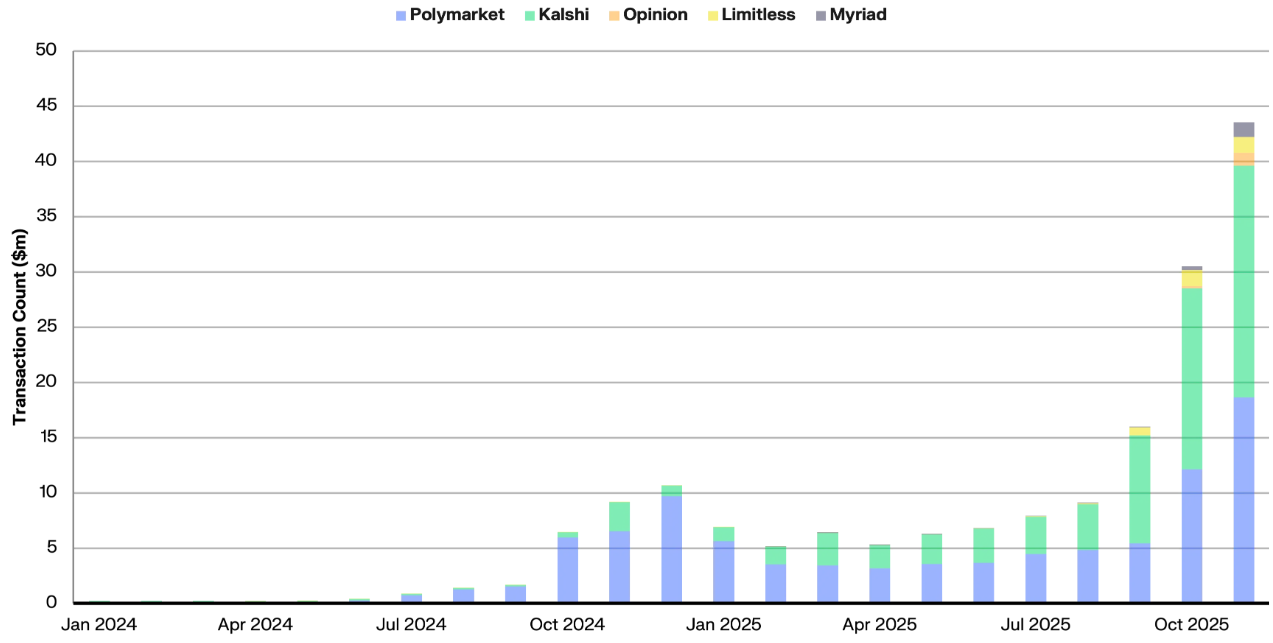
Source: Dune
What they are (and what they are not)
What they are: event contracts with clear payoffs
A prediction market lists event contracts—typically “Yes/No” contracts—that pay $1 if an event occurs and $0 if it doesn’t (or an equivalent cash-settled payout). If a “Yes” contract trades at $0.62, the market is pricing ~62% probability (before fees/frictions).
Examples include:
-
“Will the central bank hike at the next meeting?”
-
“Will Party A win control of the legislature?”
-
“Will CPI print above X?”
Platforms differ in structure and regulation. Two widely discussed names are Kalshi (U.S. event contracts under CFTC oversight) and Polymarket (crypto-based prediction markets with their own design and resolution mechanics).
What they are not
-
Not sportsbooks: Sportsbooks set odds and embed a house margin. Prediction markets are designed as markets where participants trade and prices emerge from supply/demand.
-
Not polls: Polls measure opinions. Prediction markets price outcomes with capital at risk and update in real time.
- Not standard options: Options are priced off an underlying asset and have continuous payoffs. Event contracts settle on a specific outcome, which makes them more direct for discrete-event questions. Unlike options, prediction markets have fixed payouts and defined risk—no greeks, complex margining, or volatility models. As liquidity deepens, their probabilities align with institutional pricing and move alongside futures, options, and swaps around major macro catalysts.
Fed Decision in December 2025. CME Fedwatch vs. Polymarket
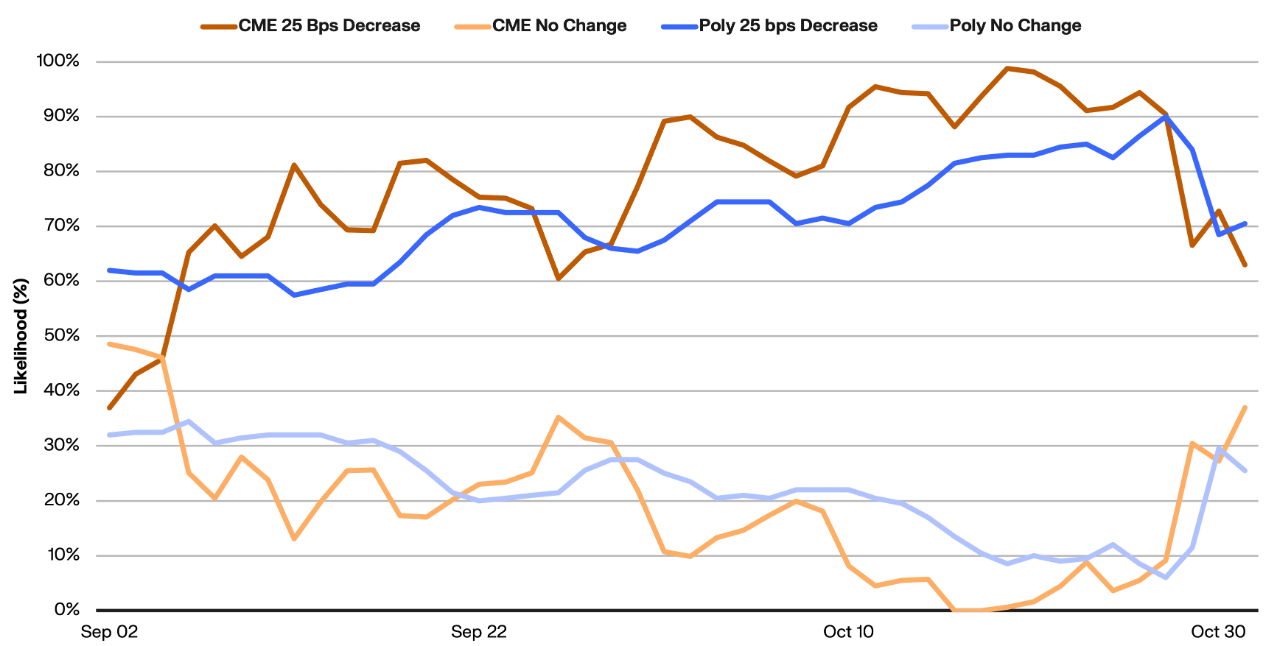
Source: Keyrock
Why they can forecast well
Prediction markets work when three conditions hold: clear contract definitions, enough liquidity, and credible settlement.
The mechanism: aggregation with incentives
Markets aggregate dispersed information. Traders with better models, faster data processing, or superior judgment take positions when the price is wrong. The price moves toward a clearing level that reflects the best available consensus.
A foundational summary of why prediction markets can be accurate is the work by Justin Wolfers and Eric Zitzewitz. The key point is simple: price is the probability, continuously updated.
Why allocators should care
A live probability is a decision input. It forces clarity:
-
What is the base case probability today?
-
How fast is probability changing?
-
What news actually matters (the price reaction tells you)?
-
What tails are being repriced, and when?
This is the same logic allocators already use with implied volatility and credit spreads. Prediction markets extend that logic to discrete events.
Forecasting Accuracy by Method
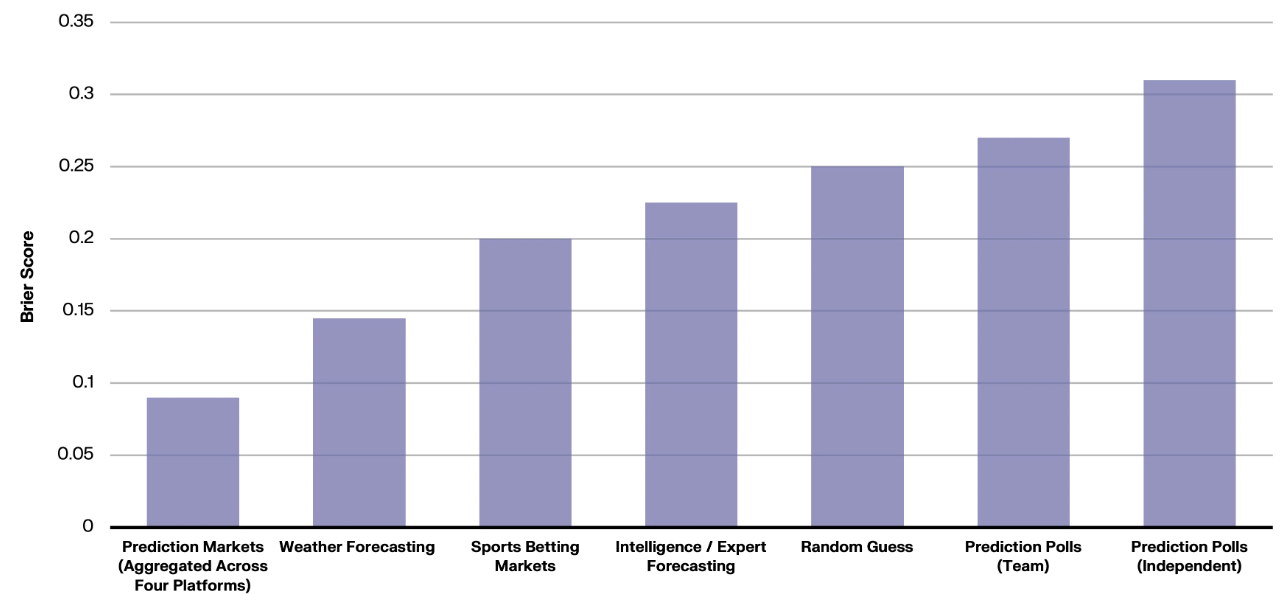
Source: Keyrock
Where prediction markets fail (and why this matters more than “being wrong”)
Forecasting error is not the primary risk. Microstructure, settlement, and governance are.
Liquidity and microstructure risk
Thin markets produce noisy probabilities. A single order can move price, spreads can widen, and “the probability” becomes a reflection of who traded last. For allocators, this means:
-
Use probabilities from liquid contracts.
-
Prefer probability changes over point estimates when liquidity is poor.
-
Track open interest/volume as a quality filter.
Manipulation and reflexivity
A price can be pushed, especially in low-liquidity markets. Even when manipulation is unprofitable long-term, it can distort signals short-term and influence narratives. Treat sharp moves without obvious catalysts as suspect until confirmed by volume and cross-market consistency.
Settlement and oracle risk
Every contract is a legal/operational document. Bad wording creates disputes. Weak resolution mechanisms create tail risks. Before trusting a price, read the resolution rules and verify the source of truth.
Venue governance and operational risk
You are underwriting the platform: KYC/AML controls, custody, operational resilience, dispute handling, and legal survivability. A probability signal is useless if the venue is unstable.
Regulatory uncertainty
The boundary between financial event contracts and gambling is contested, and it affects product scope and access. Monitor the primary regulator and rulebook context.
The allocator lens: three use cases that survive the hype cycle
A) Scenario probabilities for risk committees
Risk committees debate scenarios. Prediction markets provide a disciplined probability input. Use them to:
-
Rank scenarios by likelihood
-
Trigger playbooks when probabilities cross thresholds
-
Communicate risk shifts with a number, not adjectives
This is most useful for macro catalysts: elections, policy, inflation prints, and central bank actions.
B) Hedging discrete event risk
Some risks are truly binary: regulatory approvals, election outcomes, referenda, court decisions. Event contracts can hedge these outcomes directly, rather than via imperfect proxies. Use-case discipline:
-
Size small (capacity and slippage constraints are real)
-
Focus on the specific event that drives your exposure
-
Treat it as insurance, not a return stream
C) Alternative data for nowcasting
Probability paths are data. Feed them into dashboards alongside rates, FX, vol, and credit. The informational edge is often in:
-
The direction and speed of repricing
-
Which catalysts reprice probability (and which don’t)
-
Divergences versus consensus forecasts
Even if you never trade, you can extract signal.
What to watch in 2026
Distribution
Expect more integration into mainstream workflows: brokers, terminals, data vendors, and risk dashboards. Distribution drives liquidity, and liquidity improves signal.
Regulation
Regulatory outcomes will decide which categories scale (politics, macro, corporate events, sports-like products). Track rulemaking and enforcement via the CFTC and venue updates from platforms such as Kalshi and Polymarket.
Product drift
Markets will expand toward higher-engagement categories. That can increase liquidity but also increases reputational and regulatory risk. Allocators should separate:
-
signal markets (macro/policy/corporate events with clear resolution)
-
activity markets (entertainment/sports-like contracts)
Conclusion
Prediction markets are moving into the same toolkit investors already use for risk: implied volatility tells you how much uncertainty is priced; credit spreads tell you where stress is building; prediction markets tell you which discrete outcomes are being priced and how fast those odds are changing. That signal is valuable because portfolios are increasingly driven by policy, politics, court decisions, and macro prints—events that are not continuous and cannot be captured cleanly with traditional instruments.
Use them with discipline. Treat the price as a probability input, not a truth oracle. Underwrite the venue and the settlement rules as rigorously as you would any derivative term sheet. If the platform, liquidity, or resolution framework is not institutional-grade, don’t trade—just harvest the signal.
The practical payoff is straightforward: clearer scenario probabilities, sharper catalyst awareness, and more decisive governance. In a market defined by event risk, the allocator advantage comes from converting probabilities into actions before everyone else updates their narrative.
Resonanz insights in your inbox...
Get the research behind strategies most professional allocators trust, but almost no-one explains.