
Why two LPs in the same hedge fund can pay different effective fees, and what allocators should ask about series accounting and equalization.
8 min read | Mar 31, 2026
Two investors can subscribe to the same hedge fund, on the same headline terms, and still end up paying different effective performance fees. That is not a legal curiosity. It is a portfolio issue — and it deserves more attention than most allocators give it.
The mechanism that determines how performance fees are allocated across investors who enter at different times changes net outcomes, affects comparability across funds, and bears directly on a simple investment committee question: are we being charged fairly for the performance we actually received?
With short-term rates materially higher than the post-GFC norm, the stakes are higher too. Allocators have less patience for hidden fee leakage. More hedge fund capital now moves through open-ended and evergreen structures, wealth channels, and rolling subscription programs — meaning more investors are entering funds at different times, after different drawdowns, and at different NAV levels. The mechanics of fee allocation are not back-office detail in that environment. They are part of the product design.
The problem
Performance fees are easy to understand when every investor enters on day one and stays forever. That is not how hedge funds work.
Investors subscribe at different dates and at different NAVs. Some enter after gains have accrued. Some enter after losses. Some redeem before a crystallization date. Some stay through drawdowns and recoveries. If the fund simply applied one performance fee at the fund level, new investors could end up paying for gains they did not enjoy, or existing investors could be diluted by newcomers who arrive after losses and share in the rebound.
A fair performance fee system needs to answer one question: how do you isolate the performance that belongs to each investor cohort without turning the fund into an administrative mess? The two main answers are series accounting and equalization.
The scale of the issue is not trivial. The SEC's January 2025 white paper on Form PF performance, fees, and allocations estimated that hedge fund fees and allocations totaled roughly $517.7 billion from 2013 to 2023 — and noted explicitly that those aggregate estimates may not reflect the fees borne by any given investor, because funds often have different share classes and fee structures. Stated fund economics and investor economics are not always the same thing.
Estimated hedge fund fees & allocations, 2013–2023 (US$bn)
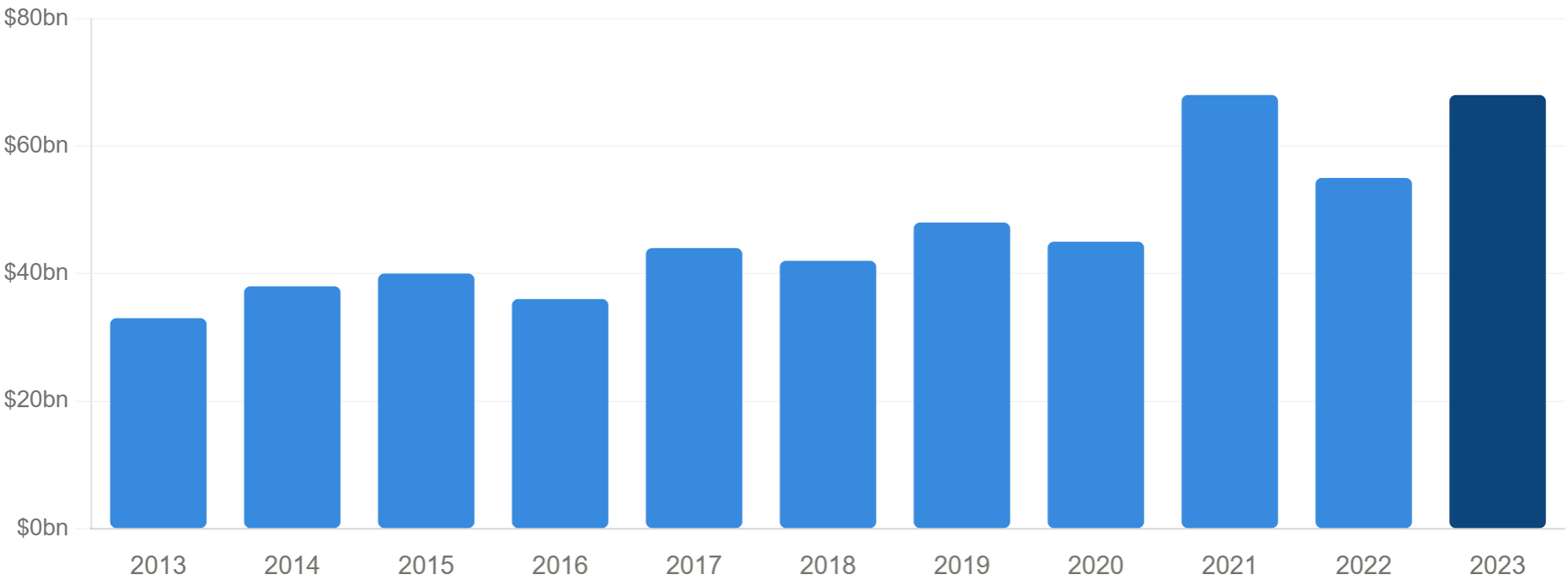
Source: Resonanz Capital; SEC Form PF White Paper, January 2025 - Estimated from gross vs. net return spread × NAV · $517.7bn cumulative total. Annual figures are staff estimates derived from Form PF filings. Totals include management fees, incentive fees, and fund expense allocations and may not reflect fees borne by any individual investor.
Series accounting
Under series accounting, each meaningful subscription date creates a separate series of shares with its own NAV path and its own performance fee accrual. New investors pay incentive fees only on gains that occur after they enter the fund.
The attraction is obvious. It is intuitive and easy to explain to an investment committee. The problem is operational: in volatile periods, especially after drawdowns, a fund can end up with many series outstanding, increasing accounting complexity, administrator workload, and investor reporting burden. It is fair, but it can be cumbersome.

Equalization
Equalization takes a different route. The fund keeps a single NAV and adjusts for fairness at the investor level through equalization credits or contingent redemptions. Investors who enter above or below different effective high-water marks receive adjustments so they do not overpay or underpay performance fees.
One fund-level NAV is operationally cleaner and often better suited to European, Middle Eastern, and Asia-Pacific structures. The trade-off is transparency: equalization can be technically fair but hard for LPs to audit, especially when hurdles and credits interact across multiple entry points or feeder structures. A method that is correct in theory but opaque in practice is not automatically superior.
What can go wrong
The simplest way to make this concrete is a rebound scenario.
Investor A enters at NAV 100. The fund falls to 90. Investor B enters at 90. The fund rises to 110. Investor A has experienced the full path — drawdown and recovery. Investor B has experienced only the recovery. If the fee system is not correctly calibrated, one investor subsidizes the other. The investor who endured the drawdown can end up sharing more of the fee burden with the investor who arrived after the pain but before the gain. That is the fairness problem both methods are trying to solve.
NAV path — same fund, different investor experiences 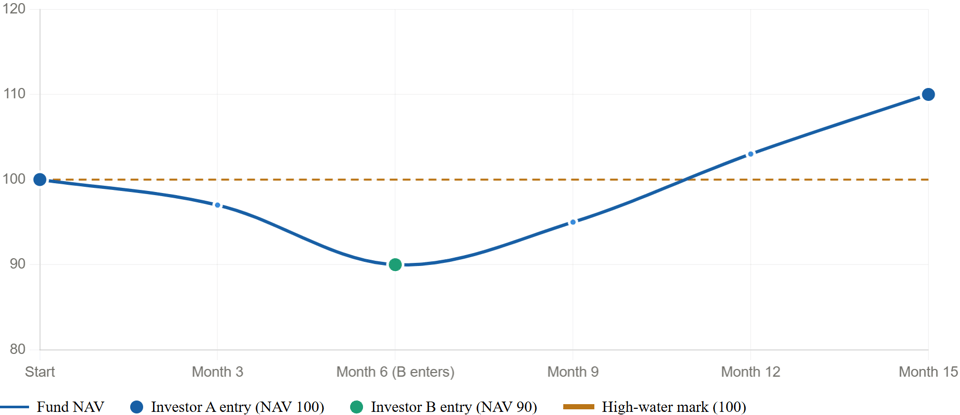
Source: Resonanz Capital; Illustrative example - Performance fee outcome depends entirely on entry point
A second failure mode is operational simplification masquerading as investor benefit. Managers and administrators naturally prefer methods that reduce complexity. That is reasonable. But "simpler for us" is not evidence that the method is better for LPs.
A third issue is auditability. Equalization can be fair, but if the LP cannot reconcile equalization credits, contingent redemptions, and crystallization outcomes from the reports they receive, fairness is theoretical. This is especially acute for wealth platforms and institutions with multiple entry points across mandates or feeder structures.
Founder share classes, side letters, and fee discounts compound the problem. Funds can combine fee accounting methods with differential economics in ways that make net-return comparability genuinely difficult. Allocators often compare the headline fee schedule and stop there. They should not.
What allocators should actually care about
The allocator does not need to become a fund accountant. But four things deserve explicit attention.
Series accounting vs. equalization — key differences for allocators
|
|
Series accounting |
Equalization |
|---|---|---|
|
How it works |
Each subscription date creates a separate share series with its own NAV and fee accrual |
Single fund NAV; fairness achieved via equalization credits or contingent redemptions at investor level |
|
Transparency |
High - Each cohort has its own economic path — easy to explain to an IC |
Moderate - Credits and adjustments require trust in administrator calculations |
|
Operational complexity |
Higher - Multiple series after drawdowns; heavier admin workload |
Lower - Single NAV simplifies fund-level administration |
|
LP auditability |
Easier - Investor can trace their series NAV directly | Harder - Reconciling credits and crystallization outcomes requires detailed reporting |
|
Common geography |
Predominantly US funds |
Europe, Middle East, Asia-Pacific |
|
Best suited for |
Funds with fewer, larger subscription events; IC audiences requiring clear attribution | Open-ended and evergreen structures; rolling subscription programmes |
Source: Resonanz Capital.
Transparency. Series accounting is usually easier to explain because each investor cohort has its own economic path. Equalization requires more trust in the administrator's calculations and in the quality of investor reporting. If the fee logic cannot be explained clearly to an IC, it is a governance problem regardless of which method is used.
Comparability. Two funds marketing "1.5 and 15" or "2 and 20" are not economically identical products if one uses series accounting and the other uses equalization. They may deliver different effective fee outcomes to investors entering after losses, during recoveries, or around crystallization dates. Headline terms are not sufficient for comparison.
Crystallization mechanics. Performance fee fairness is not just about subscriptions. It is also about what happens when investors redeem before crystallization or exit after a rebound. Annual, quarterly, monthly, and redemption-triggered crystallization all produce different outcomes for the same underlying performance path.
Reporting quality. A methodology is only as good as the investor's ability to verify it. The SEC's Form PF white paper reinforces this point: actual fee outcomes can vary materially across investor groups and share classes, even within the same fund.
What to ask in due diligence
Five questions every allocator should put to every hedge fund manager:
- Which performance fee method do you use — series accounting, equalization, or a hybrid?
- Can you show a worked example for two investors entering at different NAVs and exiting at different times?
- How are founder classes, side letters, and fee discounts handled within the method?
- When do performance fees crystallize — annually, quarterly, monthly, or on redemption?
- What exactly does the LP see in reporting, and how can they reconcile it independently?
A sixth, more pointed question is worth adding: if two investors invest at different dates and earn different economic paths, why do you believe your method is the fairest available? That question usually reveals whether the manager has thought about this as an investor issue or only as an operations issue. The manager who answers it fluently has thought about it from your side of the table. The manager who deflects to the administrator probably has not.
The bottom line
Series accounting is often easier to understand and easier to defend in front of an IC. Equalization can preserve fairness under a single NAV and may fit certain structures better. Neither should be accepted on autopilot.
The real point is broader. Hedge fund fees should be judged by investor experience, not marketing shorthand. "2 and 20" says nothing about entry timing, equalization adjustments, crystallization mechanics, share class differences, or reporting clarity. Allocators are not buying legal structures. They are buying net outcomes. The right question is not whether the stated fee is acceptable — it is whether the method ensures that each investor pays for the performance they actually received.
Resonanz insights in your inbox...
Get the research behind strategies most professional allocators trust, but almost no-one explains.