
Private assets report smooth, low-volatility returns because they’re priced rarely, not because they’re safe. How to read the marks, and how to de-smooth them.
9 min read | Oct 18, 2026
A private credit fund shows you a chart a public bond fund can only envy. The returns grind higher in a near-straight line, the drawdowns are shallow, and the volatility is a fraction of anything quoted on a screen. The pitch writes itself: equity-like income, bond-like stability.
A good deal of that stability is manufactured by the way the assets are valued, not by the assets themselves. There's a name for the effect, coined by Cliff Asness of AQR, and it has stuck: volatility laundering.
What volatility laundering actually is
Start with how a price gets set. A public bond or stock is marked continuously. Its price moves every second the market is open, and the volatility you measure from it captures all of that movement, the noise included. A private loan or a private company has no such price. It is valued far less often, usually once a quarter, by appraisal or by model rather than by an actual trade. In accounting terms these are "Level 3" marks, the label for assets valued from a model rather than from observable market prices.
Because each quarterly mark leans partly on the one before it, the return you report in any period is not this period's true change in value. It is a blend of this period's move and the lingering echo of the last few.
Reported Return ≈ a blend of this quarter's true return and the previous few quarters
more formally: rtobs = θ0 rt + θ1 rt−1 + θ2 rt−2, with θ0 + θ1 + θ2 = 1
And that blending is where the low volatility comes from, because an average is always calmer than the things being averaged. Averaging today's move with yesterday's damps the swings, so the reported series looks calmer than the economic reality underneath it. It also leaves a fingerprint: the reported returns show positive autocorrelation, which means each quarter's number looks a lot like the one before it. (Autocorrelation is just the tendency of a series to repeat itself period to period.) Public equity returns have autocorrelation near zero, because each quarter is close to independent. A heavily smoothed private series does not. When a return stream looks too serene and too self-similar quarter after quarter, you are usually looking at the valuation process, not at the risk.
The same asset, valued two ways
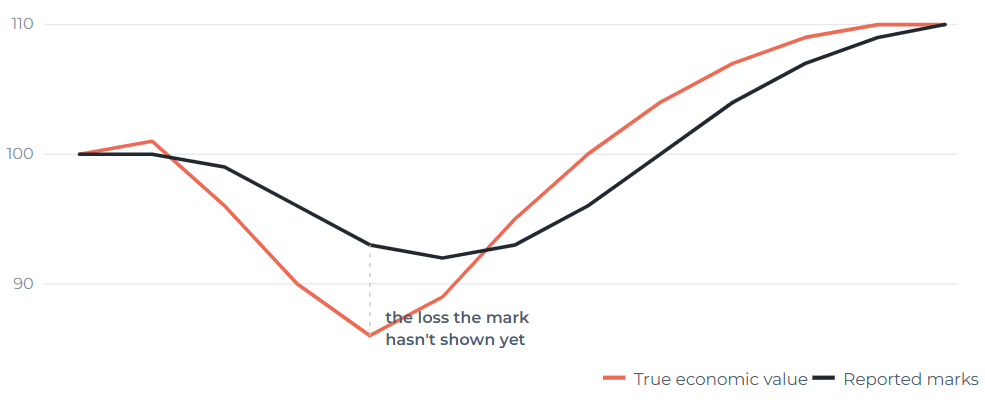 Source: Resonanz Capital; illustrative. Same start, same finish, very different ride. Both lines describe one asset through a stress and a recovery. The reported marks post a shallower, later drawdown and a smoother path, which is exactly what lowers their measured volatility. The economic value fell further and earlier; the mark simply had not caught up.
None of this has to be fraud, or even deliberate. A private asset really has no second-by-second price, and there is a fair argument that a slow, appraisal-based mark is a reasonable way to value something that trades rarely. The trouble is only that the smoothness gets read as low risk, when all it really signals is low frequency.
Because the true series can't be observed directly, recovering it is a modelling exercise, and there are a few established ways to do it.
Common Frameworks to Un-Smooth A Return
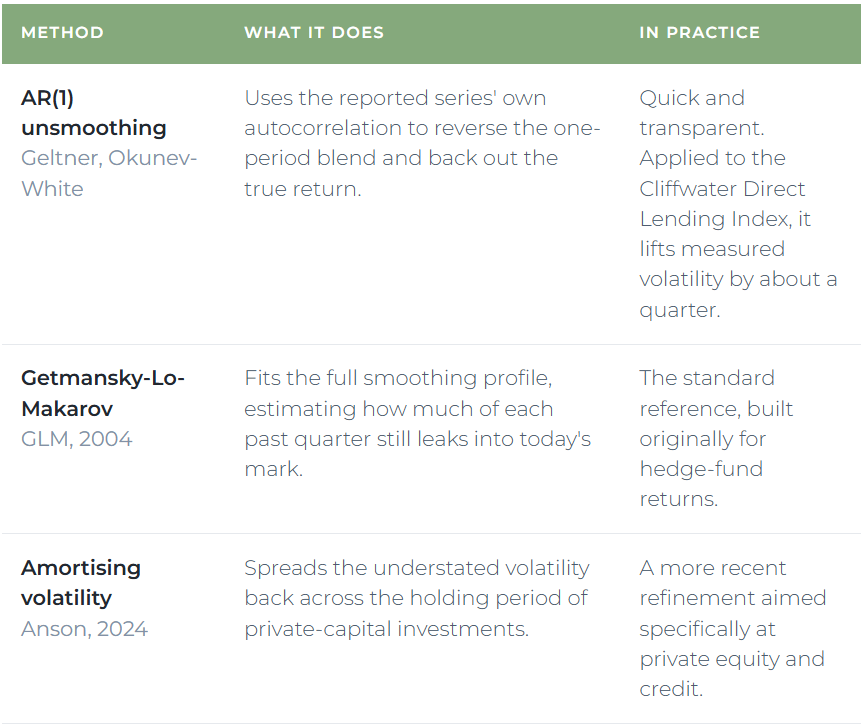 Source: Resonanz Capital. All three recover roughly the same thing, a truer picture of risk, from the same smoothed series. Because they infer the true path rather than observe it, the de-smoothed numbers are a correction, not gospel. What never changes is the direction: de-smoothing always raises volatility and lowers the reported Sharpe ratio.
What the smooth line hides
The smoothing flatters the numbers in three related ways. Reported volatility comes out too low. That feeds straight into the Sharpe ratio, the standard measure of return per unit of risk, which then looks too high, because the risk figure in its denominator is understated. And since a smoothed series barely moves when public markets do, its measured correlation with the rest of your book is too low, so the asset looks like a far better diversifier than it is.
The drawdown is where the gap gets widest. Work on de-smoothed private-equity returns found a return stream whose reported worst loss was around 12% had in truth fallen closer to 40% peak to trough.
The drawdown the fact sheet doesn't show
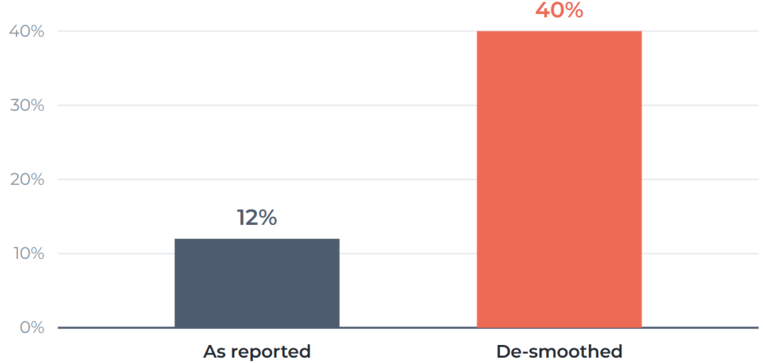 Source: "Volatility Laundering in Private Credit" (SSRN, July 2026), and related 2026 commentary from DoubleLine and others. Drawdown figures from a de-smoothing study of private-equity returns as cited in 2026 market commentary. The smooth line is not a smaller loss, only a loss shown more gently. On the same de-smoothed basis, a 30% loss over three years looks almost impossible in the reported data and sits closer to a one-in-seven chance in reality. Unsmoothing one well-known private real-estate fund cut its reported Sharpe ratio by roughly 30%.
The correlation effect is the quieter one, and for the way most books are put together it matters more. Because the marks move late and lean on their own past, a private holding barely seems to budge when public markets fall. On a fact sheet that looks like fine diversification. In a real stress it is a timing illusion. The economic value fell alongside everything else, and the mark simply had not caught up yet. The low correlation you sized the position against was measured on lagged data, which is the broader argument in A Sleeve Is Only as Good as Its Regime.
There is one more point from Asness that a buyer should sit with. Investors don't merely tolerate the smoothing, they pay for it. That smoothness is treated as a feature worth owning, demand bids the assets up, and you can end up accepting a lower expected return for the comfort of not being told how much your holdings really moved.
In private credit, it is loss deferral, not smoothing
The newest work sharpens the point for private credit specifically, and this is where it stops being a borrowed critique. In private equity the smoothing runs both ways. A strong quarter gets marked up a little less than it should, a weak one marked down a little less, and over time the overs and unders roughly offset. A loan cannot do that, because its upside is capped. You cannot mark a performing loan above par to bank a cushion against a bad one. So the smoothing becomes one-directional. Losses are deferred rather than denied, a quiet queue of unrecognised marks that builds until a restructuring or a default forces it into the open.
That changes how to read a smooth credit track record. A calm credit line is less a case of smoothing two-sided noise than of postponing bad news, which is why the reckoning, when it comes, tends to arrive in a lump rather than a drift, a pattern we traced in The Private Credit Liquidity Reckoning. The quarterly marks look fine right up until the quarter they don't.
How to read a smooth track record
De-smooth before you compare. Any time a private return series is going next to a public one, in a Sharpe-ratio beauty parade, a correlation matrix or a risk model, run the de-smoothing correction first, or at the very least look at the autocorrelation. If it is high, discount the reported volatility hard before you trust a single risk number built on it.
Treat smoothness as illiquidity, not as low risk. The low volatility is the price of not being able to sell, which can be a perfectly sensible trade. But it is an illiquidity decision, and it belongs in your liquidity budget, not in the "safe and uncorrelated" bucket where a smooth line tends to get filed.
Don't pay up for the calm. If two assets carry the same economic risk and one simply reports it less often, the quiet one is not safer. Paying a premium for the smoother line is paying more for a worse picture of the same thing.
Then size the position to its de-smoothed risk and its real, un-lagged correlation, and decide what job it is there to do before the track record talks you into it (Decide the Role Before You Read the Track Record). One quiet argument for running return engines that mark to market every day is that the risk you see is the risk you have. There is no stored-up surprise waiting on a valuation lag.
The fair counterargument
It is worth being fair to the other side, because not everyone accepts the laundering framing and some of the objection is reasonable. A private asset's price really is slow-moving, not only slowly reported. A senior secured loan that will very likely pay par at maturity does carry less mark-to-market risk than a bond that gyrates every day on sentiment, and forcing a public-style price onto it can overstate the risk as easily as smoothing understates it. The effect is also far larger in private equity than in senior, floating-rate private credit, where more frequent marks and contractual cash flows leave much less to smooth.
The claim here is deliberately narrow. A smooth reported return line is not, on its own, evidence of low risk or of diversification, and anyone building a portfolio on reported private volatility is almost certainly underestimating both the risk they hold and its correlation with the rest of the book.
A quiet return stream can mean the risk really is low. It can also just mean nobody has repriced the thing lately. Before you treat the calm as safety, make the numbers tell you which.
Resonanz insights in your inbox...
Get the research behind strategies most professional allocators trust, but almost no-one explains.