
July's QIS composites averaged +0.11%, but returns ranged from +3.56% to -3.78%. What paid, what didn't, and what's ahead for August.
4 min read | Aug 3, 2026
July broke the pattern that had supported QIS through May and June. Carry stopped being the dominant return engine. Convexity finally earned its premium, but only selectively: in rates, not across hedging strategies as a whole. The late-month unwind in AI-sensitive equities and yen-funded positioning turned an almost flat index month into a much louder systematic cross-section.
The S&P 500 ended July broadly unchanged. That headline number hid a 3.2% decline in the Nasdaq, steep losses across Asian technology markets, a 22-24% rise in crude oil, and a meaningful selloff in long-dated government bonds. Two violent reversals closed out the month: forced deleveraging in crowded AI positions, and a sharp yen appreciation following suspected intervention. Under a quiet index number, the market was dislocated.
What the numbers said
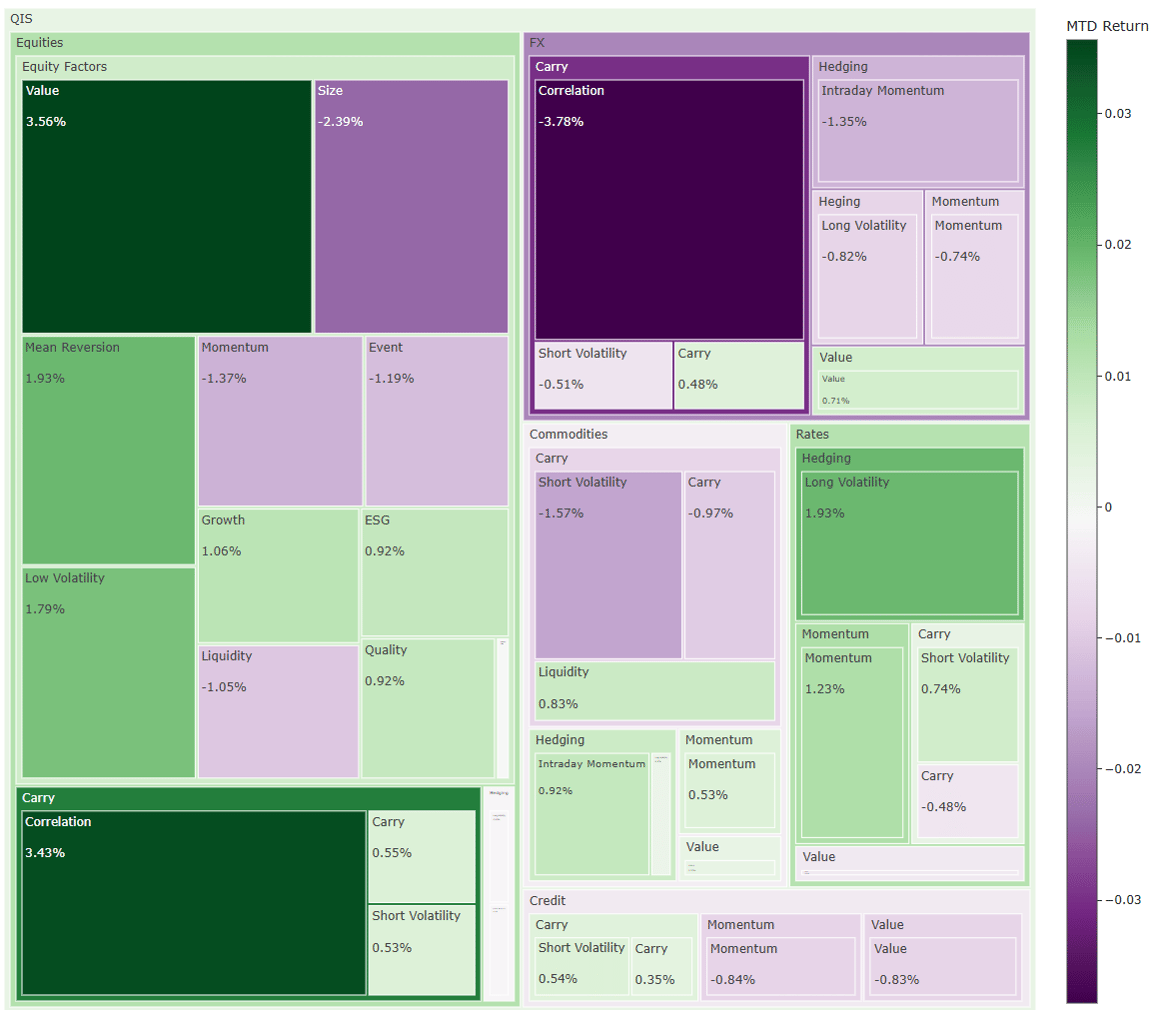
Average composite return: +0.11%. Median: +0.20%. Just over half of composites finished positive: 21 of 40. Dispersion widened materially to approximately 7.3 percentage points, from the best performer at +3.56% to the weakest at -3.78%.
The hierarchy changed from previous months. Equity Factors led at +0.37%, while Carry, May and June's anchor, was effectively flat at +0.01%. By asset class, Rates (+0.60%) and Equities (+0.52%) performed best. FX fell 0.86%, the clear laggard.
The S&P 500 was flat in July. The average composite returned +0.11%. Both numbers look uneventful. Underneath them, individual composites spanned more than 7 points. The average told you almost nothing this month.
What paid: reversal, dispersion and rates convexity
FX absorbed the month's most concentrated loss.
After USD/JPY reached approximately 163.85, suspected intervention and official signaling produced a violent reversal into month-end. FX Correlation fell 3.78%, the weakest result in the entire universe. Almost all of that loss occurred during the final four trading sessions. FX Intraday Momentum declined 1.35%, while FX Momentum lost 0.74%.
The exception was FX Value, up 0.71%, which benefited as the yen's late-month reversal moved against the prevailing rate-differential trade. July rewarded mean reversion. It disrupted correlation, trend, and short-horizon relationships.
Commodities were similarly divided. The sharp rally in oil supported Commodities Intraday Momentum (+0.92%), Liquidity (+0.83%) and Momentum (+0.53%). But the move wasn't a broad commodity rally: U.S. natural gas fell sharply and precious metals stayed subdued. That split hurt strategies built on stable volatility and curve dynamics: Commodities Short Volatility lost 1.57%, and Commodities Carry declined 0.97%.
The commodity average ended close to flat. July rewarded strategies that adapted to the oil shock, not broad commodity exposure.
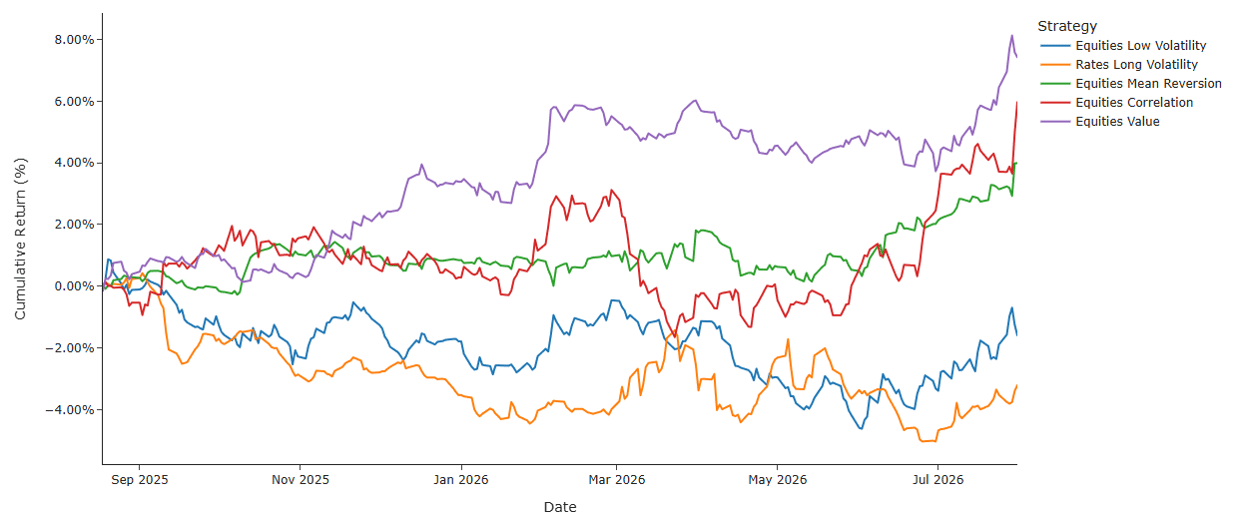
Leaders: Equities Value +3.56% · Equities Correlation +3.43% · Equities Mean Reversion +1.93% · Rates Long Volatility +1.93% · Equities Low Volatility +1.79%
Laggards: FX Correlation -3.78% · Equities Size -2.39% · Commodities Short Volatility -1.57% · Equities Momentum -1.37% · FX Intraday Momentum -1.35%
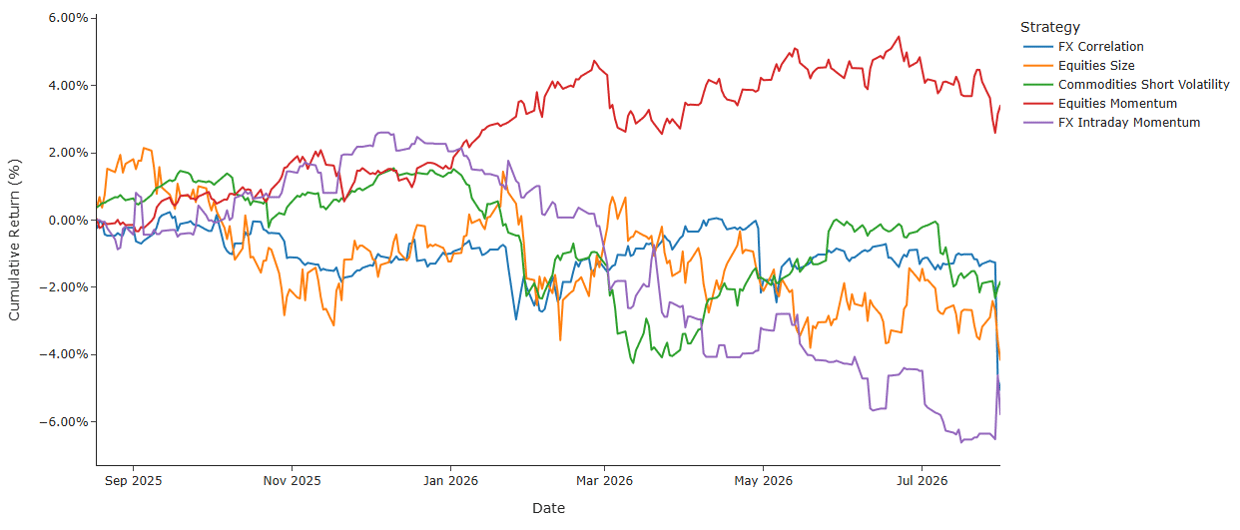
Equity reversal and rates convexity paid. FX relationship stability, equity trend persistence, and commodity short volatility did not.
What we take into August
July doesn't invalidate the case for carry, but it shows the case is asset-specific. When geopolitical shocks, intervention risk, and forced deleveraging start driving markets, some carry holds and some doesn't. Credit and equity carry stayed positive in several implementations. FX correlation and commodity short volatility broke down.
"Convexity" isn't one exposure either. Rates long volatility paid as yields repriced higher. FX long volatility didn't. Commodity long volatility was only modestly positive, and commodity short volatility got hurt. What decided the outcome was where the shock landed, and whether the implementation could actually monetize it.
The average QIS composite is roughly flat for 2026 so far, at +0.07%, with fewer than half of strategies positive. The gap between individual outcomes tells a different story: in a market shaped by crowding, intervention, and geopolitical transmission, QIS earns its keep less through the average strategy and more through combining genuinely different reaction functions.
Three variables will decide August: whether the AI unwind turns into a sustained factor rotation, whether high oil prices keep pressure on long-term yields, and whether further yen intervention forces more deleveraging of carry positions. Any one of them can overwhelm a quiet-looking index number. That's the case for staying diversified even when, especially when, the headline says little.ersification is most valuable precisely when the index appears to say very little.
Resonanz insights in your inbox...
Get the research behind strategies most professional allocators trust, but almost no-one explains.