
Is your hedge fund manager's financing one margin call away from forced selling? A framework for allocators on prime broker concentration risk.
7 min read | May 4, 2026
The hedge fund industry's financing is now concentrated in four prime brokers at leverage multiples not seen since the pre-GFC era. That is the unavoidable conclusion from S&P Global's latest report, published this week: BNP Paribas, Barclays, Goldman Sachs, and Morgan Stanley collectively dominate hedge fund financing while gross leverage across the industry has climbed to approximately eight times NAV, up from five times a decade ago.
Prime brokerage revenues at those four banks jumped roughly 25% over the past year, driven by rising balances and expanding margin lending. The four institutions now sit at the centre of a financing web that connects the largest multi-strategy platforms, systematic macro funds, and relative-value shops to the repo and securities-lending markets they depend on for daily operations.
Most allocators have no framework for measuring the risk this creates. They should.
The leverage context
Eight times gross leverage is not, in itself, a crisis indicator. Many strategies — basis trades, capital structure arbitrage, statistical equity market-making — require leverage to extract returns from narrow spreads. The question is not whether leverage exists. The question is what happens when the financing behind that leverage is concentrated in a small number of counterparties, each of which faces correlated margin-call dynamics during stress.
OFR Hedge Fund Monitor leverage by strategy
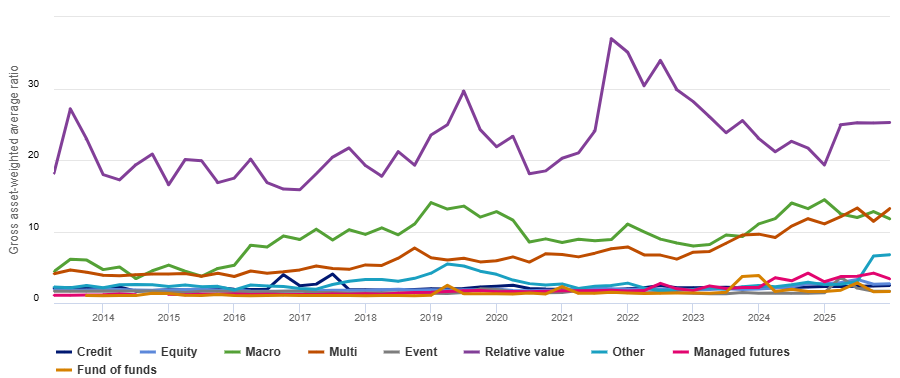
Source: Hege Fund Aggregated Statistics from SEC Form PF Filings, OFR
How concentration creates correlated deleveraging
To understand the risk, consider the plumbing. A multi-strategy hedge fund typically maintains prime brokerage relationships with two or three banks. Those banks provide margin financing, stock loan, repo access, and synthetic exposure via swaps. In return, the fund posts collateral — often the same portfolio positions it is leveraging.
When volatility spikes, prime brokers raise margin requirements. If a fund's relationships are concentrated among the same four banks, it faces a coordination problem: all of its financing counterparties are likely to tighten terms simultaneously, because they are responding to the same risk models, the same regulatory signals, and the same portfolio overlaps across their client bases.
This is not a theoretical risk. The Financial Stability Board's 2024 research on non-bank financial intermediation documented precisely this dynamic. When prime brokers share a large proportion of the same clients, margin calls become procyclical — each bank's decision to tighten terms reinforces the pressure on funds that depend on multiple relationships within that same cluster. The result is correlated forced selling. Funds do not unwind idiosyncratic positions in an orderly fashion. They liquidate whatever is most liquid, which tends to be the same equity and credit positions held across similar strategies, amplifying the drawdown for every fund in the ecosystem.
BIS Prime Broker–Hedge Fund Nexus chart
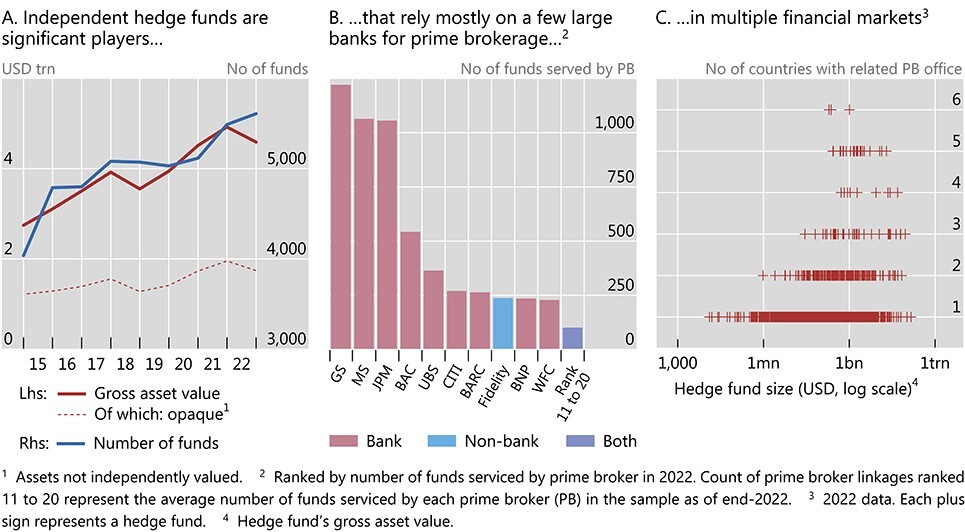
Source: US SEC Form ADV; BIS' calculations
The Archegos lesson most allocators missed
Archegos Capital Management's collapse in March 2021 is typically framed as a story about concentrated equity positions and total return swaps that circumvented disclosure requirements. That framing is correct but incomplete.
The deeper lesson was about prime brokerage behaviour under stress. When Archegos failed, Goldman Sachs and Morgan Stanley moved quickly to liquidate collateral, limiting their losses. Credit Suisse and Nomura, which delayed, absorbed billions in write-downs. The speed differential between prime brokers turned an orderly unwind into a fire sale that hit other funds holding overlapping positions.
Now imagine that dynamic at industry scale. If the four dominant prime brokers simultaneously face a credit event at a large client — or face correlated margin pressure across dozens of clients during a broad market dislocation — the same first-mover incentive applies. The bank that liquidates fastest protects its balance sheet. Every fund caught in the middle faces margin calls that escalate faster than it can raise cash.
The March 2020 liquidity crisis offered a preview. During the COVID sell-off, prime brokers raised margin requirements sharply across rates, credit, and equity strategies within days. Funds with diversified PB relationships — including relationships with banks outside the dominant four — navigated the period with materially less forced selling than those dependent on a concentrated set of counterparties.
What allocators should be asking
The S&P data should prompt a specific set of questions in every allocator's next operational due diligence review.
The first is concentration within the PB roster. How many prime brokerage relationships does the manager maintain, and how is financing distributed across them? A fund that reports three PB relationships but sources 80% of its margin from one bank has a concentration problem regardless of the headline number.
The second is the nature of the financing. Does the manager have committed financing facilities, or are its PB arrangements terminable on short notice? Committed term financing — even at a higher cost — provides a buffer against procyclical margin calls. Uncommitted arrangements can be pulled precisely when they are most needed.
The third is rehypothecation policy. When a prime broker rehypothecates client collateral, it uses that collateral to fund its own activities. In normal markets this is efficient. In stress, it creates a chain of dependencies: the fund's collateral is tied up in the PB's own financing operations, reducing its ability to move assets or switch counterparties quickly.
The fourth is stress-test credibility. Has the manager stress-tested a scenario in which its primary PB raises margin requirements by 200–300 basis points within 48 hours? If the answer is no — or if such a scenario would force liquidation of core positions — then the fund's leverage is less well-managed than its risk reports suggest.
Why this matters more for multi-strategy platforms
The concentration risk identified by S&P is not uniformly distributed. It is most acute for large multi-strategy platforms — precisely the structures that have attracted the most capital over the past five years.
Multi-strategy funds depend on prime brokerage relationships for a broader range of services than single-strategy managers: cross-margining across asset classes, intraday financing for high-turnover strategies, and complex swap infrastructure for relative-value trades. This makes them stickier clients for the dominant PBs — but it also makes them more vulnerable to coordinated tightening, because switching a multi-strategy book to a new prime broker is operationally far more complex than moving a long/short equity portfolio.
Prime brokerage — estimated revenue share, top banks (2025)
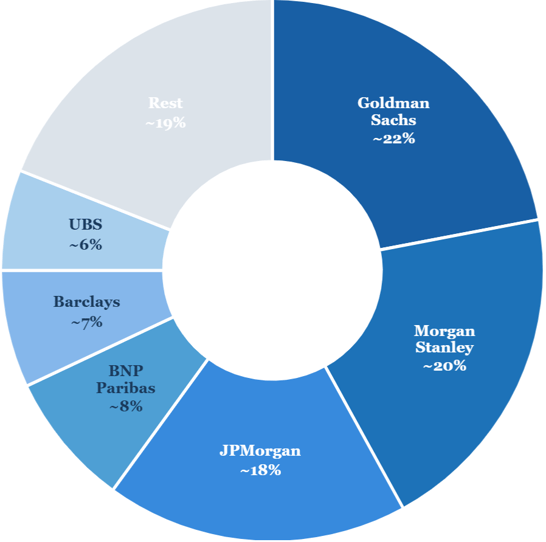 Source: IFR / BCG Expand; Vali Analytics; Navnoor Bawa / Substack (January 2026) · Total industry revenue projected at ~$37bn in 2025 · Top 4 account for ~68% of market. Revenue share estimates derived from IFR/BCG Expand market share data, Vali Analytics 2023 revenue figures, and Q3 2025 bank reporting. Figures are approximations; precise revenue splits are not publicly disclosed by all banks.
For those building portfolios of liquid alternatives, the implication is clear. Manager-level risk analysis is necessary but insufficient. The question is not only whether a given fund manages its leverage prudently, but whether the financing infrastructure supporting that leverage is robust enough to withstand a systemic stress event in which the four dominant counterparties all respond to the same signals at the same time.
The structural blind spot
Most institutional due diligence frameworks assess credit risk, market risk, liquidity risk, and operational risk. Counterparty concentration at the prime-brokerage level falls into an awkward gap between these categories — too operational for the portfolio risk team, too systemic for the operational due diligence team.
The S&P report should close that gap. When four banks control the majority of hedge fund financing and leverage stands at eight times NAV, counterparty concentration is not an operational footnote. It is a portfolio-level risk factor that belongs in the same conversation as strategy selection and manager sizing. Those who treat it otherwise are not managing risk — they are ignoring it.
Resonanz insights in your inbox...
Get the research behind strategies most professional allocators trust, but almost no-one explains.