
Managed futures, crisis alpha, return stacking: why pairing equity with trend following keeps coming back, and when the pairing disappoints.
9 min read | Nov 23, 2026
Every decade rediscovers it
In the early 2000s the idea was hedge funds paired with managed futures. After 2008 people called it "crisis alpha", and in 2021 "return stacking". Each version came with new vocabulary and new advocates. Each was presented, at least in part, as a fresh insight.
Strip away the labels and the proposition is the same each time: hold equity, and hold trend following alongside it.
When an idea keeps coming back under new names, there are usually two explanations. It may be a marketing cycle: a category sells well in one environment, fades, and is repackaged ten years later. Or it may rest on something structural that each generation of investors works out again for itself. We think equity plus trend is the second kind. The reason has to do with the shape of returns, not their level.
The structural reason: two different shapes
Most portfolio discussions rest on two numbers, expected return and volatility. Volatility treats a gain and a loss of the same size as equally important. Investors don't experience them that way.
What volatility leaves out is skewness, which tells you whether the distribution of returns is lopsided and in which direction.
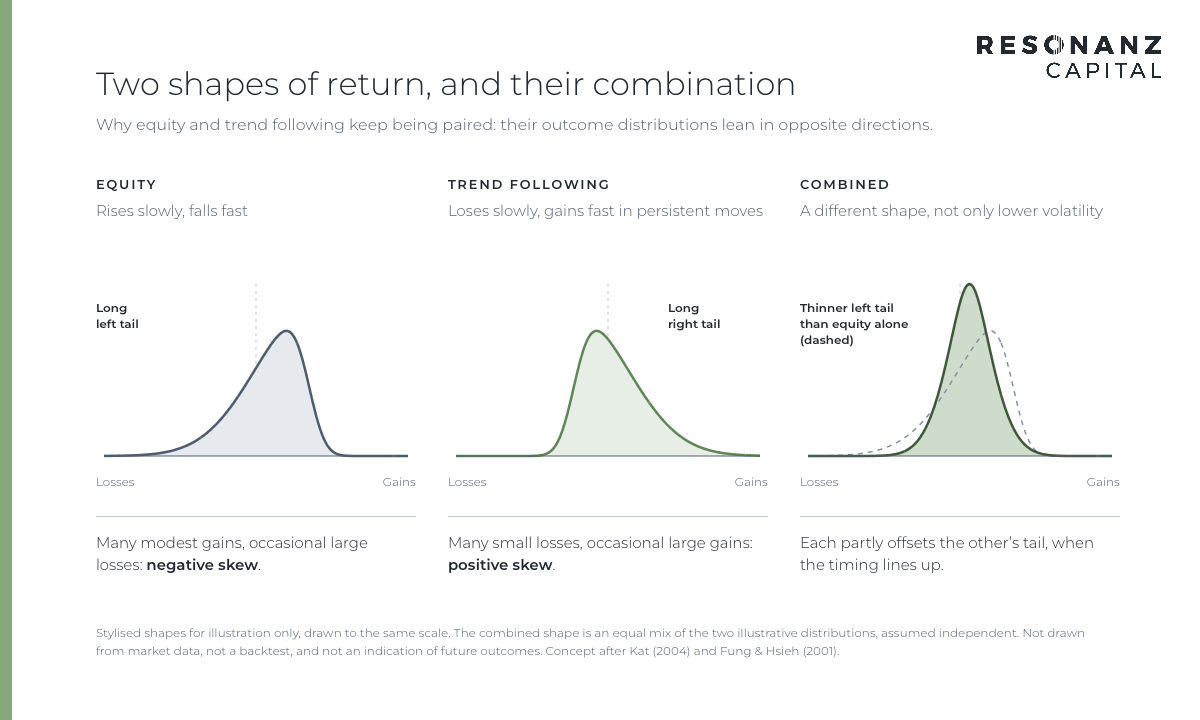
Equity returns are negatively skewed. Markets tend to climb in many small steps and fall in a few large ones; traders call it taking the stairs up and the elevator down. Chen, Hong and Stein (2001) document this negative skewness in stock returns and study when it is most pronounced. Anyone who has sat through a drawdown knows what that means. The losses come faster, and bigger, than the volatility figure suggested.
Trend following tends to lean the other way. A trend follower takes small losses often, on signals that fizzle out. Now and then it makes a large gain, when a market keeps moving in one direction. That is positive skew. Fung and Hsieh (2001) showed that this payoff looks a lot like owning a particular kind of option, which is where Piece 2 picks up.
Combine the two and more than the volatility figure changes. The distribution of outcomes takes on a different shape, because the long right tail of one can partly offset the long left tail of the other. Note the word can. Whether it does depends on timing, and we come back to that below.
The same idea in different clothes
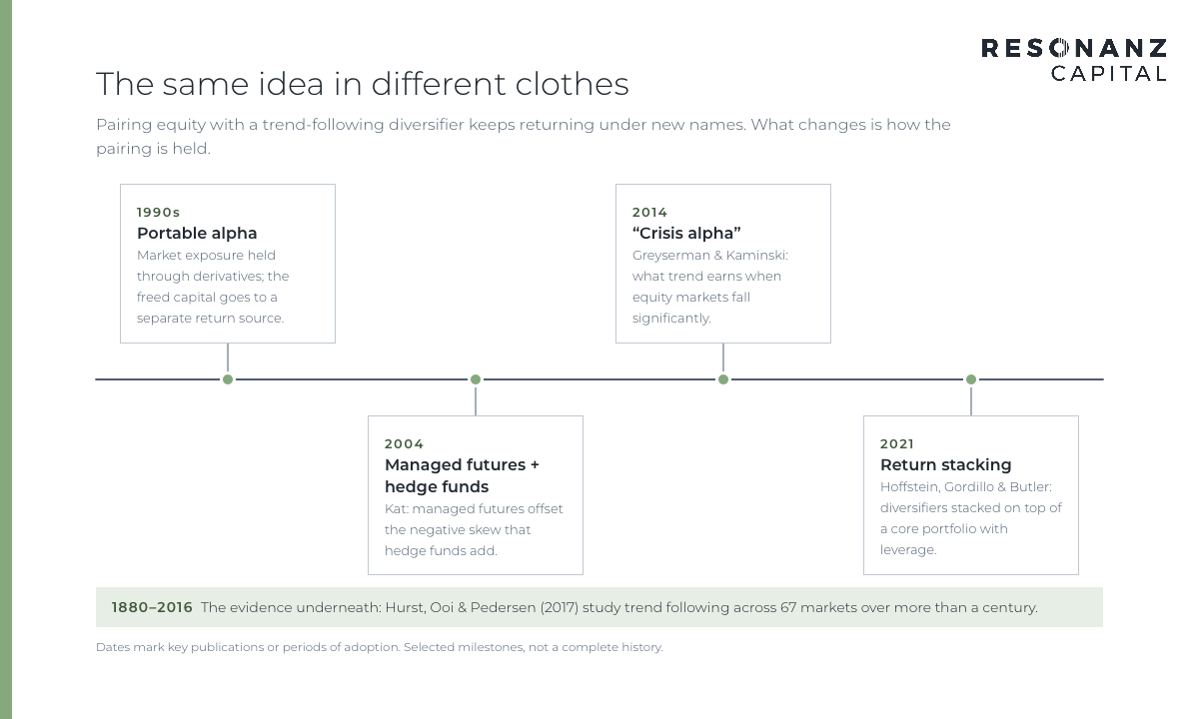
Hedge funds and managed futures (early 2000s). The clearest early statement of the idea is Harry Kat's "Managed Futures and Hedge Funds: A Match Made in Heaven", which circulated as a working paper in 2002 and appeared in the Journal of Investment Management in 2004. Kat studied what happened when hedge funds were added to a stock and bond portfolio between 1994 and 2001. Standard deviation fell, as promised. But skewness turned more negative and kurtosis rose: the portfolio looked calmer on average, yet it was more exposed to large losses. Adding managed futures instead cut standard deviation by more, and faster, without those side effects. The best results came from combining the two. As long as roughly 45 to 50% of the alternatives allocation went to managed futures, the unwanted effects on skewness and kurtosis disappeared.
Kat's argument is easy to misread. He did not claim that hedge funds were a source of market beta, or that managed futures earned more; he notes that managed futures had the lower expected return. His point was about higher moments. Managed futures earned their place through the shape they gave the portfolio, not through their return.
"Crisis alpha" (2010s). After 2008, Kathryn Kaminski gave the idea its best-known label, and in 2014 she and Alex Greyserman developed it at book length in Trend Following with Managed Futures: The Search for Crisis Alpha. They use the term for what trend-following strategies earn when equity markets fall significantly. The explanation is partly behavioural, partly institutional. In a crisis, many investors are forced to do the same thing at the same time: cut leverage and move to safety. That shared behaviour produces persistent trends across asset classes.
We put the term in quotation marks on purpose, because "alpha" implies a return from skill. In Piece 2 we argue that trend following is better understood as a diversifying return premium. Greyserman and Kaminski document a real phenomenon, but the label is theirs, and we don't adopt it.
Portable alpha and return stacking (1990s to 2020s). The most recent versions change the mechanics, not the idea. Portable alpha, which institutions took up from the 1990s, held market exposure through derivatives and put the capital this freed up into a separate source of return. Return stacking applies the same capital efficiency to diversifiers. The term was popularised by a 2021 paper from Corey Hoffstein, Rodrigo Gordillo and Adam Butler: get more than one unit of exposure for each unit of capital, and stack uncorrelated return streams, trend following among them, on top of a core portfolio.
These versions span about three decades. The record behind them is far longer. Hurst, Ooi and Pedersen (2017) took the evidence on trend following back to 1880, across 67 markets. They report positive returns in every decade of their sample, and find that trend did well in eight of the ten largest drawdowns of a 60/40 portfolio. These are historical, simulated results from their paper, not a guide to what anyone should expect. What they do show is that the pattern is not confined to one market cycle.
Where the versions agree, and where they part
Every version agrees on the pairing. They differ on how it is held.
One family puts trend on top: full equity exposure, plus trend exposure financed with leverage. Total risk rises, and the case rests on diversification making the extra risk worthwhile. The other approach starts from a single, fixed risk budget and divides it between the two. Equity gives up some room to trend, and total risk stays where it was set.
These are different propositions with different trade-offs: more leverage and more total risk on one side, some forgone equity upside on the other. We take the comparison up properly in Piece 4. For now it is enough to note that agreeing equity and trend belong together does not settle how to hold them.
When it disappoints
This is the section most writing on the topic keeps short. We think it is the most important one.
The offset only works when the timing lines up. Trend following responds to moves that have already persisted for weeks or months. How fast a drawdown unfolds therefore matters a great deal.
- Slow, prolonged bear markets. Declines that unfold over many months, in repeated legs down, give trend signals time to turn and positions time to build. This is where the historical record is most favourable.
- Sudden crashes. When equity falls sharply within days, a signal built on months of data is still pointing the old way. A trend follower can be long equity on the day it collapses. The offset arrives late, or not at all.
- V-shaped rebounds. If a market falls fast and recovers fast, trend may turn short just as prices turn up, and lose on the way down and on the way back.
- Calm, rising markets. Trend pays its cost of frequent small losses while equity does all the work. The combination lags pure equity, sometimes for years.
Eight out of ten also means two out of ten. Positive skew describes a tendency across many episodes, not a promise about any single one.
The practical consequence is behavioural. Anyone holding this combination should expect long stretches in which trend seems not to earn its place, and should decide in advance whether they will hold through them. The investors who abandon the idea often do so at the worst moment: after the years of waiting, and before the period that would have justified it.
The question it leaves
The pairing has survived several rebrandings because the reason for it never depended on the brand. Equity's returns lean one way, trend's lean the other, and investors keep finding that useful.
Every version described here also agrees on which partner provides the offset: trend following. Which raises the question we have so far stepped around. What is trend following, mechanically? And if it behaves as described, losing small and gaining big, why should it earn anything at all?
That is the subject of Piece 2.
References
- Chen, J., Hong, H., & Stein, J. C. (2001). "Forecasting Crashes: Trading Volume, Past Returns, and Conditional Skewness in Stock Prices." Journal of Financial Economics, 61(3), 345–381.
- Fung, W., & Hsieh, D. A. (2001). "The Risk in Hedge Fund Strategies: Theory and Evidence from Trend Followers." Review of Financial Studies, 14(2), 313–341.
- Greyserman, A., & Kaminski, K. (2014). Trend Following with Managed Futures: The Search for Crisis Alpha. John Wiley & Sons (Wiley Trading).
- Hoffstein, C., Gordillo, R., & Butler, A. (2021). "Return Stacking: Strategies for Overcoming a Low Return Environment." Newfound Research / ReSolve Asset Management, October 2021.
- Hurst, B., Ooi, Y. H., & Pedersen, L. H. (2017). "A Century of Evidence on Trend-Following Investing." Journal of Portfolio Management, 44(1), Fall 2017.
- Kat, H. M. (2004). "Managed Futures and Hedge Funds: A Match Made in Heaven." Journal of Investment Management, 2(1).
Resonanz insights in your inbox...
Get the research behind strategies most professional allocators trust, but almost no-one explains.