
ELTIF 2.0 is scaling the semi-liquid wrapper the US just stress-tested. The liquidity lives in the rulebook, not the portfolio — how to read the terms.
5 min read | Aug 10, 2026
A semi-liquid wrapper does not make an illiquid asset liquid. It reschedules the illiquidity. Europe spent 2026 building the case for that sentence — rolling ELTIF 2.0 evergreen funds into wealth portfolios at the same moment the US private-credit market demonstrated what these structures do when redemptions arrive faster than cash.
The two events belong in the same paragraph. One is the stress test. The other is the roll-out.
The structure travels. The assets stay put.
ELTIF 2.0 came into force in January 2024 and did four things that matter here. It removed minimum investment thresholds. It cut the required allocation to eligible assets from 70% to 55%. It permitted fund-of-funds structures. And it removed the separate suitability test that previously stood between a retail buyer and the product.
The effect has been fast. ELTIF assets roughly doubled in two years — from €14.9 billion at the end of 2023 to about €34 billion at the end of 2025 — with high-net-worth individuals, banks and insurers the main buyers. That figure had already passed the €30–35 billion Scope, a year earlier, expected only by the end of 2026. Scope now expects the market to reach €65–70 billion by 2027.
ELTIF assets under management (€bn, end of year)
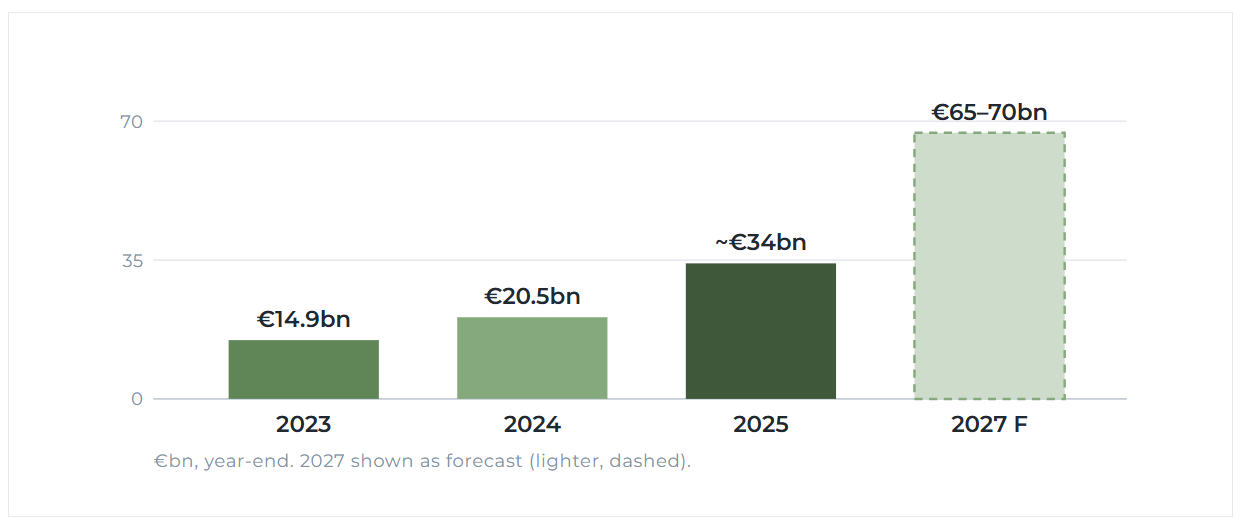
Source: Resonanz Capital. Data: Scope Fund Analysis ELTIF studies — end-2023 €14.9bn, end-2024 €20.5bn; end-2025 ~€34bn via EFAMA (efama.org); 2027 forecast €65–70bn via Investment Officer (investmentofficer.com). Year-end figures; total ELTIF AUM across all strategies.
None of this changed the underlying assets. A direct loan to a mid-market borrower has the same maturity and the same secondary-market depth inside an evergreen ELTIF as it has anywhere else. What changed is the schedule on which investors are told they can leave.
What the US just demonstrated
In the first quarter of 2026, a sequence of US non-traded vehicles moved to limit redemptions — Blue Owl, then Apollo, then Ares, among others — without any deterioration in the underlying loans. The trigger was not credit. It was the arithmetic of the wrapper: when redemption requests outrun the cash set aside to meet them, the manager reaches for the gate.
The mismatch can be stark. We traced the full anatomy of that dynamic in The Private Credit Liquidity Reckoning. The point worth repeating in a European context is narrower: the liquidity in one of these vehicles is not a property of what it owns. It is a property of its cash management and its inflows. Europe is now importing that property at scale.
The waterfall, and where the gate sits
A semi-liquid fund meets redemptions in layers. It draws first on a cash sleeve, then on an undrawn revolving facility, then — if those run short — on the sale of assets into the secondary market at a haircut. The gate binds only once the layers above it fail to clear the queue.
The redemption waterfall — order of defence under stress
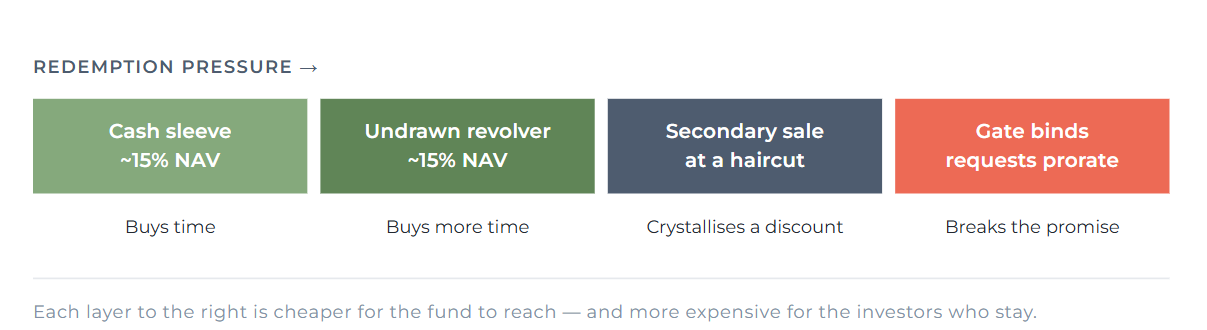
Source: Resonanz Capital. Illustrative waterfall; buffer figures based on industry-reported cash-management ranges and Aon's May 2026 private-credit report, as summarised by Odit Frontier Partners — oditfrontierpartners.net.
The order matters, because each layer has a cost to the investors who stay. Cash drawn down concentrates the portfolio in its least liquid holdings. A secondary sale crystallises a discount that depresses NAV for the remaining base. During the 2026 stress, one manager cleared roughly 30% of its fund through a single full-portfolio secondary trade; another faced requests far beyond its cap. The last investor in a gated vehicle holds the worst version of the portfolio.
Reading an ELTIF 2.0 evergreen: six terms before the yield
The headline spread is the easy number. The terms that decide whether that spread survives a stressed quarter are further down the document.
The evergreen term sheet — what to read, and why it bites
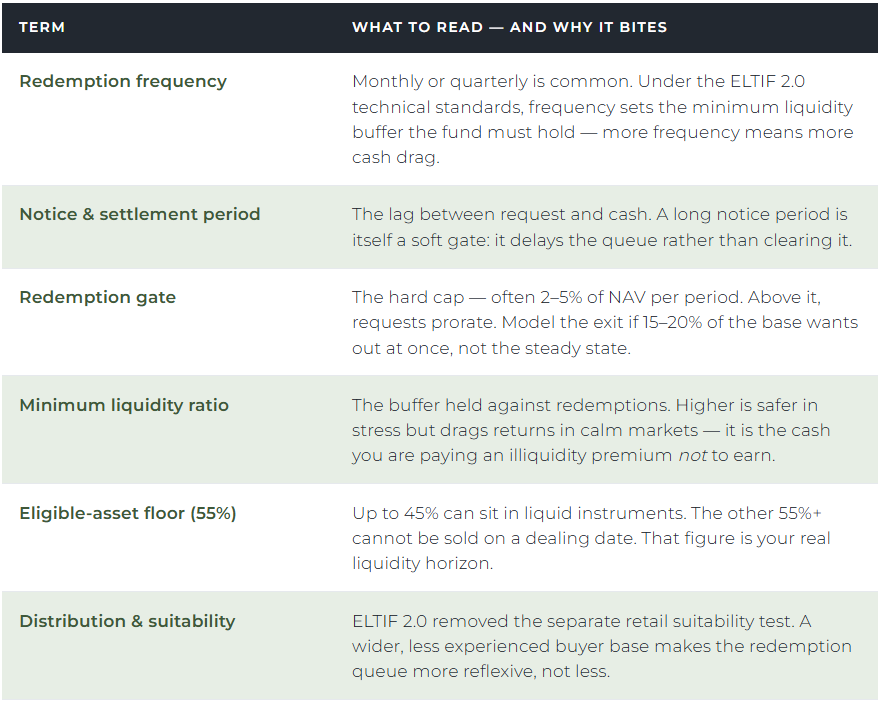
Source: Resonanz Capital. Framework based on ELTIF 2.0 and its regulatory technical standards, as summarized by PwC Switzerland
What Europe's design fixes — and what it can't
ELTIF 2.0 is not a straight copy of the US non-traded model. Its technical standards specify minimum liquidity ratios tied to redemption frequency and notice period — a uniform buffer requirement the US wealth-distribution market never had. That is a genuine mitigant, and it deserves credit.
Two things the rulebook cannot legislate away remain. The first is the asset: a 55% floor of long-dated private holdings is still 55% of the fund that cannot be sold on a dealing date. The liquidity sleeve is a cash-management feature, not an asset feature. The second is the buyer. Removing the suitability test widened the base to exactly the investors least equipped to model a redemption queue — and most likely to join one the moment a gate signals stress.
Conclusion
The lesson is not to avoid ELTIFs. Illiquidity premia are real, and a structured route into private lending has a place. The lesson is that liquidity has to be assessed at the asset level, not the vehicle level. A quarterly dealing date is a schedule, not a guarantee.
Where a portfolio genuinely needs daily or weekly liquidity, that liquidity has to come from assets that are themselves daily-liquid — not from a wrapper placed around assets that are not. Where the illiquidity premium is the objective, the honest move is to accept the lockup and size the position as illiquid from the start.
ELTIF 2.0 has made the middle ground easier to buy. It has not made it more solid.
Resonanz insights in your inbox...
Get the research behind strategies most professional allocators trust, but almost no-one explains.