
March 2026’s correlation shock hit dispersion trades hard. What broke, what changed, and how investors should rethink sizing, hedging and basket design
8 min read | Apr 21, 2026
March 2026 delivered one of the worst monthly returns for equity dispersion strategies in over a decade — with a JPMorgan index tracking the trade down 4.9%, driven by a geopolitical shock that pushed implied correlation sharply higher. For those with exposure to dispersion through QIS wrappers, volatility-focused hedge funds, or multi-strategy platforms, the month raised an urgent question: was this a one-off event, or does it reveal a structural vulnerability in one of the most crowded relative-value trades of the past three years?
What Happened in March
The trigger was the sharp escalation in Middle East tensions during the second week of March, centered on the Iran situation. Equity markets sold off broadly, but the defining feature of the move was not the magnitude of the decline — it was the speed at which single-stock correlations converged toward one.
Dispersion strategies profit from the gap between implied volatility on an index (such as the S&P 500) and implied volatility on the index's constituent stocks (for more details see our previous blog post on Dispersion trading). In normal markets, this gap is positive: index options carry a correlation risk premium because hedgers pay up for portfolio-level protection, while single-stock options reflect more idiosyncratic risk. Dispersion traders sell index volatility and buy single-stock volatility, capturing the spread.
When a macro shock hits, that gap compresses violently. Stocks stop trading on their own fundamentals and start moving together. Implied correlation surges, the index vol that dispersion traders are short spikes relative to the single-stock vol they are long, and the trade generates losses.
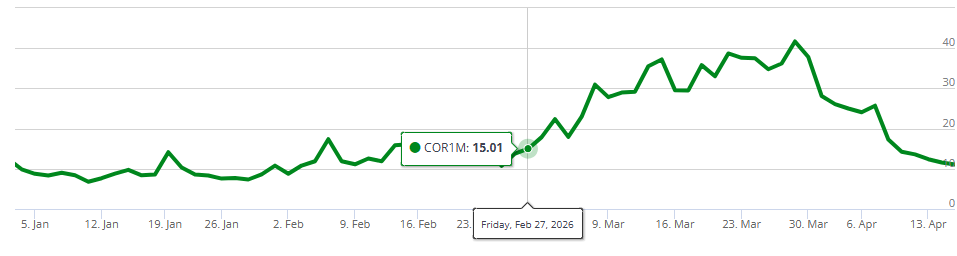
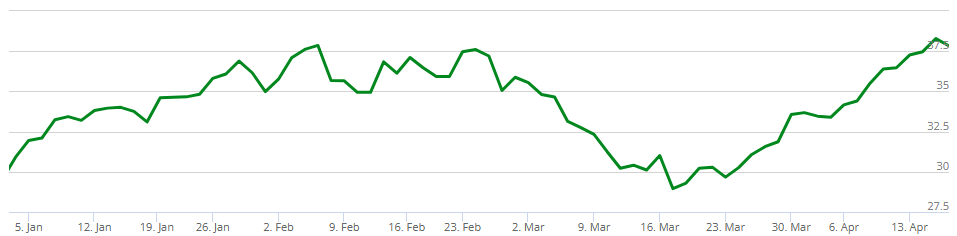
This is consistent with what the DSPX Index — a forward-looking measure of implied S&P 500 dispersion, rather than a benchmark return index for systematic dispersion strategies — showed in March. DSPX fell 6.1% on a month-end basis, while a JPMorgan index tracking the dispersion trade lost 4.9%, the worst month since 2011 in back-tested data. S&P 500 implied correlation, as measured by COR1M, rose from roughly 15 at the end of February to around 40 by late March, compressing the dispersion spread to levels that turned profitable positions into mark-to-market losses overnight.
The CBOE S&P 500 Implied Correlation Index surged in March 2026
Source: CBOE Global Markets
The DSPX declined 6.1% in March 2026
Source: CBOE Global Markets
The Mechanics of a Correlation Shock
Understanding why dispersion broke in March requires looking beyond the headline trigger to the structural dynamics at play.
When geopolitical risk escalates, institutional hedging demand surges at the index level. Asset managers, pension funds, and risk parity strategies buy S&P 500 puts or VIX calls to protect broad portfolio exposure. This flood of demand pushes index implied volatility sharply higher. Dealers who sell this protection — often the same banks that intermediate dispersion trades — hedge their exposure in ways that can push implied correlation higher still.
Meanwhile, single-stock implied volatility rises, but not proportionally. In a macro-driven sell-off, the idiosyncratic component of single-stock risk — the part that dispersion traders are long — becomes less relevant. Earnings surprises, sector rotation, and company-specific catalysts are swamped by the macro signal. The single-stock leg of the trade underperforms the index leg, and the spread compresses sharply.
This is not a failure of the strategy's logic. It is the strategy working as designed in a regime it is structurally short: high, rising correlation. The question is not whether dispersion can lose money in a correlation shock — that is well understood — but whether the frequency and severity of such shocks are adequately reflected in how the trade is sized and managed.
How Practitioners Are Adapting
The most significant response to March has been a shift in how dispersion portfolios are constructed. Before the shock, many systematic dispersion strategies ran broad baskets — selling S&P 500 index vol against a diversified set of 50–100 constituent single-stock options. This approach maximised the correlation risk premium but also maximised exposure to a broad correlation spike.
Post-March, some hedge funds and QIS desks are moving toward curated single-stock baskets. Rather than buying volatility on a broad cross-section of the index, they are selecting a smaller set of names with the highest idiosyncratic volatility — stocks where company-specific catalysts (earnings, FDA decisions, M&A activity) are more likely to dominate the correlation signal even during macro stress.
The logic is intuitive. A stock undergoing a hostile takeover bid or awaiting a binary regulatory decision will move on its own terms regardless of what the S&P 500 does. By concentrating the single-stock leg in high-idiosyncratic-vol names, the trade seeks to retain more of its dispersion premium during correlation spikes, because the long leg can hold up better when correlations surge.
This adaptation comes at a cost. Curated baskets are more concentrated, which introduces single-name event risk. They also require more active management — the selection of names must be refreshed regularly as catalysts expire and new ones emerge. But the trade-off may be worth it: curated-basket dispersion strategies would likely have lost less in March than broad-basket implementations, though the exact outcome depends on basket construction, rebalancing, and hedging assumptions.
Hedging Innovations
Beyond basket construction, March accelerated the adoption of partial hedging techniques designed to cap the downside of dispersion exposure without eliminating the premium.
VIX call overlays are the most straightforward approach. By purchasing out-of-the-money VIX calls, a dispersion portfolio gains convex protection against exactly the scenario that caused March's losses — a sharp, sudden spike in index implied volatility. The cost of this protection erodes some of the strategy's carry, but it truncates the left tail in a way that makes the remaining exposure more palatable for institutional portfolios with drawdown constraints.
VStoxx hedges can serve a similar function for European-focused dispersion books. For a portfolio that is primarily exposed to US equity dispersion but wants to hedge macro correlation risk, they may offer a complementary source of protection depending on the nature of the shock and the portfolio's geographic exposures.
Intraday correlation hedges represent a more sophisticated approach, used primarily by quantitative hedge funds. These strategies monitor real-time correlation among basket constituents and dynamically adjust the index short when correlation exceeds a threshold — effectively scaling down the trade's exposure before a full correlation shock materialises. The March event tested these systems, and practitioners argue that they can reduce drawdowns relative to static approaches.
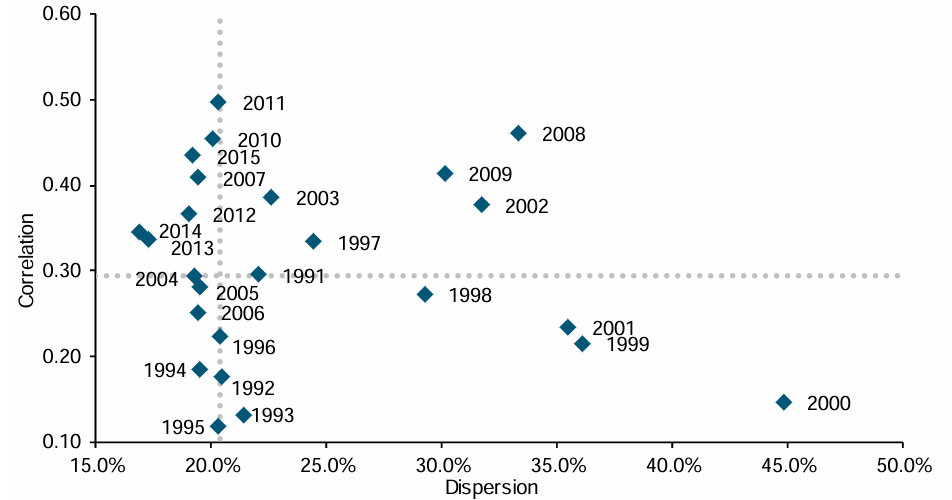
S&P 500 Dispersion–Correlation Map: March 2026 pushed markets deep into the high-correlation regime
Source: S&P Dow Jones Indices.
Portfolio Implications
For institutional investors who hold dispersion exposure — whether directly or embedded within a multi-strategy allocation — March should prompt three recalibrations.
First, understand the correlation regime you are implicitly betting on. Dispersion is a short-correlation strategy. Every dollar of exposure carries an implicit assumption that correlation will remain below a certain level. If your portfolio's risk framework does not explicitly model the correlation regime, you are running a position without understanding its primary risk factor.
Second, ask your managers how they have adapted. The distinction between broad-basket and curated-basket dispersion is not cosmetic — it represents a material difference in how the strategy behaves during stress. A manager still running a pre-March approach without hedging overlays is making a specific bet that March was an anomaly. That may prove correct, but it should be a conscious, disclosed choice rather than an unreflected default.
Third, size the allocation for the drawdown, not the carry. Dispersion has generated attractive risk-adjusted returns over the past three years, and the temptation is to size it based on its Sharpe ratio during a benign correlation environment. March demonstrated that the strategy's drawdown profile is meaningfully worse than its steady-state returns suggest. A position sized at 5% of a liquid alternatives portfolio produced a 25-basis-point drag in a single month — tolerable, perhaps, but worth comparing against the contribution the trade makes in a full-year context.
The Trade Is Not Broken — But It Has Changed
March 2026 did not invalidate dispersion as a strategy. It validated the risk that was always embedded in the trade and forced the market to adapt. The managers and investors who will benefit most from that adaptation are those who treat March as a data point rather than an aberration — updating their models, refining their baskets, and sizing their exposure for a world in which correlation shocks are a recurring feature of equity markets, not an exception to them.
Resonanz insights in your inbox...
Get the research behind strategies most professional allocators trust, but almost no-one explains.